
同辈人对安全选择的评价与青少年的物质纯真有关。
Valuation of peers' safe choices is associated with substance-naïveté in adolescents.
机构信息
Fralin Biomedical Research Institute at VTC, Virginia Tech, Roanoke, VA 24016.
Department of Biomedical Engineering, Ulsan National Institute of Science and Technology, Ulsan 44919, South Korea.
出版信息
Proc Natl Acad Sci U S A. 2020 Dec 15;117(50):31729-31737. doi: 10.1073/pnas.1919111117. Epub 2020 Nov 30.
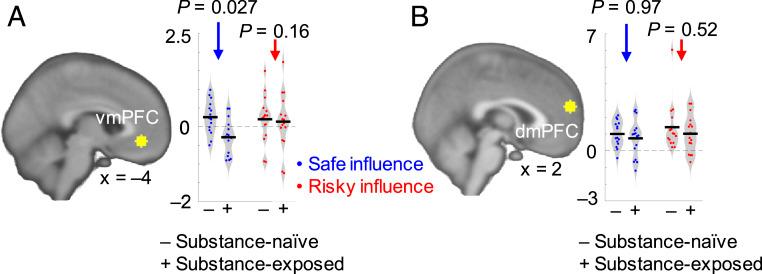
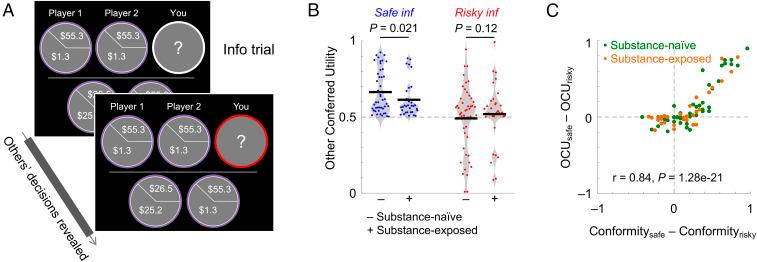
Social influences on decision-making are particularly pronounced during adolescence and have both protective and detrimental effects. To evaluate how responsiveness to social signals may be linked to substance use in adolescents, we used functional neuroimaging and a gambling task in which adolescents who have and have not used substances (substance-exposed and substance-naïve, respectively) made choices alone and after observing peers' decisions. Using quantitative model-based analyses, we identify behavioral and neural evidence that observing others' safe choices increases the subjective value and selection of safe options for substance-naïve relative to substance-exposed adolescents. Moreover, the effects of observing others' risky choices do not vary by substance exposure. These results provide neurobehavioral evidence for a role of positive peers (here, those who make safer choices) in guiding adolescent real-world risky decision-making.
社会影响对决策的影响在青少年时期尤为明显,既有保护作用,也有不利影响。为了评估对社会信号的反应能力如何与青少年的物质使用相关,我们使用功能神经影像学和赌博任务,让使用过和未使用过物质的青少年(分别为物质暴露和物质未暴露)在独自做出选择和观察同伴做出决定后做出选择。使用定量基于模型的分析,我们确定了行为和神经证据,表明观察到他人的安全选择会增加物质未暴露青少年对安全选择的主观价值和选择,而与物质暴露无关。此外,观察他人冒险选择的影响不因物质暴露而变化。这些结果为积极的同伴(在这里是指做出更安全选择的同伴)在指导青少年现实世界的冒险决策方面的作用提供了神经行为证据。
 Zotero 插件