
新冠疫情封锁措施对中国南京环境空气中挥发性有机物(VOCs)水平和来源的影响。
Impact of COVID-19 lockdown on ambient levels and sources of volatile organic compounds (VOCs) in Nanjing, China.
机构信息
Collaborative Innovation Center of Atmospheric Environment and Equipment Technology, Jiangsu Key Laboratory of Atmospheric Environment Monitoring and Pollution Control, School of Environmental Science and Engineering, Nanjing University of Information Science & Technology, Nanjing 210044, China.
College of Environmental Sciences and Engineering, Peking University, Beijing 100871, China.
出版信息
Sci Total Environ. 2021 Feb 25;757:143823. doi: 10.1016/j.scitotenv.2020.143823. Epub 2020 Nov 20.
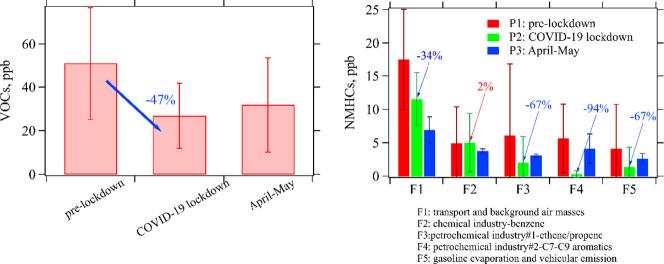
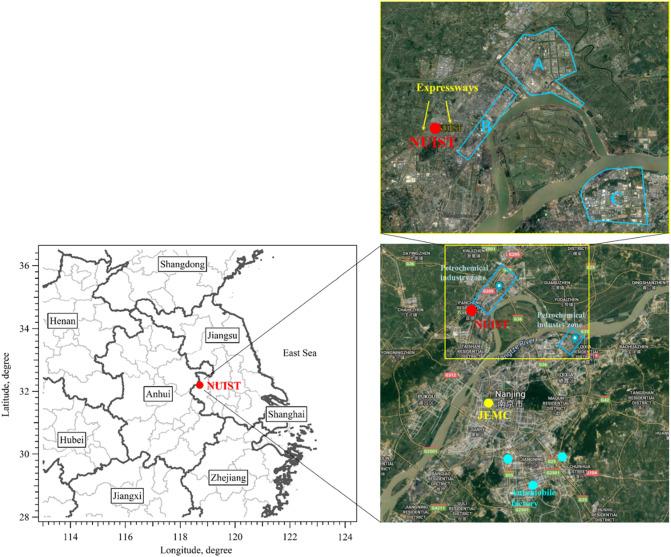
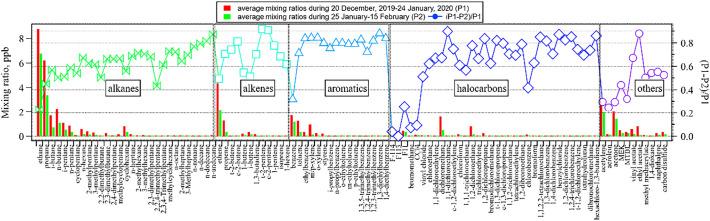
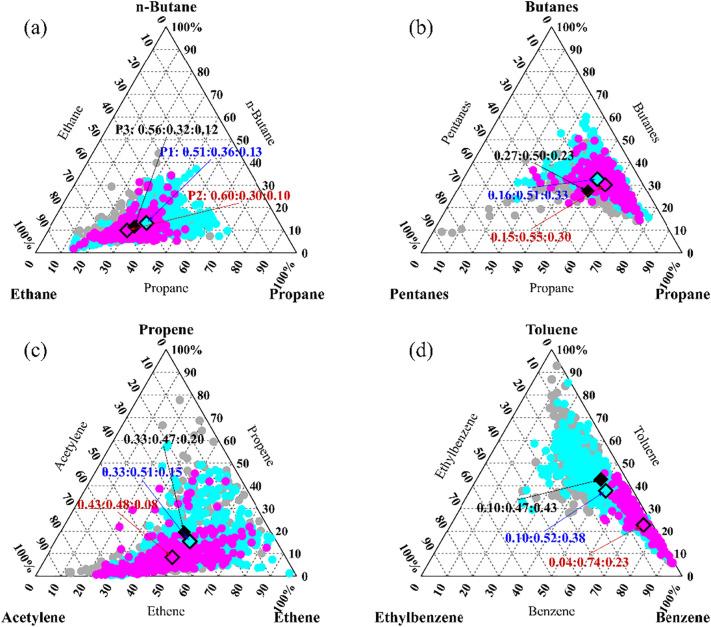
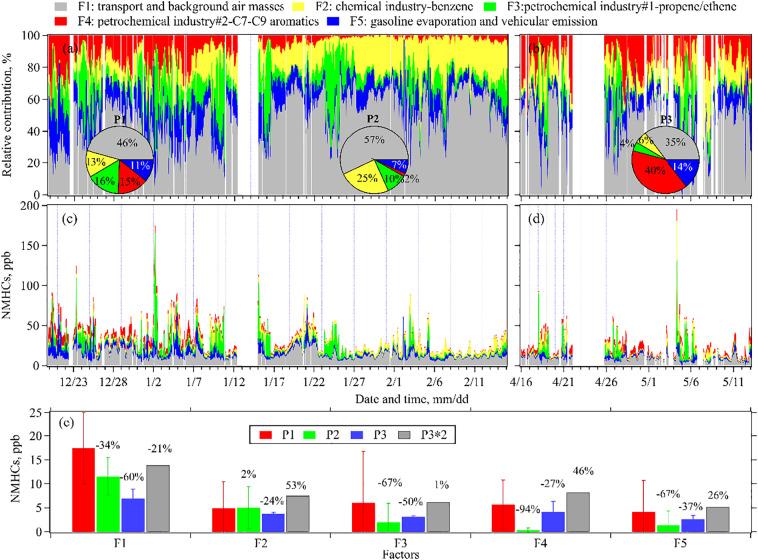
A lot of restrictive measures were implemented in China during January-February 2020 to control rapid spread of COVID-19. Many studies reported impact of COVID-19 lockdown on air quality, but little research focused on ambient volatile organic compounds (VOCs) till now, which play important roles in production of ozone and secondary organic aerosol. In this study, impact of COVID-19 lockdown on VOCs mixing ratios and sources were assessed based on online measurements of VOCs in Nanjing during December 20, 2019-Feburary 15, 2020 (P1-P2) and April 15-May 13, 2020 (P3). Average VOCs levels during COVID-19 lockdown period (P2) was 26.9 ppb, about half of value for pre-lockdown period (P1). Chemical composition of VOCs also showed significant changes. Aromatics contribution during decreased from 13% during P1 to 9% during P2, whereas alkanes contribution increased from 64% to 68%. Positive matrix factorization (PMF) was then applied for non-methane hydrocarbons (NMHCs) sources apportionment. Five sources were identified, including a source related to transport and background air masses, three sources related to petrochemical industry or chemical industry (petrochemical industry#1-propene/ethene, petrochemical industry#2-C7-C9 aromatics, and chemical industry-benzene), and a source attributed to gasoline evaporation and vehicular emission. During P2, NMHCs levels from petrochemical industry#2-C7-C9 aromatics showed the largest relative decline of 94%, followed by petrochemical industry#1-propene/ethene (67%), and gasoline evaporation and vehicular emission (67%). Furthermore, ratios of OH reactivity of NMHCs versus NO level (R/NO) and total oxidant production rate (P (O)) were calculated to assess potential influences of COVID-19 lockdown on O formation.
2020 年 1 月至 2 月期间,中国实施了多项限制措施以控制 COVID-19 的快速传播。许多研究报告了 COVID-19 封锁对空气质量的影响,但到目前为止,很少有研究关注环境挥发性有机化合物(VOCs),而 VOCs 在臭氧和二次有机气溶胶的形成中起着重要作用。在这项研究中,基于 2019 年 12 月 20 日至 2020 年 2 月 15 日(P1-P2)和 2020 年 4 月 15 日至 5 月 13 日(P3)期间在南京进行的 VOCs 在线测量,评估了 COVID-19 封锁对 VOCs 混合比和来源的影响。封锁期间(P2)的 VOCs 平均水平为 26.9 ppb,约为封锁前(P1)的一半。VOCs 的化学成分也发生了显著变化。芳香族化合物的贡献从 P1 的 13%下降到 P2 的 9%,而烷烃的贡献从 64%增加到 68%。然后应用正矩阵因子分解(PMF)对非甲烷烃(NMHCs)的来源进行分配。确定了五个来源,包括与交通和背景气团有关的来源,与石化或化工有关的三个来源(石化工业#1-丙烯/乙烯,石化工业#2-C7-C9 芳烃和化工-苯),以及归因于汽油蒸发和车辆排放的来源。在 P2 期间,石化工业#2-C7-C9 芳烃的 NMHCs 水平下降幅度最大,为 94%,其次是石化工业#1-丙烯/乙烯(67%)和汽油蒸发和车辆排放(67%)。此外,还计算了 NMHCs 与 NO 水平(R/NO)的 OH 反应性比和总氧化剂生成速率(P(O)),以评估 COVID-19 封锁对 O 形成的潜在影响。



 Zotero 插件