
体重指数、中心性肥胖和身体活动对肺功能的影响:EpiHealth研究结果
The impact of body mass index, central obesity and physical activity on lung function: results of the EpiHealth study.
作者信息
Svartengren Magnus, Cai Gui-Hong, Malinovschi Andrei, Theorell-Haglöw Jenny, Janson Christer, Elmståhl Sölve, Lind Lars, Lampa Erik, Lindberg Eva
机构信息
Dept of Medical Sciences, Occupational and Environmental Medicine, Uppsala University, Uppsala, Sweden.
Dept of Medical Sciences, Respiratory, Allergy and Sleep Research, Uppsala University, Uppsala, Sweden.
出版信息
ERJ Open Res. 2020 Nov 2;6(4). doi: 10.1183/23120541.00214-2020. eCollection 2020 Oct.
STUDY OBJECTIVES
Obesity is often associated with lower lung function; however, the interaction of lung function with central obesity and physical inactivity is less clear. As such, we investigated the effect on lung function of body size (body mass index (BMI)), central obesity (waist circumference (WC)) and self-reported physical activity.
METHODS
Lung function, height, weight and WC were measured in 22 743 participants (12 791 women), aged 45-75 years, from the EpiHealth cohort study. Physical activity, gender and educational level were assessed using a questionnaire.
RESULTS
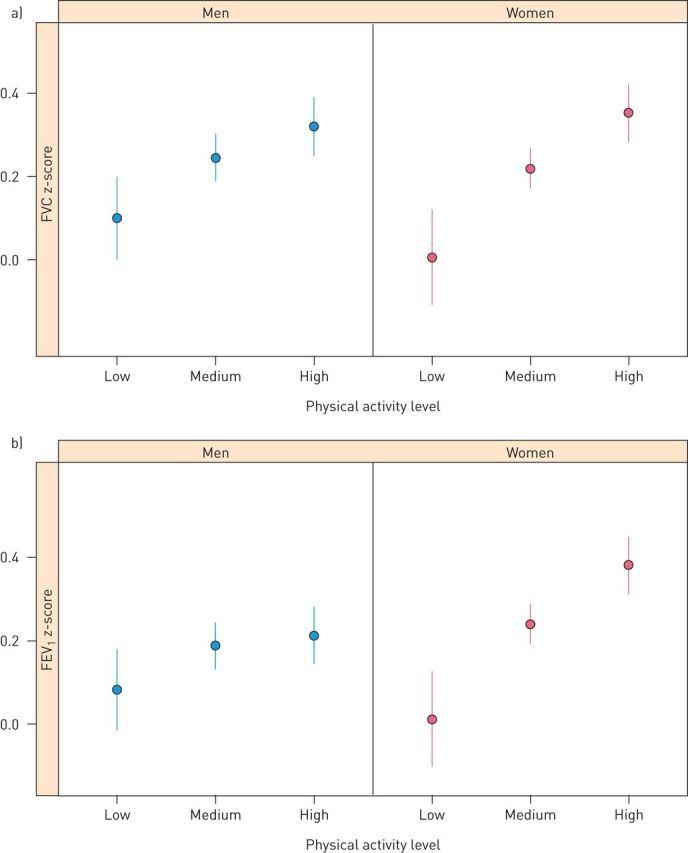
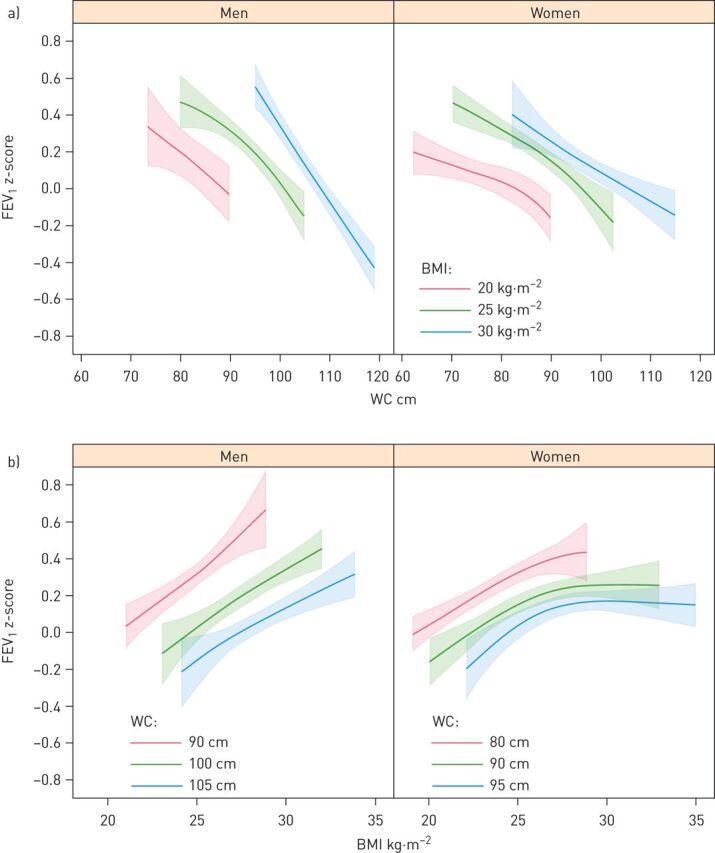
Obesity, central obesity and physical inactivity were all associated with lower forced expiratory volume in 1 s (FEV) and forced vital capacity (FVC). However, in participants without central obesity there was an increase in both FEV and FVC by BMI (% predicted FVC increasing from median 98%, interquartile range (IQR) 89-110% in underweight participants (BMI <20) to 103%, IQR 94-113% in obese participants (BMI ≥30)). In contrast, there was a decrease in % predicted FVC in participants with central obesity (from 98%, IQR 89-109% in the normal weight group to 95%, IQR 85-105% in the obese weight group). We further found a negative association between physical activity and lung function among those with low and high levels of physical activity (% predicted FEV 97%, IQR 86-107% 103%, IQR 94-113%, respectively and % predicted FVC 96%, IQR 85-106% 103%, IQR 94-113%, respectively). All results remained when calculated by z-scores.
CONCLUSIONS
The association between BMI and lung function is dependent on the presence of central obesity. Independent of obesity, there is an association between physical activity and lung function.
研究目的
肥胖常与肺功能降低相关;然而,肺功能与中心性肥胖及身体活动不足之间的相互作用尚不清楚。因此,我们研究了身体大小(体重指数(BMI))、中心性肥胖(腰围(WC))和自我报告的身体活动对肺功能的影响。
方法
在EpiHealth队列研究中,对22743名年龄在45 - 75岁的参与者(12791名女性)测量了肺功能、身高、体重和腰围。使用问卷评估身体活动、性别和教育水平。
结果
肥胖、中心性肥胖和身体活动不足均与1秒用力呼气量(FEV)和用力肺活量(FVC)降低相关。然而,在没有中心性肥胖的参与者中,FEV和FVC均随BMI增加(预测FVC百分比从体重过轻参与者(BMI <20)的中位数98%,四分位间距(IQR)89 - 110%增加到肥胖参与者(BMI≥30)的103%,IQR 94 - 113%)。相比之下,有中心性肥胖的参与者预测FVC百分比降低(从正常体重组的98%,IQR 89 - 109%降至肥胖体重组的95%,IQR 85 - 105%)。我们进一步发现,身体活动水平低和高的人群中,身体活动与肺功能呈负相关(预测FEV百分比分别为97%,IQR 86 - 107% 103%,IQR 94 - 113%;预测FVC百分比分别为96%,IQR
研究目的
肥胖常与肺功能降低相关;然而,肺功能与中心性肥胖及身体活动不足之间的相互作用尚不清楚。因此,我们研究了身体大小(体重指数(BMI))、中心性肥胖(腰围(WC))和自我报告的身体活动对肺功能的影响。
方法
在EpiHealth队列研究中,对22743名年龄在45 - 75岁的参与者(12791名女性)测量了肺功能、身高、体重和腰围。使用问卷评估身体活动、性别和教育水平。
结果
肥胖、中心性肥胖和身体活动不足均与1秒用力呼气量(FEV)和用力肺活量(FVC)降低相关。然而,在没有中心性肥胖的参与者中,FEV和FVC均随BMI增加(预测FVC百分比从体重过轻参与者(BMI <20)的中位数98%,四分位间距(IQR)89 - 110%增加到肥胖参与者(BMI≥30)的103%,IQR 94 - 113%)。相比之下,有中心性肥胖的参与者预测FVC百分比降低(从正常体重组的98%,IQR 89 - 109%降至肥胖体重组的95%,IQR 85 - 105%)。我们进一步发现,身体活动水平低和高的人群中,身体活动与肺功能呈负相关(预测FEV百分比分别为97%,IQR 86 - 107% 103%,IQR 94 - 113%;预测FVC百分比分别为96%,IQR 85 - 106% 103%,IQR 94 - 113%)。所有结果以z分数计算时均保持不变。
结论
BMI与肺功能之间的关联取决于是否存在中心性肥胖。独立于肥胖因素,身体活动与肺功能之间存在关联。 85 - 106% 103%,IQR 94 - 113%)。所有结果以z分数计算时均保持不变。
结论
BMI与肺功能之间的关联取决于是否存在中心性肥胖。独立于肥胖因素,身体活动与肺功能之间存在关联。

 Zotero 插件