
丙泊酚诱导的高甘油三酯血症的发生率及相关危险因素的识别
The Incidence of Propofol-Induced Hypertriglyceridemia and Identification of Associated Risk Factors.
作者信息
Corrado Michael J, Kovacevic Mary P, Dube Kevin M, Lupi Kenneth E, Szumita Paul M, DeGrado Jeremy R
机构信息
All authors: Department of Pharmacy, Brigham and Women's Hospital, Boston, MA.
出版信息
Crit Care Explor. 2020 Nov 30;2(12):e0282. doi: 10.1097/CCE.0000000000000282. eCollection 2020 Dec.
OBJECTIVES
The objective of this study was to describe the incidence of propofol-induced hypertriglyceridemia and the risk factors associated with hypertriglyceridemia in mechanically ventilated ICU patients while receiving propofol.
DESIGN
This was a single-center case-control study.
SETTING
Brigham and Women's Hospital, a tertiary academic medical center in Boston, MA.
SUBJECTS
Adult ICU patients who received continuous infusion propofol for at least 24 hours from May 1, 2019, to December 31, 2019, were included. Patients were excluded if they were diagnosed with acute pancreatitis upon admission or did not have any serum triglyceride levels evaluated during propofol administration.
INTERVENTIONS
None.
MEASUREMENTS AND MAIN RESULTS
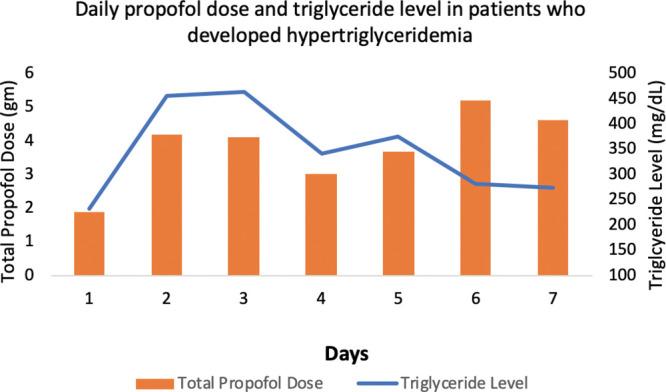
The major outcome was the incidence and risk factors associated with the development of propofol-induced hypertriglyceridemia, defined as triglyceride level greater than or equal to 400 mg/dL. Minor outcomes included the prevalence of acute pancreatitis. A hybrid multivariate logistic regression analysis was used to evaluate the relation between individual risk factors and the dependent variable of hypertriglyceridemia. During the study period, 552 patients were evaluated for inclusion, of which 136 were included in the final analysis. A total of 38 patients (27.9%) developed hypertriglyceridemia with a median time to hypertriglyceridemia of 47 hours. The only significant independent risk factor for development of hypertriglyceridemia identified was the cumulative propofol dose (odds ratio, 1.04; 95% CI, 1.01-1.08; = 0.016). Two of the 38 hypertriglyceridemia patients (5.3%) were diagnosed with acute pancreatitis.
CONCLUSIONS
In our analysis, approximately one third of patients developed hypertriglyceridemia with cumulative propofol dose identified as a significant predictor of the development of hypertriglyceridemia. Despite a high incidence of hypertriglyceridemia, a significant number of patients continued propofol therapy, and a relatively low prevalence of pancreatitis was observed. Future analyses are warranted to further investigate these results.
目的
本研究的目的是描述机械通气的重症监护病房(ICU)患者在接受丙泊酚治疗时丙泊酚诱导的高甘油三酯血症的发生率以及与高甘油三酯血症相关的危险因素。
设计
这是一项单中心病例对照研究。
地点
马萨诸塞州波士顿的三级学术医疗中心布莱根妇女医院。
研究对象
纳入2019年5月1日至2019年12月31日期间接受丙泊酚持续输注至少24小时的成年ICU患者。如果患者入院时被诊断为急性胰腺炎或在丙泊酚给药期间未评估任何血清甘油三酯水平,则将其排除。
干预措施
无。
测量指标及主要结果
主要结局是丙泊酚诱导的高甘油三酯血症(定义为甘油三酯水平大于或等于400mg/dL)的发生率及相关危险因素。次要结局包括急性胰腺炎的患病率。采用混合多变量逻辑回归分析评估个体危险因素与高甘油三酯血症因变量之间的关系。在研究期间,对552例患者进行了纳入评估,其中136例纳入最终分析。共有38例患者(27.9%)发生高甘油三酯血症,发生高甘油三酯血症的中位时间为47小时。确定的发生高甘油三酯血症的唯一显著独立危险因素是丙泊酚累积剂量(比值比,1.04;95%可信区间,1.01 - 1.08;P = 0.016)。38例高甘油三酯血症患者中有2例(5.3%)被诊断为急性胰腺炎。
结论
在我们的分析中,约三分之一的患者发生了高甘油三酯血症,丙泊酚累积剂量被确定为高甘油三酯血症发生的显著预测因素。尽管高甘油三酯血症发生率较高,但仍有相当数量的患者继续接受丙泊酚治疗,且观察到胰腺炎的患病率相对较低。有必要进行进一步分析以深入研究这些结果。
 Zotero 插件