
短端粒综合征的造血外表现。
Extrahematopoietic manifestations of the short telomere syndromes.
机构信息
Department of Oncology and Telomere Center at Johns Hopkins, Sidney Kimmel Comprehensive Cancer Center, Johns Hopkins University School of Medicine, Baltimore, MD.
出版信息
Hematology Am Soc Hematol Educ Program. 2020 Dec 4;2020(1):115-122. doi: 10.1182/hematology.2020000170.
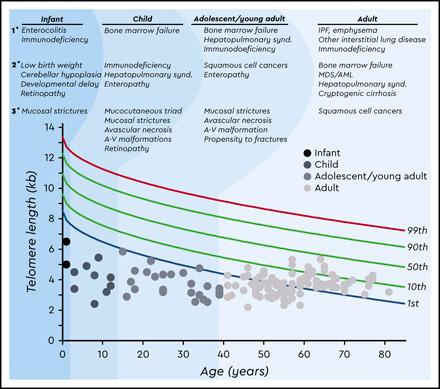
The short telomere syndromes encompass a spectrum of clinical manifestations that present from infancy to late adulthood. They are caused by mutations in telomerase and other telomere maintenance genes and have a predominantly degenerative phenotype characterized by organ failure across multiple systems. They are collectively one of the most common inherited bone marrow failure syndromes; however, their most prevalent presentations are extrahematopoietic. This review focuses on these common nonhematologic complications, including pulmonary fibrosis, liver pathology, and immunodeficiency. The short telomere syndrome diagnosis informs clinical care, especially in guiding diagnostic evaluations as well as in the solid organ transplant setting. Early recognition allows an individualized approach to screening and management. This review illustrates a myriad of extrahematopoietic presentations of short telomere syndromes and how they impact clinical decisions.
短端粒综合征涵盖了一系列临床表现,从婴儿期到成年后期都有出现。它们是由端粒酶和其他端粒维持基因的突变引起的,主要表现为多系统器官衰竭的退行性表型。它们是最常见的遗传性骨髓衰竭综合征之一;然而,它们最常见的表现是造血系统以外的表现。这篇综述重点介绍了这些常见的非血液学并发症,包括肺纤维化、肝脏病理学和免疫缺陷。短端粒综合征的诊断为临床护理提供了信息,特别是在指导诊断评估以及实体器官移植方面。早期识别可以采用个体化的筛查和管理方法。本综述说明了短端粒综合征的多种造血系统以外的表现及其对临床决策的影响。
 Zotero 插件