
痴呆症与 2019 年冠状病毒病(COVID-19)肺炎的结局:系统评价和荟萃分析。
Dementia and outcomes from coronavirus disease 2019 (COVID-19) pneumonia: A systematic review and meta-analysis.
机构信息
Faculty of Medicine, Pelita Harapan University, Boulevard Jendral Sudirman street, Karawaci, Tangerang, Indonesia 15811.
Memory clinic, Department of Neurology, Siloam Hospitals Lippo Village, Boulevard Jendral Sudirman street, Karawaci, Tangerang, Indonesia 15811.
出版信息
Arch Gerontol Geriatr. 2021 Mar-Apr;93:104299. doi: 10.1016/j.archger.2020.104299. Epub 2020 Nov 19.
BACKGROUND
The number of positive and death cases from coronavirus disease 2019 (COVID-19) is still increasing until now. One of the most prone individuals, even in normal situations is patients with dementia. Currently, no study provides clear evidence regarding the link between dementia and COVID-19. This study aims to analyze the relationship between dementia and poor outcomes of COVID-19 infection.
MATERIALS AND METHODS
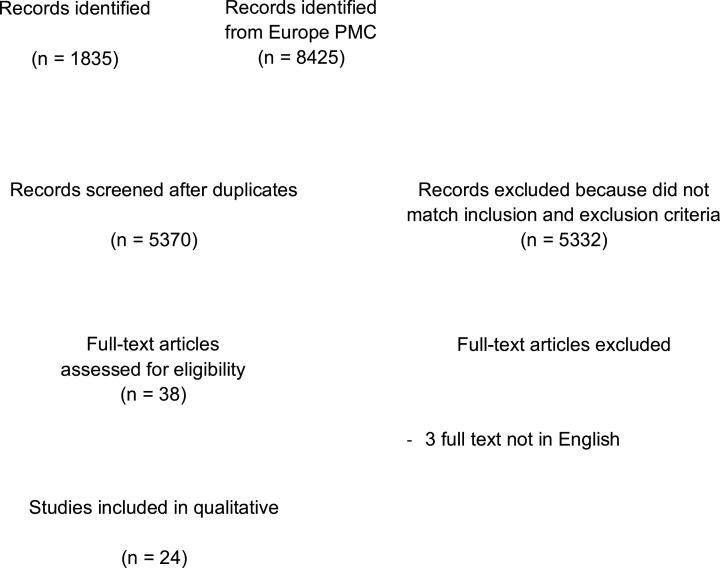
We systematically searched the PubMed and Europe PMC database using specific keywords related to our aims until October 25th, 2020. All articles published on COVID-19 and dementia were retrieved. The quality of the study was assessed using the Newcastle Ottawa Scale (NOS) tool for observational studies. Statistical analysis was done using Review Manager 5.4 software.
RESULTS
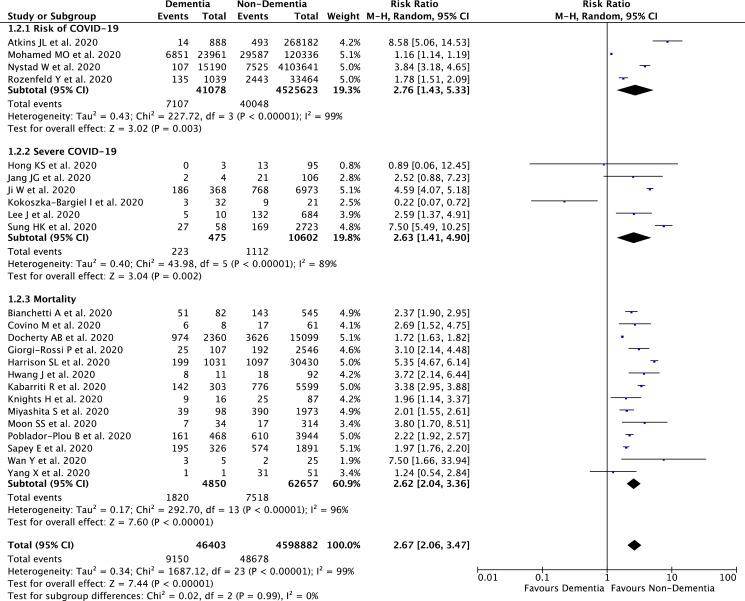
A total of 24 studies with 46,391 dementia patients were included in this meta-analysis. This meta-analysis showed that dementia was associated with composite poor outcome [RR 2.67 (95% CI 2.06 - 3.47), p < 0.00001, I = 99%, random-effect modeling] and its subgroup which comprised of risk of COVID-19 infection [RR 2.76 (95% CI 1.43 - 5.33), p = 0.003, I = 99%, random-effect modeling], severe COVID-19 [RR 2.63 (95% CI 1.41 - 4.90), p = 0.002, I = 89%, random-effect modeling], and mortality from COVID-19 infection [RR 2.62 (95% CI 2.04 - 3.36), p < 0.00001, I = 96%, random-effect modeling].
CONCLUSIONS
Extra care and close monitoring should then be provided to patients with dementia to minimize the risk of infections, preventing the development of severe and mortality outcomes.
背景
截至目前,2019 年冠状病毒病(COVID-19)的阳性和死亡病例数量仍在不断增加。即使在正常情况下,最容易感染的人群之一也是痴呆症患者。目前,尚无研究提供痴呆症与 COVID-19 之间关联的确凿证据。本研究旨在分析痴呆症与 COVID-19 感染不良结局之间的关系。
材料与方法
我们使用特定的关键词,在 PubMed 和 Europe PMC 数据库中进行系统检索,检索时间截至 2020 年 10 月 25 日。检索到所有关于 COVID-19 和痴呆症的文章。使用纽卡斯尔-渥太华量表(NOS)工具评估研究质量。使用 Review Manager 5.4 软件进行统计分析。
结果
共有 24 项研究,纳入 46391 例痴呆症患者纳入本荟萃分析。本荟萃分析表明,痴呆症与复合不良结局相关[RR 2.67(95%CI 2.06-3.47),p<0.00001,I=99%,随机效应模型]及其亚组包括 COVID-19 感染风险[RR 2.76(95%CI 1.43-5.33),p=0.003,I=99%,随机效应模型]、严重 COVID-19[RR 2.63(95%CI 1.41-4.90),p=0.002,I=89%,随机效应模型]和 COVID-19 感染死亡率[RR 2.62(95%CI 2.04-3.36),p<0.00001,I=96%,随机效应模型]。
结论
因此,应该为痴呆症患者提供额外的护理和密切监测,以最大程度地降低感染风险,防止出现严重和死亡结局。

 Zotero 插件