
结节性硬化症蛋白复合物的结构。
Architecture of the Tuberous Sclerosis Protein Complex.
机构信息
Section for Structural Biology, Department of Infectious Disease, Imperial College London, Exhibition Road, London SW7 2BB, United Kingdom.
State Key Laboratory of Microbial Metabolism, School of Life Sciences & Biotechnology, The Joint International Research Laboratory of Metabolic & Developmental Sciences MOE, Shanghai Jiao Tong University, Shanghai, China.
出版信息
J Mol Biol. 2021 Jan 22;433(2):166743. doi: 10.1016/j.jmb.2020.166743. Epub 2020 Dec 8.
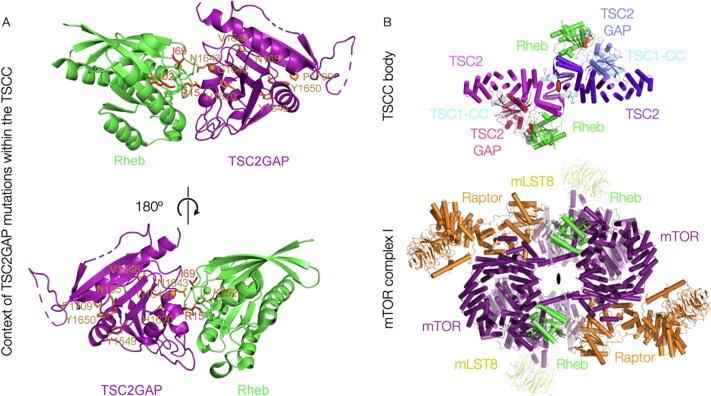
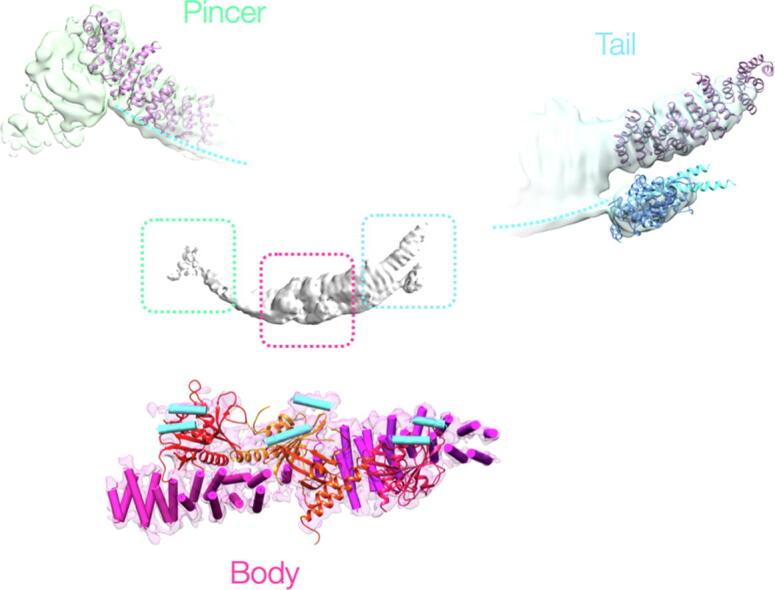
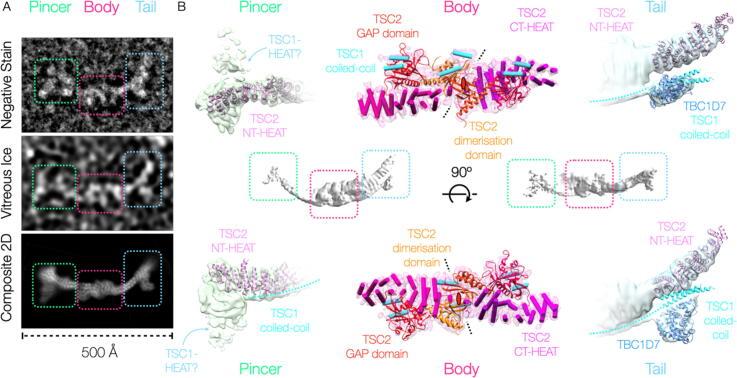
The Tuberous Sclerosis Complex (TSC) protein complex (TSCC), comprising TSC1, TSC2, and TBC1D7, is widely recognised as a key integration hub for cell growth and intracellular stress signals upstream of the mammalian target of rapamycin complex 1 (mTORC1). The TSCC negatively regulates mTORC1 by acting as a GTPase-activating protein (GAP) towards the small GTPase Rheb. Both human TSC1 and TSC2 are important tumour suppressors, and mutations in them underlie the disease tuberous sclerosis. We used single-particle cryo-EM to reveal the organisation and architecture of the complete human TSCC. We show that TSCC forms an elongated scorpion-like structure, consisting of a central "body", with a "pincer" and a "tail" at the respective ends. The "body" is composed of a flexible TSC2 HEAT repeat dimer, along the surface of which runs the TSC1 coiled-coil backbone, breaking the symmetry of the dimer. Each end of the body is structurally distinct, representing the N- and C-termini of TSC1; a "pincer" is formed by the highly flexible N-terminal TSC1 core domains and a barbed "tail" makes up the TSC1 coiled-coil-TBC1D7 junction. The TSC2 GAP domain is found abutting the centre of the body on each side of the dimerisation interface, poised to bind a pair of Rheb molecules at a similar separation to the pair in activated mTORC1. Our architectural dissection reveals the mode of association and topology of the complex, casts light on the recruitment of Rheb to the TSCC, and also hints at functional higher order oligomerisation, which has previously been predicted to be important for Rheb-signalling suppression.
结节性硬化症复合物(TSC)蛋白复合物(TSCC),由 TSC1、TSC2 和 TBC1D7 组成,被广泛认为是细胞生长和细胞内应激信号在上游哺乳动物雷帕霉素靶蛋白复合物 1(mTORC1)的关键整合枢纽。TSCC 通过作为小 GTPase Rheb 的 GTPase 激活蛋白(GAP)负调节 mTORC1。人 TSC1 和 TSC2 都是重要的肿瘤抑制因子,它们的突变是结节性硬化症的基础。我们使用单颗粒冷冻电镜揭示了完整的人 TSCC 的组织和结构。我们表明,TSCC 形成一个拉长的蝎子状结构,由中央“主体”组成,在相对的两端分别有一个“钳子”和一个“尾巴”。“主体”由一个灵活的 TSC2 HEAT 重复二聚体组成,沿着其表面运行 TSC1 卷曲螺旋骨干,打破二聚体的对称性。主体的每一端结构都不同,代表 TSC1 的 N-和 C-末端;“钳子”由高度灵活的 TSC1 核心结构域形成,带刺的“尾巴”由 TSC1 卷曲螺旋-TBC1D7 连接组成。TSC2 GAP 结构域位于二聚体界面中心两侧的主体上,准备在与激活的 mTORC1 中相似的分离处结合一对 Rheb 分子。我们的结构剖析揭示了复合物的结合方式和拓扑结构,阐明了 Rheb 招募到 TSCC 的方式,也暗示了功能更高阶的寡聚化,这以前被预测对 Rheb 信号抑制很重要。
 Zotero 插件