
乳腺癌中的激素受体丧失:分子机制、临床情况及治疗意义
Hormone Receptor Loss in Breast Cancer: Molecular Mechanisms, Clinical Settings, and Therapeutic Implications.
作者信息
Zattarin Emma, Leporati Rita, Ligorio Francesca, Lobefaro Riccardo, Vingiani Andrea, Pruneri Giancarlo, Vernieri Claudio
机构信息
Fondazione IRCCS Istituto Nazionale dei Tumori, Via G. Venezian 1, 20133 Milan, Italy.
Department of Oncology and Haematology, University of Milan, Via Festa del Perdono 7, 20122 Milan, Italy.
出版信息
Cells. 2020 Dec 9;9(12):2644. doi: 10.3390/cells9122644.
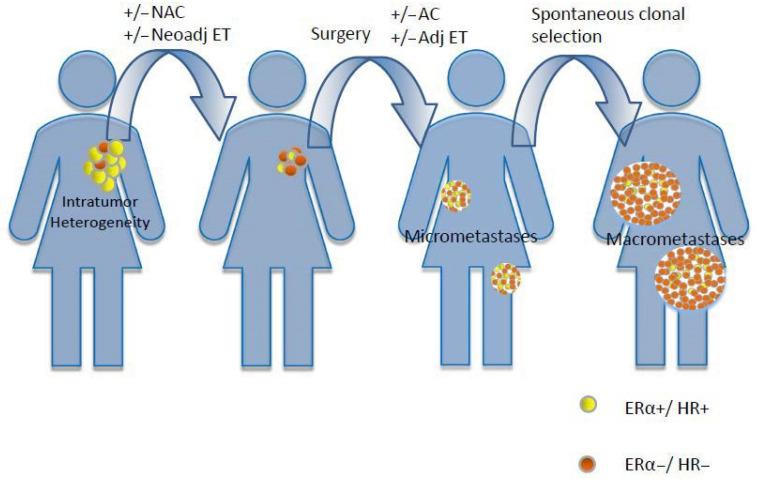
Hormone receptor-positive breast cancer (HR+ BC) accounts for approximately 75% of new BC diagnoses. Despite the undisputable progresses obtained in the treatment of HR+ BC in recent years, primary or acquired resistance to endocrine therapies still represents a clinically relevant issue, and is largely responsible for disease recurrence after curative surgery, as well as for disease progression in the metastatic setting. Among the mechanisms causing primary or acquired resistance to endocrine therapies is the loss of estrogen/progesterone receptor expression, which could make BC cells independent of estrogen stimulation and, consequently, resistant to estrogen deprivation or the pharmacological inhibition of estrogen receptors. This review aims at discussing the molecular mechanisms and the clinical implications of HR loss as a result of the therapies used in the neoadjuvant setting or for the treatment of advanced disease in HR+ BC patients.
激素受体阳性乳腺癌(HR+ BC)约占新发乳腺癌诊断病例的75%。尽管近年来HR+ BC治疗取得了无可争议的进展,但对内分泌治疗的原发性或获得性耐药仍然是一个临床相关问题,并且在很大程度上导致了根治性手术后疾病复发以及转移性疾病进展。导致对内分泌治疗原发性或获得性耐药的机制之一是雌激素/孕激素受体表达缺失,这可能使乳腺癌细胞不依赖雌激素刺激,从而对雌激素剥夺或雌激素受体的药理抑制产生耐药。本综述旨在讨论新辅助治疗或HR+ BC患者晚期疾病治疗中所使用疗法导致HR缺失的分子机制及临床意义。


 Zotero 插件