
年龄分层参考区间释放了循环游离 DNA 作为健康个体和结直肠癌患者不良预后生物标志物的临床潜力。
Age-stratified reference intervals unlock the clinical potential of circulating cell-free DNA as a biomarker of poor outcome for healthy individuals and patients with colorectal cancer.
机构信息
Department of Surgery, Herning Regional Hospital, Herning, Denmark.
Department of Molecular Medicine, Aarhus University Hospital, Aarhus, Denmark.
出版信息
Int J Cancer. 2021 Apr 1;148(7):1665-1675. doi: 10.1002/ijc.33434. Epub 2020 Dec 21.
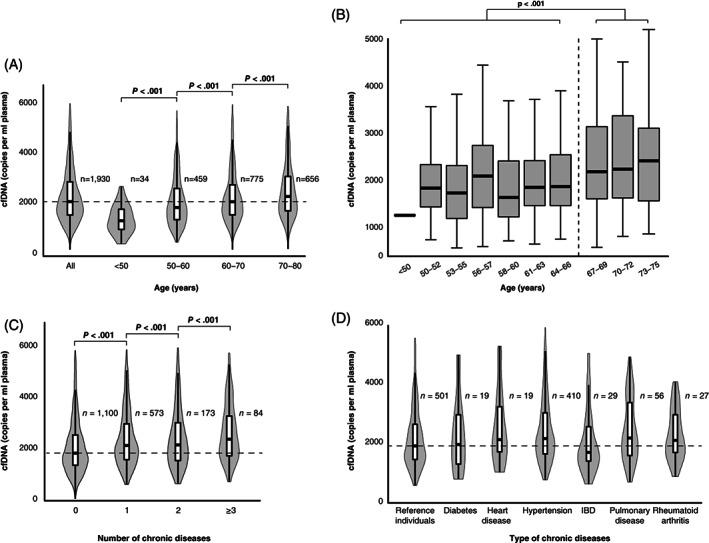
Circulating cell-free DNA (cfDNA) has spurred much interest as a biomarker in oncology. However, inter- and intra-individual cfDNA levels vary greatly. Consequently, in order to base clinical decisions on cfDNA measurements, normal reference intervals are essential to avoid that ordinary variation is confused with clinically relevant change. The lack of reference intervals may potentially explain the ambiguous results reported in the field. Our study aimed to establish reference intervals and to evaluate the association between cfDNA and demographic and clinical variables, including colorectal cancer (CRC). Plasma samples and clinical data from 2817 subjects were collected including 1930 noncancer individuals and 887 CRC patients. cfDNA was measured using droplet digital polymerase chain reaction (PCR). The large cohort combined with robust cfDNA quantification enabled establishment of reference intervals (<67 years: 775-4860 copies/mL; ≥67 years: 807-6561 copies/mL). A cfDNA level above the age-stratified 90% percentile was prognostic of reduced survival in both noncancer individuals and CRC patients, with HR values of 2.56 and 2.01, respectively. Moreover, cfDNA levels increased significantly with age, elevated BMI and chronic diseases. In CRC, the cfDNA level was increased for Stage IV, but not Stage I to Stage III cancer. In summary, the use of reference intervals revealed that high cfDNA levels were predictive of shorter survival in both noncancer individuals and CRC patients, and that CRC development did not affect the cfDNA level until metastatic dissemination. Furthermore, cfDNA levels were impacted by age and chronic diseases. Conclusively, our study presents reference intervals that will help pave the way for clinical utilization of cfDNA.
循环细胞游离 DNA(cfDNA)作为肿瘤学中的生物标志物引起了广泛关注。然而,个体间和个体内的 cfDNA 水平差异很大。因此,为了将临床决策建立在 cfDNA 测量的基础上,正常的参考区间对于避免将普通变化与临床相关变化混淆至关重要。缺乏参考区间可能是该领域报告的结果存在歧义的原因。我们的研究旨在建立参考区间,并评估 cfDNA 与人口统计学和临床变量之间的关系,包括结直肠癌(CRC)。我们收集了 2817 名受试者的血浆样本和临床数据,其中包括 1930 名非癌症个体和 887 名 CRC 患者。使用液滴数字聚合酶链反应(PCR)测量 cfDNA。由于有大量的队列和稳健的 cfDNA 定量方法,我们能够建立参考区间(<67 岁:775-4860 拷贝/mL;≥67 岁:807-6561 拷贝/mL)。在非癌症个体和 CRC 患者中,高于年龄分层 90%分位数的 cfDNA 水平预示着生存率降低,风险比(HR)值分别为 2.56 和 2.01。此外,cfDNA 水平随年龄、升高的 BMI 和慢性疾病而显著增加。在 CRC 中,cfDNA 水平在 IV 期增加,但在 I 期至 III 期癌症中不增加。总之,使用参考区间显示,高 cfDNA 水平在非癌症个体和 CRC 患者中均预示着生存率降低,并且直到转移扩散,CRC 的发展才会影响 cfDNA 水平。此外,cfDNA 水平受年龄和慢性疾病的影响。综上所述,我们的研究提供了参考区间,这将有助于为 cfDNA 的临床应用铺平道路。

 Zotero 插件