
自闭症谱系障碍与儿童言语失用症:基于结构磁共振成像研究的早期语言相关特征
Autism Spectrum Disorder and Childhood Apraxia of Speech: Early Language-Related Hallmarks across Structural MRI Study.
作者信息
Conti Eugenia, Retico Alessandra, Palumbo Letizia, Spera Giovanna, Bosco Paolo, Biagi Laura, Fiori Simona, Tosetti Michela, Cipriani Paola, Cioni Giovanni, Muratori Filippo, Chilosi Anna, Calderoni Sara
机构信息
IRCCS Fondazione Stella Maris, 56128 Pisa, Italy.
National Institute for Nuclear Physics (INFN), Pisa Division, 56127 Pisa, Italy.
出版信息
J Pers Med. 2020 Dec 12;10(4):275. doi: 10.3390/jpm10040275.
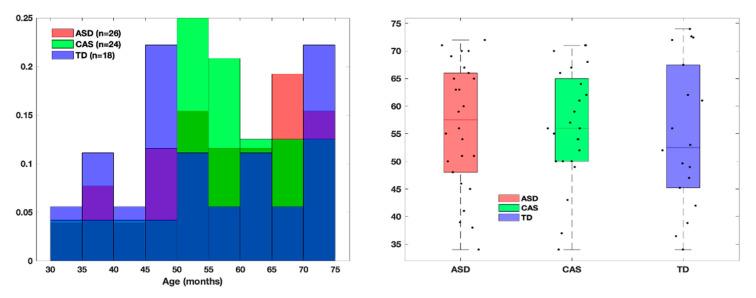
Autism Spectrum Disorder (ASD) and Childhood Apraxia of Speech (CAS) are developmental disorders with distinct diagnostic criteria and different epidemiology. However, a common genetic background as well as overlapping clinical features between ASD and CAS have been recently reported. To date, brain structural language-related abnormalities have been detected in both the conditions, but no study directly compared young children with ASD, CAS and typical development (TD). In the current work, we aim: (i) to test the hypothesis that ASD and CAS display neurostructural differences in comparison with TD through morphometric Magnetic Resonance Imaging (MRI)-based measures (ASD vs. TD and CAS vs. TD); (ii) to investigate early possible disease-specific brain structural patterns in the two clinical groups (ASD vs. CAS); (iii) to evaluate predictive power of machine-learning (ML) techniques in differentiating the three samples (ASD, CAS, TD). We retrospectively analyzed the T1-weighted brain MRI scans of 68 children (age range: 34-74 months) grouped into three cohorts: (1) 26 children with ASD (mean age ± standard deviation: 56 ± 11 months); (2) 24 children with CAS (57 ± 10 months); (3) 18 children with TD (55 ± 13 months). Furthermore, a ML analysis based on a linear-kernel Support Vector Machine (SVM) was performed. All but one brain structures displayed significant higher volumes in both ASD and CAS children than TD peers. Specifically, ASD alterations involved fronto-temporal regions together with basal ganglia and cerebellum, while CAS alterations are more focused and shifted to frontal regions, suggesting a possible speech-related anomalies distribution. Caudate, superior temporal and hippocampus volumes directly distinguished the two conditions in terms of greater values in ASD compared to CAS. The ML analysis identified significant differences in brain features between ASD and TD children, whereas only some trends in the ML classification capability were detected in CAS as compared to TD peers. Similarly, the MRI structural underpinnings of two clinical groups were not significantly different when evaluated with linear-kernel SVM. Our results may represent the first step towards understanding shared and specific neural substrate in ASD and CAS conditions, which subsequently may contribute to early differential diagnosis and tailoring specific early intervention.
自闭症谱系障碍(ASD)和儿童言语失用症(CAS)是具有不同诊断标准和不同流行病学特征的发育障碍。然而,最近有报道称ASD和CAS之间存在共同的遗传背景以及重叠的临床特征。迄今为止,在这两种情况下均已检测到与脑结构语言相关的异常,但尚无研究直接比较患有ASD、CAS和发育正常(TD)的幼儿。在当前的研究中,我们旨在:(i)通过基于形态测量磁共振成像(MRI)的测量方法(ASD与TD对比以及CAS与TD对比)来检验ASD和CAS与TD相比存在神经结构差异的假设;(ii)研究这两个临床组中早期可能存在的疾病特异性脑结构模式(ASD与CAS对比);(iii)评估机器学习(ML)技术在区分这三个样本(ASD、CAS、TD)方面的预测能力。我们回顾性分析了68名儿童(年龄范围:34 - 74个月)的T1加权脑MRI扫描图像,这些儿童被分为三个队列:(1)26名患有ASD的儿童(平均年龄±标准差:56±11个月);(2)24名患有CAS的儿童(57±10个月);(3)18名发育正常的儿童(55±13个月)。此外,还进行了基于线性核支持向量机(SVM)的ML分析。除一个脑结构外,ASD和CAS儿童的所有脑结构体积均显著高于发育正常的同龄人。具体而言,ASD的改变涉及额颞区域以及基底神经节和小脑,而CAS的改变更集中并转移至额叶区域,这表明可能存在与言语相关的异常分布。尾状核、颞上回和海马体的体积在ASD中比CAS具有更大的值,直接区分了这两种情况。ML分析确定了ASD和发育正常儿童在脑特征方面存在显著差异,而与发育正常的同龄人相比,在CAS中仅检测到一些ML分类能力的趋势。同样,当用线性核SVM评估时,两个临床组的MRI结构基础没有显著差异。我们的结果可能代表了朝着理解ASD和CAS情况下共享和特定神经基质迈出的第一步,这随后可能有助于早期鉴别诊断和制定特定的早期干预措施。

 Zotero 插件