
公园指数:一种实用的公园可达性和使用情况衡量方法的验证与应用
ParkIndex: Validation and application of a pragmatic measure of park access and use.
作者信息
Kaczynski Andrew T, Hughey S Morgan, Stowe Ellen W, Wende Marilyn E, Hipp J Aaron, Oliphant Elizabeth L, Schipperijn Jasper
机构信息
Department of Health Promotion, Education and Behavior, Arnold School of Public Health, University of South Carolina, United States.
Prevention Research Center, Arnold School of Public Health, University of South Carolina, United States.
出版信息
Prev Med Rep. 2020 Oct 3;20:101218. doi: 10.1016/j.pmedr.2020.101218. eCollection 2020 Dec.
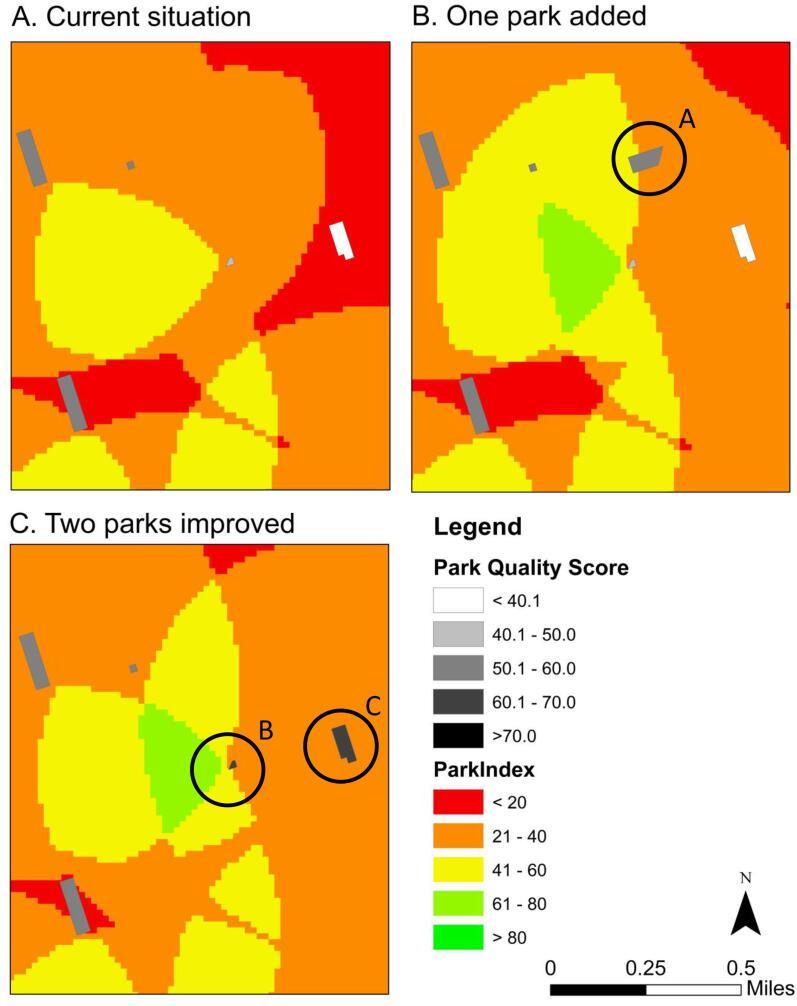
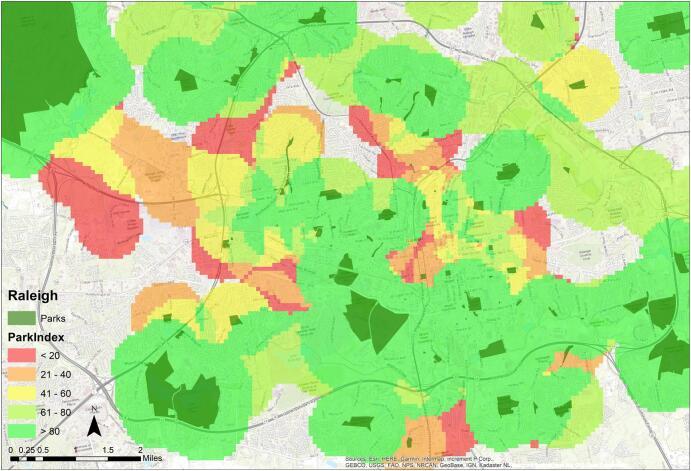
Composite metrics integrating park availability, features, and quality for a given address or neighborhood are lacking. The purposes of this study were to describe the validation, application, and demonstration of ParkIndex in four diverse communities. This study occurred in Fall 2018 in 128 census block groups within Seattle(WA), Brooklyn(NY), Raleigh(NC), and Greenville County(SC). All parks within a half-mile buffer were audited to calculate a composite park quality score, and select households provided data about use of proximal parks via an online, map-based survey. For each household, the number of parks, total park acreage, and average park quality score within one half-mile were calculated using GIS. Logistic regression was used to identify a parsimonious model predicting park use. ParkIndex values (representing the probability of park use) were mapped for all study areas and after scenarios involving the addition and renovation/improvement of parks. Out of 360 participants, 23.3% reported visiting a park within the past 30 days. The number of parks (OR = 1.36, 95% CI = 1.15-1.62), total park acreage (OR = 1.13, 95% CI = 1.07-1.19), and average park quality score (OR = 1.04, 95% CI = 1.01-1.06) within one half-mile were all associated with park use. Composite ParkIndex values across the study areas ranged from 0 to 100. Hypothetical additions of or renovations to study area parks resulted in ParkIndex increases of 22.7% and 19.2%, respectively. ParkIndex has substantial value for park and urban planners, citizens, and researchers as a common metric to facilitate awareness, decision-making, and intervention planning related to park access, environmental justice, and community health.
目前尚缺乏针对给定地址或社区,综合考量公园可达性、设施及质量的复合指标。本研究旨在描述公园指数(ParkIndex)在四个不同社区中的验证、应用及展示情况。该研究于2018年秋季在华盛顿州西雅图、纽约州布鲁克林、北卡罗来纳州罗利以及南卡罗来纳州格林维尔县的128个人口普查街区组开展。对半英里缓冲区内的所有公园进行评估,以计算公园综合质量得分,并通过基于地图的在线调查,让部分家庭提供其对附近公园使用情况的数据。利用地理信息系统(GIS)计算每个家庭半英里范围内的公园数量、公园总面积以及平均公园质量得分。采用逻辑回归分析确定一个预测公园使用情况的简约模型。针对所有研究区域以及公园增加和翻新/改善后的情景,绘制了公园指数(代表公园使用概率)值。在360名参与者中,23.3%报告在过去30天内去过公园。半英里范围内的公园数量(比值比[OR]=1.36,95%置信区间[CI]=1.15 - 1.62)、公园总面积(OR=1.13,95% CI=1.07 - 1.19)以及平均公园质量得分(OR=1.04,95% CI=1.01 - 1.06)均与公园使用情况相关。研究区域内的综合公园指数值范围为0至100。假设对研究区域内的公园进行新增或翻新,公园指数分别提高了22.7%和19.2%。公园指数对于公园和城市规划者、市民以及研究人员具有重要价值,可作为一个通用指标,促进与公园可达性、环境公平和社区健康相关的认知、决策及干预规划。
 Zotero 插件