
具有不对称分支模式的肺中气体成分传输与交换的建模。应用于一氧化氮。
Modeling of the Transport and Exchange of a Gas Species in Lungs With an Asymmetric Branching Pattern. Application to Nitric Oxide.
作者信息
Buess Alexandra, Van Muylem Alain, Nonclercq Antoine, Haut Benoit
机构信息
Transfers, Interfaces and Processes, Ecole Polytechnique de Bruxelles, Université Libre de Bruxelles, Brussels, Belgium.
Chest Department, Erasme University Hospital, Université Libre de Bruxelles, Brussels, Belgium.
出版信息
Front Physiol. 2020 Dec 10;11:570015. doi: 10.3389/fphys.2020.570015. eCollection 2020.
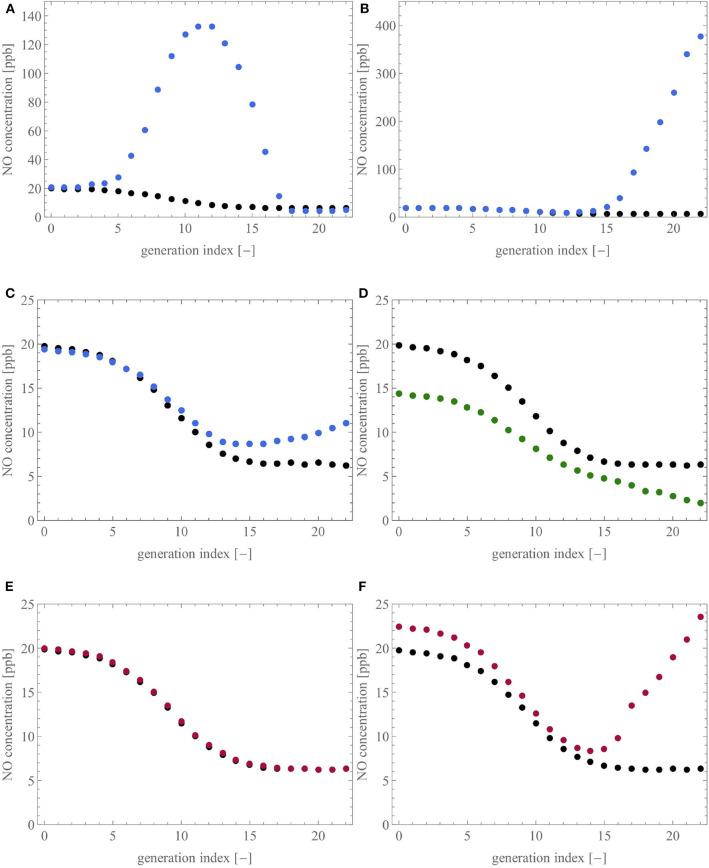
Over the years, various studies have been dedicated to the mathematical modeling of gas transport and exchange in the lungs. Indeed, the access to the distal region of the lungs with direct measurements is limited and, therefore, models are valuable tools to interpret clinical data and to give more insights into the phenomena taking place in the deepest part of the lungs. In this work, a new computational model of the transport and exchange of a gas species in the human lungs is proposed. It includes (i) a method to generate a lung geometry characterized by an asymmetric branching pattern, based on the values of several parameters that have to be given by the model user, and a method to possibly alter this geometry to mimic lung diseases, (ii) the calculation of the gas flow distribution in this geometry during inspiration or expiration (taking into account the increased resistance to the flow in airways where the flow is non-established), (iii) the evaluation of the exchange fluxes of the gaseous species of interest between the tissues composing the lungs and the lumen, and (iv) the computation of the concentration profile of the exchanged species in the lumen of the tracheobronchial tree. Even if the model is developed in a general framework, a particular attention is given to nitric oxide, as it is not only a gas species of clinical interest, but also a gas species that is both produced in the walls of the airways and consumed within the alveolar region of the lungs. First, the model is presented. Then, several features of the model, applied to lung geometry, gas flow and NO exchange and transport, are discussed, compared to existing works and notably used to give new insights into experimental data available in the literature, regarding diseases, such as asthma, cystic fibrosis, and chronic obstructive pulmonary disease.
多年来,各种研究致力于肺部气体传输和交换的数学建模。实际上,通过直接测量进入肺部远端区域的途径有限,因此,模型是解释临床数据以及更深入了解肺部最深处发生的现象的宝贵工具。在这项工作中,提出了一种新的人体肺部气体物种传输和交换的计算模型。它包括:(i)一种基于模型用户必须给出的几个参数值生成具有不对称分支模式特征的肺部几何形状的方法,以及一种可能改变这种几何形状以模拟肺部疾病的方法;(ii)在吸气或呼气过程中计算该几何形状中的气流分布(考虑到在气流未建立的气道中气流阻力增加);(iii)评估构成肺部的组织与管腔之间感兴趣的气态物种的交换通量;(iv)计算气管支气管树管腔内交换物种的浓度分布。即使该模型是在一个通用框架中开发的,但对一氧化氮给予了特别关注,因为它不仅是一种具有临床意义的气体物种,而且是一种在气道壁中产生并在肺部肺泡区域消耗的气体物种。首先,介绍该模型。然后,讨论该模型应用于肺部几何形状、气流以及一氧化氮交换和传输的几个特征,并与现有工作进行比较,特别是用于对文献中有关哮喘、囊性纤维化和慢性阻塞性肺疾病等疾病的实验数据给出新的见解。


 Zotero 插件