
CXCL12/CXCR4/CXCR7趋化因子轴在癌症中的作用
The Role of the CXCL12/CXCR4/CXCR7 Chemokine Axis in Cancer.
作者信息
Shi Yi, Riese David J, Shen Jianzhong
机构信息
Department of Drug Discovery and Development, Harrison School of Pharmacy, Auburn University, Auburn, AL, United States.
出版信息
Front Pharmacol. 2020 Dec 8;11:574667. doi: 10.3389/fphar.2020.574667. eCollection 2020.
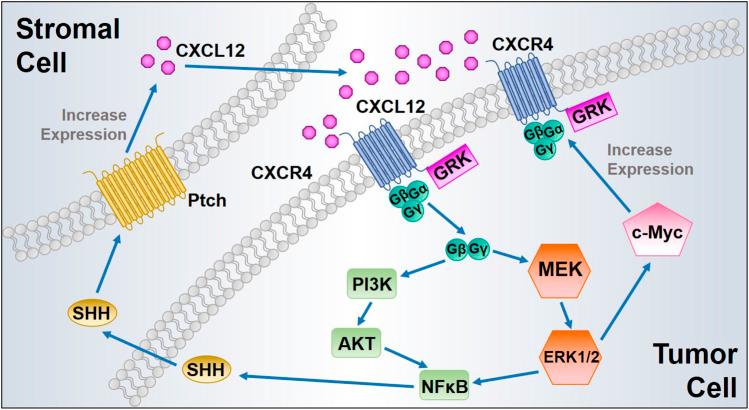
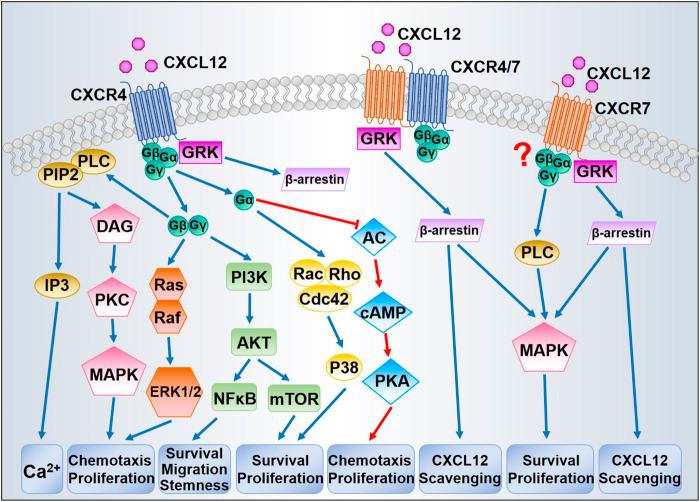
Chemokines are a family of small, secreted cytokines which regulate a variety of cell functions. The C-X-C motif chemokine ligand 12 (CXCL12) binds to C-X-C chemokine receptor type 4 (CXCR4) and C-X-C chemokine receptor type 7 (CXCR7). The interaction of CXCL12 and its receptors subsequently induces downstream signaling pathways with broad effects on chemotaxis, cell proliferation, migration, and gene expression. Accumulating evidence suggests that the CXCL12/CXCR4/CXCR7 axis plays a pivotal role in tumor development, survival, angiogenesis, metastasis, and tumor microenvironment. In addition, this chemokine axis promotes chemoresistance in cancer therapy via complex crosstalk with other pathways. Multiple small molecules targeting CXCR4/CXCR7 have been developed and used for preclinical and clinical cancer treatment. In this review, we describe the roles of the CXCL12/CXCR4/CXCR7 axis in cancer progression and summarize strategies to develop novel targeted cancer therapies.
趋化因子是一类小的分泌型细胞因子,可调节多种细胞功能。C-X-C基序趋化因子配体12(CXCL12)与C-X-C趋化因子受体4型(CXCR4)和C-X-C趋化因子受体7型(CXCR7)结合。CXCL12与其受体的相互作用随后诱导下游信号通路,对趋化性、细胞增殖、迁移和基因表达产生广泛影响。越来越多的证据表明,CXCL12/CXCR4/CXCR7轴在肿瘤发生、存活、血管生成、转移和肿瘤微环境中起关键作用。此外,该趋化因子轴通过与其他通路的复杂串扰促进癌症治疗中的化学抗性。已经开发了多种靶向CXCR4/CXCR7的小分子,并将其用于临床前和临床癌症治疗。在本综述中,我们描述了CXCL12/CXCR4/CXCR7轴在癌症进展中的作用,并总结了开发新型靶向癌症治疗方法的策略。
 Zotero 插件