
2017-2019 年乌干达不同传播强度地区疟疾调查中快速诊断检测的局限性:对 HRP2 RDT 选择和使用的影响。
Limitations of rapid diagnostic tests in malaria surveys in areas with varied transmission intensity in Uganda 2017-2019: Implications for selection and use of HRP2 RDTs.
机构信息
College of Health Sciences, Makerere University, Kampala, Uganda.
National Malaria Control Division, Kampala, Uganda.
出版信息
PLoS One. 2020 Dec 31;15(12):e0244457. doi: 10.1371/journal.pone.0244457. eCollection 2020.
BACKGROUND
Plasmodium falciparum histidine-rich protein 2 (HRP2)-based rapid diagnostic tests (RDTs) are exclusively recommended for malaria diagnosis in Uganda; however, their functionality can be affected by parasite-related factors that have not been investigated in field settings.
METHODS
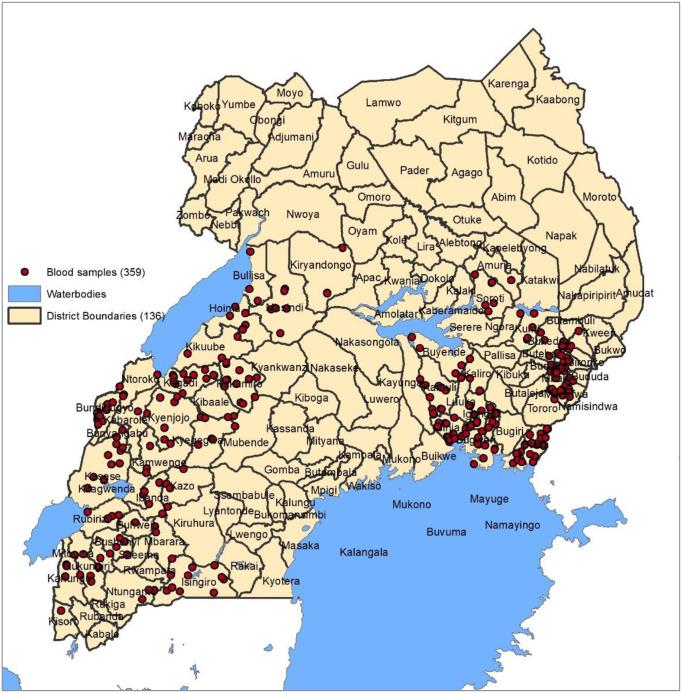
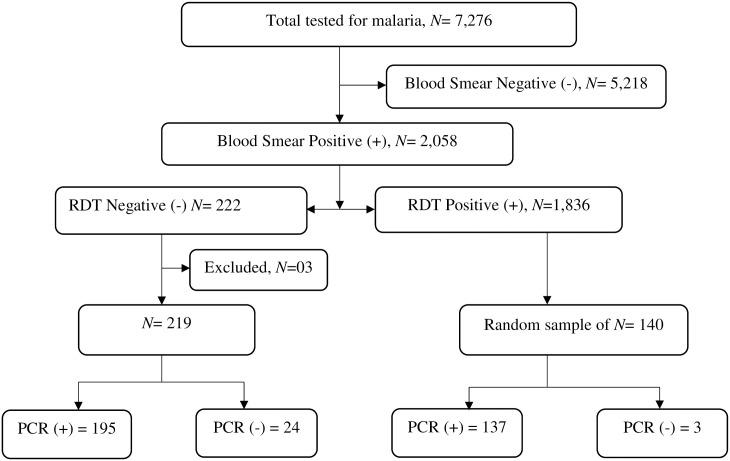
Using a cross-sectional design, we analysed 219 RDT-/microscopy+ and 140 RDT+/microscopy+ dried blood spots obtained from symptomatic children aged 2-10 years from 48 districts in Uganda between 2017 and 2019. We aimed to investigate parasite-related factors contributing to false RDT results by molecular characterization of parasite isolates. ArcGIS software was used to map the geographical distribution of parasites. Statistical analysis was performed using chi-square or Fisher's exact tests, with P ≤ 0.05 indicating significance. Odds ratios (ORs) were used to assess associations, while logistic regression was performed to explore possible factors associated with false RDT results.
RESULTS
The presence of parasite DNA was confirmed in 92.5% (332/359) of the blood samples. The levels of agreement between the HRP2 RDT and PCR assay results in the (RDT+/microscopy+) and (RDT-/microscopy+) sample subsets were 97.8% (137/140) and 10.9% (24/219), respectively. Factors associated with false-negative RDT results in the (RDT-/microscopy+) samples were parasite density (<1,000/μl), pfhrp2/3 gene deletion and non-P. falciparum species (aOR 2.65, 95% CI: 1.62-4.38, P = 0.001; aOR 4.4, 95% CI 1.72-13.66, P = 0.004; and aOR 18.65, 95% CI: 5.3-38.7, P = 0.001, respectively). Overall, gene deletion and non-P. falciparum species contributed to 12.3% (24/195) and 19.0% (37/195) of false-negative RDT results, respectively. Of the false-negative RDTs results, 80.0% (156/195) were from subjects with low-density infections (< 25 parasites per 200 WBCs or <1,000/μl).
CONCLUSION
This is the first evaluation and report of the contributions of pfhrp2/3 gene deletion, non-P. falciparum species, and low-density infections to false-negative RDT results under field conditions in Uganda. In view of these findings, the use of HRP2 RDTs should be reconsidered; possibly, switching to combination RDTs that target alternative antigens, particularly in affected areas, may be beneficial. Future evaluations should consider larger and more representative surveys covering other regions of Uganda.
背景
在乌干达,基于恶性疟原虫 HRP2 的快速诊断检测(RDT)专门用于疟疾诊断;然而,其功能可能会受到寄生虫相关因素的影响,而这些因素在现场环境中尚未得到调查。
方法
采用横断面设计,我们分析了 2017 年至 2019 年间乌干达 48 个区 2-10 岁有症状儿童的 219 份 RDT-/显微镜+和 140 份 RDT+/显微镜+干燥血斑。我们的目的是通过寄生虫分离物的分子特征来研究导致假 RDT 结果的寄生虫相关因素。ArcGIS 软件用于绘制寄生虫的地理分布。使用卡方或 Fisher 确切检验进行统计分析,P≤0.05 表示差异有统计学意义。使用比值比(OR)评估关联,同时进行逻辑回归以探索与假 RDT 结果相关的可能因素。
结果
92.5%(332/359)的血样中证实存在寄生虫 DNA。在(RDT+/显微镜+)和(RDT-/显微镜+)样本亚集中,HRP2 RDT 和 PCR 检测结果之间的一致性水平分别为 97.8%(137/140)和 10.9%(24/219)。在(RDT-/显微镜+)样本中与假阴性 RDT 结果相关的因素包括寄生虫密度(<1000/μl)、pfhrp2/3 基因缺失和非恶性疟原虫种(OR 2.65,95%CI:1.62-4.38,P=0.001;OR 4.4,95%CI 1.72-13.66,P=0.004;OR 18.65,95%CI:5.3-38.7,P=0.001)。总的来说,基因缺失和非恶性疟原虫种分别导致 12.3%(24/195)和 19.0%(37/195)的假阴性 RDT 结果。在假阴性 RDT 结果中,80.0%(156/195)来自低密度感染的患者(<25 个寄生虫/200 个白细胞或<1000/μl)。
结论
这是首次在乌干达现场条件下评估和报告 pfhrp2/3 基因缺失、非恶性疟原虫种和低密度感染对假阴性 RDT 结果的贡献。鉴于这些发现,应重新考虑使用 HRP2 RDT;可能,在受影响地区,切换到针对替代抗原的组合 RDT 可能会更有益。未来的评估应考虑更大和更具代表性的调查,涵盖乌干达的其他地区。

 Zotero 插件