
消毒剂成分对爱尔兰奶牛场与乳腺炎相关的乳头皮肤细菌的影响。
The effect of disinfectant ingredients on teat skin bacteria associated with mastitis in Irish dairy herds.
作者信息
Fitzpatrick Sarah Rose, Garvey Mary, Flynn Jim, O'Brien Bernadette, Gleeson David
机构信息
Teagasc, Animal & Grassland Research and Innovation Centre, Moorepark, Fermoy, County Cork, Ireland.
Department of Life Science, Institute of Technology Sligo, County Sligo, Ireland.
出版信息
Ir Vet J. 2021 Jan 2;74(1):1. doi: 10.1186/s13620-020-00179-7.
BACKGROUND
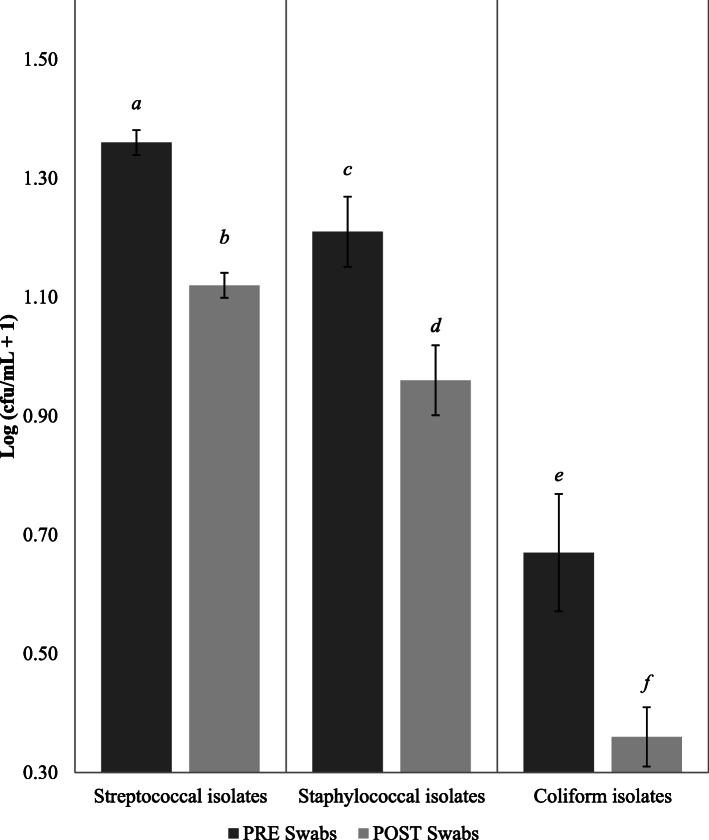
Teat disinfection is an important step in the control of mastitis within a dairy herd. The objective of this study was to evaluate the effectiveness of 96 commercially available teat disinfectant products in Ireland against bacterial isolates on teat skin. Teat disinfection products were applied to the teats of seventeen Holstein-Friesian cows. A split-udder model was used where one cow received two different teat disinfection products on each day. A composite swab sample was taken of the left teats and the right teats before and after teat disinfectant application. Swab samples were plated onto 3 different selective agars to enumerate bacterial counts of streptococcal, staphylococcal and coliform isolates.
RESULTS
Streptococcal isolates were the most prominent bacterial group recovered on teat swabs taken before the application of a teat disinfection product (55.0%), followed by staphylococcal isolates (41.3%) and coliform isolates (3.7%). Products were reclassified by active ingredients (n = 9) for analysis. These ingredient groups included; chlorhexidine, chlorine dioxide, diamine, iodine, iodine and lactic acid, lactic acid, lactic acid and chlorhexidine, lactic acid and hydrogen peroxide, and lactic acid and salicylic acid. The ingredient group, chlorine dioxide, resulted in comparable reductions to the iodine group for streptococcal isolates. The ingredient group, iodine combined with lactic acid, resulted in the greatest reduction of staphylococcal isolates. When observing products individually, a product containing 1.6% w/w lactic acid combined with hydrogen peroxide was the most effective at reducing streptococcal isolates on the teat skin, whereas a product containing lactic acid combined with 0.6% w/w chlorhexidine was the most effective against staphylococcal isolates. Minor differences were observed regarding the relationship between effectiveness and active ingredient concentration between products.
CONCLUSIONS
This study suggests that some teat disinfectant products achieve a higher reduction in bacterial levels against different specific bacterial groups on teat skin than other products. Therefore, when choosing a teat disinfectant product, the bacteria in the dairy herds' environment should be considered. Further studies are necessary to evaluate products efficacy against new IMIs and any possible effects on teat skin condition.
背景
乳头消毒是奶牛群乳腺炎防控的重要环节。本研究的目的是评估爱尔兰96种市售乳头消毒剂产品对乳头皮肤上细菌分离株的有效性。将乳头消毒剂产品应用于17头荷斯坦 - 弗里生奶牛的乳头。采用分侧乳房模型,即每天有一头奶牛的两侧乳房分别使用两种不同的乳头消毒剂产品。在使用乳头消毒剂前后,分别对左侧和右侧乳头采集复合拭子样本。将拭子样本接种到3种不同的选择性琼脂平板上,以计数链球菌、葡萄球菌和大肠菌群分离株的细菌数量。
结果
在使用乳头消毒剂产品前采集的乳头拭子中,分离出的最主要细菌群体是链球菌(55.0%),其次是葡萄球菌(41.3%)和大肠菌群(3.7%)。根据活性成分(n = 9)对产品进行重新分类以进行分析。这些成分组包括:洗必泰、二氧化氯、二胺、碘、碘和乳酸、乳酸、乳酸和洗必泰、乳酸和过氧化氢、以及乳酸和水杨酸。二氧化氯成分组对链球菌分离株的减少效果与碘成分组相当。碘与乳酸组合的成分组对葡萄球菌分离株的减少效果最为显著。单独观察产品时,一种含有1.6% w/w乳酸与过氧化氢组合的产品在减少乳头皮肤上的链球菌分离株方面最有效,而一种含有乳酸与0.6% w/w洗必泰组合的产品对葡萄球菌分离株最有效。在产品有效性与活性成分浓度之间的关系上观察到细微差异。
结论
本研究表明,一些乳头消毒剂产品在降低乳头皮肤上不同特定细菌群体的细菌水平方面比其他产品效果更好。因此,在选择乳头消毒剂产品时,应考虑奶牛群环境中的细菌情况。有必要进一步研究评估产品对新的隐性乳房炎感染的疗效以及对乳头皮肤状况的任何可能影响。

 Zotero 插件