
三磷酸腺苷合酶抑制诱导间充质干细胞依赖 AMPK 的糖酵解开关转换,增强其免疫治疗潜能。
The ATP synthase inhibition induces an AMPK-dependent glycolytic switch of mesenchymal stem cells that enhances their immunotherapeutic potential.
机构信息
Centro de Investigación e Innovación Biomédica, Facultad de Medicina, Universidad de los Andes, Santiago, Chile.
IRMB, Université de Montpellier, INSERM, Montpellier, France.
出版信息
Theranostics. 2021 Jan 1;11(1):445-460. doi: 10.7150/thno.51631. eCollection 2021.
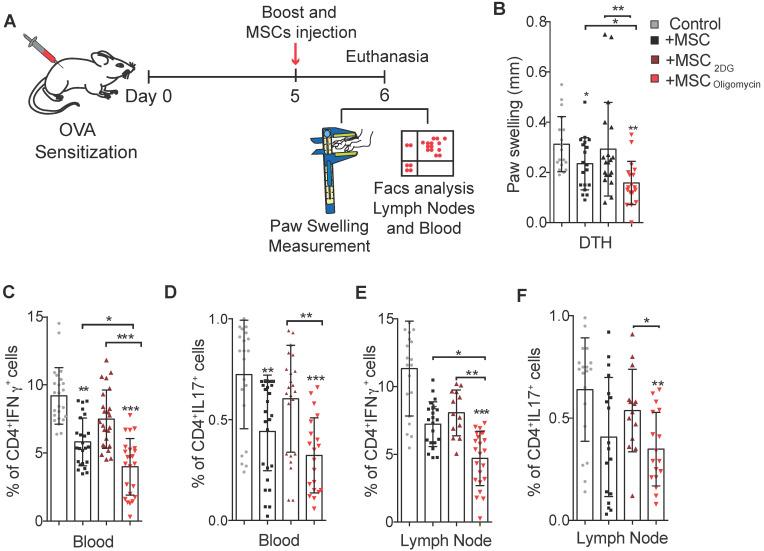
Mesenchymal Stem/Stromal Cells (MSC) are promising therapeutic tools for inflammatory diseases due to their potent immunoregulatory capacities. Their suppressive activity mainly depends on inflammatory cues that have been recently associated with changes in MSC bioenergetic status towards a glycolytic metabolism. However, the molecular mechanisms behind this metabolic reprogramming and its impact on MSC therapeutic properties have not been investigated. Human and murine-derived MSC were metabolically reprogramed using pro-inflammatory cytokines, an inhibitor of ATP synthase (oligomycin), or 2-deoxy-D-glucose (2DG). The immunosuppressive activity of these cells was tested using co-culture experiments with pro-inflammatory T cells and with the Delayed-Type Hypersensitivity (DTH) and the Graph versus Host Disease (GVHD) murine models. We found that the oligomycin-mediated pro-glycolytic switch of MSC significantly enhanced their immunosuppressive properties . Conversely, glycolysis inhibition using 2DG significantly reduced MSC immunoregulatory effects. Moreover, , MSC glycolytic reprogramming significantly increased their therapeutic benefit in the DTH and GVHD mouse models. Finally, we demonstrated that the MSC glycolytic switch effect partly depends on the activation of the AMPK signaling pathway. Altogether, our findings show that AMPK-dependent glycolytic reprogramming of MSC using an ATP synthase inhibitor contributes to their immunosuppressive and therapeutic functions, and suggest that pro-glycolytic drugs might be used to improve MSC-based therapy.
间充质干细胞(MSC)因其强大的免疫调节能力,有望成为治疗炎症性疾病的有效手段。它们的抑制活性主要取决于炎症信号,这些信号最近与 MSC 生物能状态向糖酵解代谢的变化有关。然而,这种代谢重编程的分子机制及其对 MSC 治疗特性的影响尚未得到研究。
使用促炎细胞因子、三磷酸腺苷合酶抑制剂(寡霉素)或 2-脱氧-D-葡萄糖(2DG)对人源和鼠源 MSC 进行代谢重编程。使用与促炎 T 细胞共培养实验以及迟发型超敏反应(DTH)和移植物抗宿主病(GVHD)小鼠模型来测试这些细胞的免疫抑制活性。
我们发现,MSC 中寡霉素介导的促糖酵解开关显著增强了其免疫抑制特性。相反,使用 2DG 抑制糖酵解会显著降低 MSC 的免疫调节作用。此外,MSC 糖酵解重编程显著增加了它们在 DTH 和 GVHD 小鼠模型中的治疗益处。最后,我们证明了 MSC 糖酵解开关效应部分取决于 AMPK 信号通路的激活。
总之,我们的研究结果表明,使用三磷酸腺苷合酶抑制剂的 AMPK 依赖性 MSC 糖酵解重编程有助于其免疫抑制和治疗功能,并表明促糖酵解药物可能用于改善基于 MSC 的治疗。



 Zotero 插件