
跨膜肽作为抑制神经氨酸酶-1激活的新策略
Transmembrane Peptides as a New Strategy to Inhibit Neuraminidase-1 Activation.
作者信息
Albrecht Camille, Kuznetsov Andrey S, Appert-Collin Aline, Dhaideh Zineb, Callewaert Maïté, Bershatsky Yaroslav V, Urban Anatoly S, Bocharov Eduard V, Bagnard Dominique, Baud Stéphanie, Blaise Sébastien, Romier-Crouzet Béatrice, Efremov Roman G, Dauchez Manuel, Duca Laurent, Gueroult Marc, Maurice Pascal, Bennasroune Amar
机构信息
Université de Reims Champagne-Ardenne, Reims, France.
CNRS UMR 7369, Matrice Extracellulaire et Dynamique Cellulaire (MEDyC), Reims, France.
出版信息
Front Cell Dev Biol. 2020 Dec 16;8:611121. doi: 10.3389/fcell.2020.611121. eCollection 2020.
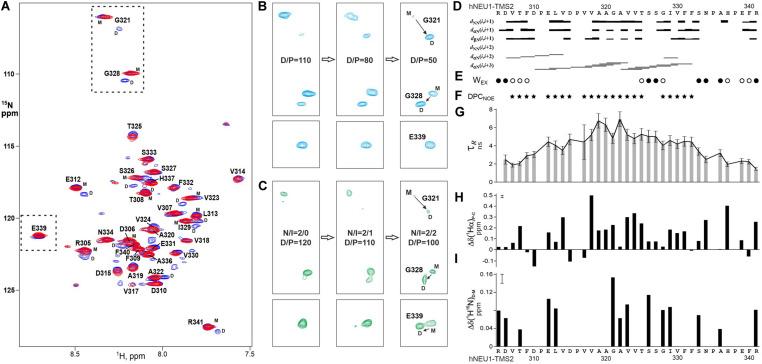
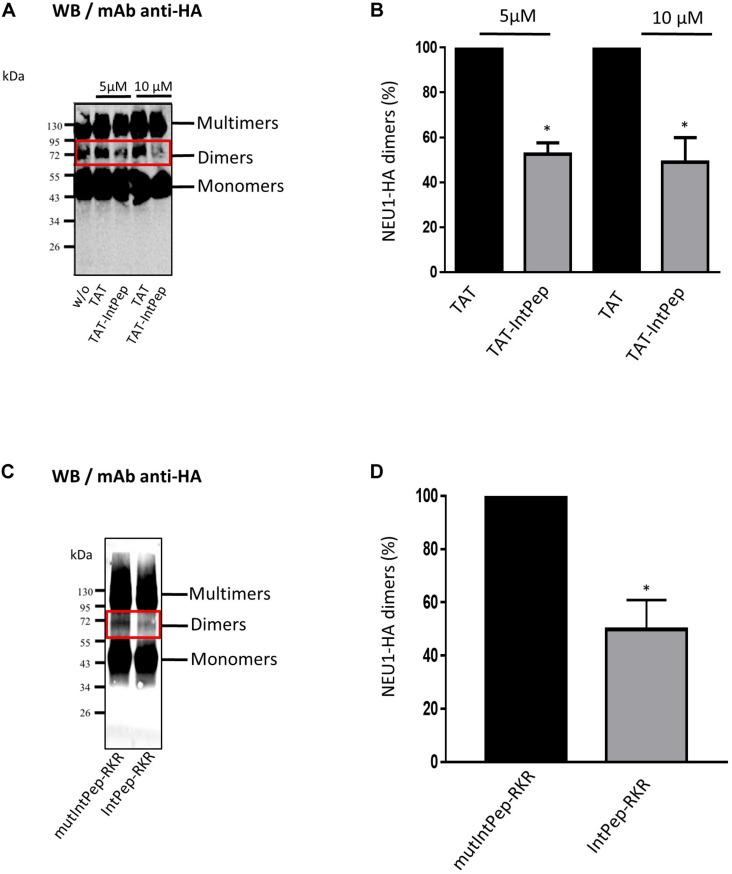
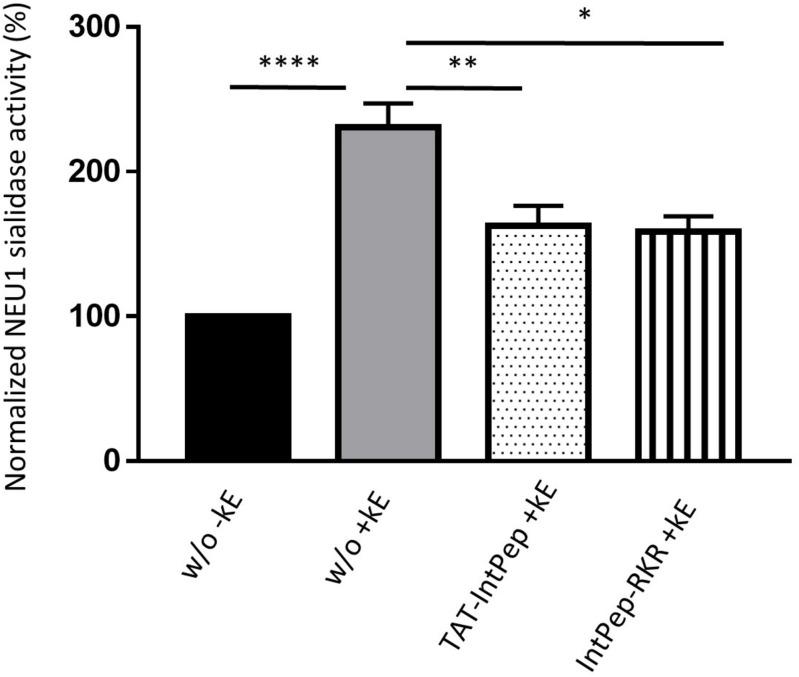
Sialidases, or neuraminidases, are involved in several human disorders such as neurodegenerative, infectious and cardiovascular diseases, and cancers. Accumulative data have shown that inhibition of neuraminidases, such as NEU1 sialidase, may be a promising pharmacological target, and selective inhibitors of NEU1 are therefore needed to better understand the biological functions of this sialidase. In the present study, we designed interfering peptides (IntPep) that target a transmembrane dimerization interface previously identified in human NEU1 that controls its membrane dimerization and sialidase activity. Two complementary strategies were used to deliver the IntPep into cells, either flanked to a TAT sequence or non-tagged for solubilization in detergent micelles. Combined with molecular dynamics simulations and heteronuclear nuclear magnetic resonance (NMR) studies in membrane-mimicking environments, our results show that these IntPep are able to interact with the dimerization interface of human NEU1, to disrupt membrane NEU1 dimerization and to strongly decrease its sialidase activity at the plasma membrane. In conclusion, we report here new selective inhibitors of human NEU1 of strong interest to elucidate the biological functions of this sialidase.
唾液酸酶,即神经氨酸酶,与多种人类疾病有关,如神经退行性疾病、传染病、心血管疾病和癌症。越来越多的数据表明,抑制神经氨酸酶,如NEU1唾液酸酶,可能是一个有前景的药理学靶点,因此需要NEU1的选择性抑制剂来更好地了解这种唾液酸酶的生物学功能。在本研究中,我们设计了干扰肽(IntPep),其靶向先前在人类NEU1中鉴定出的跨膜二聚化界面,该界面控制其膜二聚化和唾液酸酶活性。我们采用了两种互补策略将IntPep递送至细胞中,一种是连接到TAT序列两侧,另一种是不标记以便在去污剂胶束中溶解。结合在模拟膜环境中的分子动力学模拟和异核核磁共振(NMR)研究,我们的结果表明,这些IntPep能够与人NEU1的二聚化界面相互作用,破坏膜NEU1二聚化,并在质膜上强烈降低其唾液酸酶活性。总之,我们在此报告了新型人类NEU1选择性抑制剂,它们对于阐明这种唾液酸酶的生物学功能具有重要意义。



 Zotero 插件