
C9orf72 肌萎缩侧索硬化症运动神经元中线粒体生物能缺陷导致轴突稳态功能障碍。
Mitochondrial bioenergetic deficits in C9orf72 amyotrophic lateral sclerosis motor neurons cause dysfunctional axonal homeostasis.
机构信息
UK Dementia Research Institute at University of Edinburgh, University of Edinburgh, Edinburgh bioQuarter, Chancellor's Building, 49 Little France Crescent, Edinburgh, EH16 4SB, UK.
Centre for Clinical Brain Sciences, University of Edinburgh, Edinburgh, UK.
出版信息
Acta Neuropathol. 2021 Feb;141(2):257-279. doi: 10.1007/s00401-020-02252-5. Epub 2021 Jan 4.
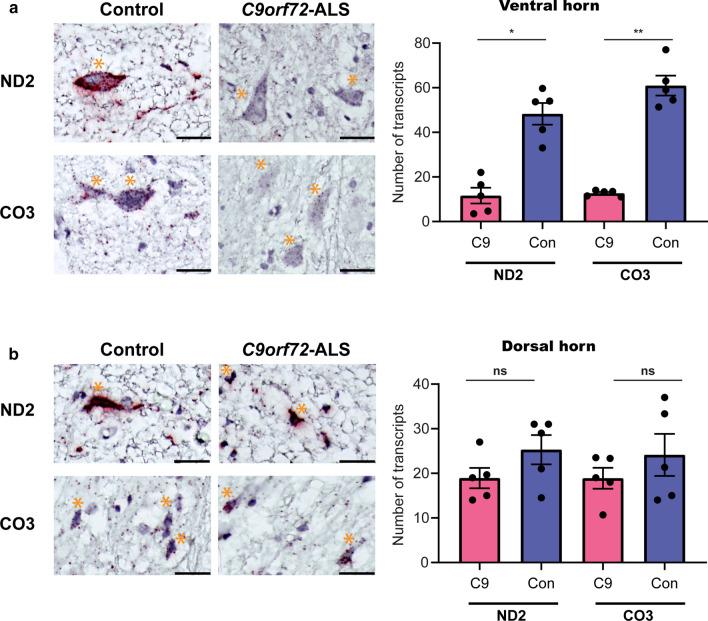
Axonal dysfunction is a common phenotype in neurodegenerative disorders, including in amyotrophic lateral sclerosis (ALS), where the key pathological cell-type, the motor neuron (MN), has an axon extending up to a metre long. The maintenance of axonal function is a highly energy-demanding process, raising the question of whether MN cellular energetics is perturbed in ALS, and whether its recovery promotes axonal rescue. To address this, we undertook cellular and molecular interrogation of multiple patient-derived induced pluripotent stem cell lines and patient autopsy samples harbouring the most common ALS causing mutation, C9orf72. Using paired mutant and isogenic expansion-corrected controls, we show that C9orf72 MNs have shorter axons, impaired fast axonal transport of mitochondrial cargo, and altered mitochondrial bioenergetic function. RNAseq revealed reduced gene expression of mitochondrially encoded electron transport chain transcripts, with neuropathological analysis of C9orf72-ALS post-mortem tissue importantly confirming selective dysregulation of the mitochondrially encoded transcripts in ventral horn spinal MNs, but not in corresponding dorsal horn sensory neurons, with findings reflected at the protein level. Mitochondrial DNA copy number was unaltered, both in vitro and in human post-mortem tissue. Genetic manipulation of mitochondrial biogenesis in C9orf72 MNs corrected the bioenergetic deficit and also rescued the axonal length and transport phenotypes. Collectively, our data show that loss of mitochondrial function is a key mediator of axonal dysfunction in C9orf72-ALS, and that boosting MN bioenergetics is sufficient to restore axonal homeostasis, opening new potential therapeutic strategies for ALS that target mitochondrial function.
轴突功能障碍是神经退行性疾病的常见表型,包括肌萎缩侧索硬化症(ALS),其中关键的病理细胞类型——运动神经元(MN)——具有延伸长达一米的轴突。轴突功能的维持是一个高度耗能的过程,这就提出了一个问题,即在 ALS 中 MN 细胞的能量代谢是否受到干扰,以及其恢复是否能促进轴突恢复。为了解决这个问题,我们对多个源自患者的诱导多能干细胞系和携带最常见 ALS 致病突变 C9orf72 的患者尸检样本进行了细胞和分子研究。使用配对的突变和同型校正对照,我们发现 C9orf72 MN 的轴突较短,线粒体货物的快速轴突运输受损,线粒体生物能功能改变。RNAseq 显示线粒体编码电子传递链转录物的基因表达减少,对 C9orf72-ALS 尸检组织的神经病理学分析重要地证实了线粒体重编码转录物在腹角脊髓 MN 中的选择性失调,但在相应的背角感觉神经元中没有失调,这一发现反映在蛋白质水平上。无论是在体外还是在人类尸检组织中,线粒体 DNA 拷贝数都没有改变。C9orf72 MN 中线粒体生物发生的遗传操纵纠正了生物能缺陷,也挽救了轴突长度和运输表型。总的来说,我们的数据表明,线粒体功能的丧失是 C9orf72-ALS 中轴突功能障碍的一个关键介质,而增强 MN 的生物能足以恢复轴突的稳态,为 ALS 提供了新的潜在治疗策略,这些策略针对线粒体功能。



 Zotero 插件