
紫草素通过 MAPK 通路介导的细胞凋亡抑制黑色素瘤细胞的增殖。
Shikonin inhibits proliferation of melanoma cells by MAPK pathway-mediated induction of apoptosis.
机构信息
Department of Companion and Laboratory Animal Science, Kongju National University, Yesan, Republic of Korea.
College of Veterinary Medicine and Bio-safety Research Institute, Jeonbuk National University, Iksan, Republic of Korea.
出版信息
Biosci Rep. 2021 Jan 29;41(1). doi: 10.1042/BSR20203834.
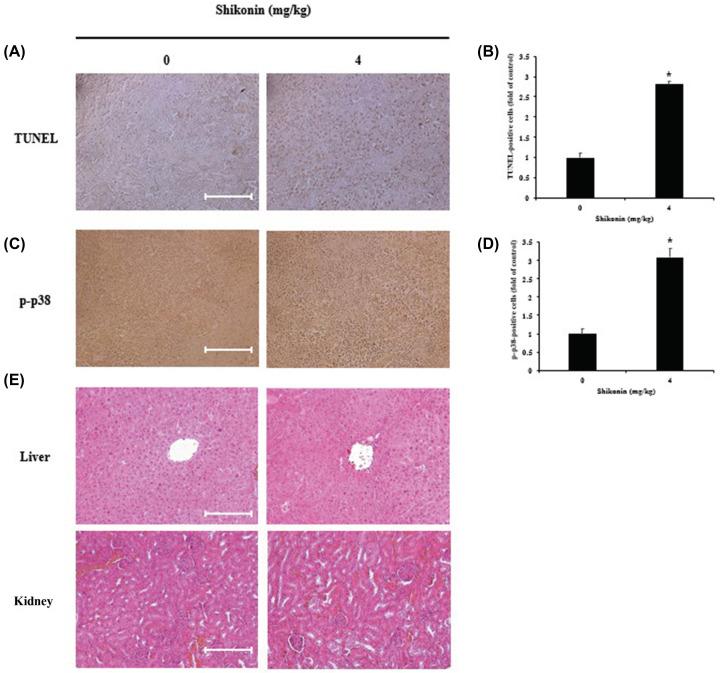
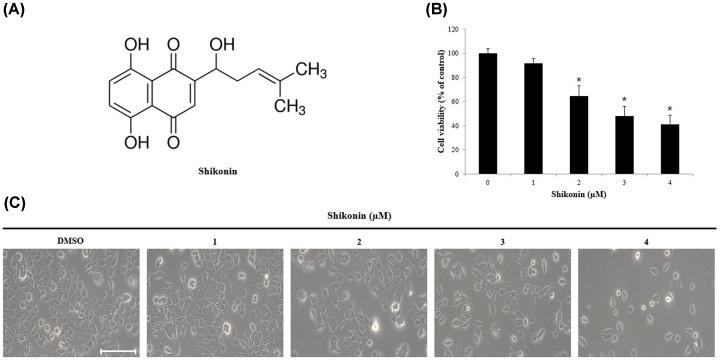
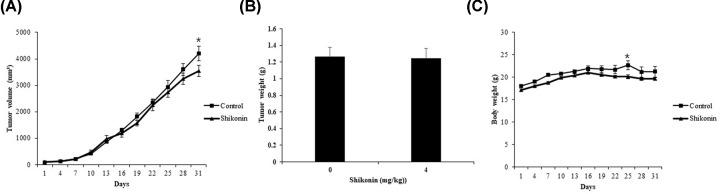
Shikonin, a natural product isolated from the roots of Lithospermum erythrorhizon, exhibits pharmacological effects against inflammation, ulcers, infections, and tumors. In the present study, we aimed to investigate the antitumor effects of shikonin on the human melanoma cell line, A375SM, and in an in vivo mouse xenograft model. We examined the anticancer effects of shikonin by in vitro experiments (MTT (3-(4,5-dimethylthiazol-2-yl)-2,5-diphenyltetrazolium bromide) assay, 4',6-diamidino-2-phenylindole (DAPI) stain, annexin V/ propidium iodide (PI) stain, and protein analysis of apoptosis and mitogen-activated protein kinase (MAPK) pathways). Further, the anticancer effect in vivo was confirmed through a xenograft model. Our results showed that shikonin inhibited the proliferation of melanoma cells in a dose-dependent manner. In addition, shikonin significantly increased nucleus and chromatin condensation and early/late apoptosis. Shikonin also increased the pro-apoptotic proteins and decreased the anti-apoptotic proteins. Additionally, shikonin was overexpressed in MAPK pathways. Investigation of the effects of shikonin in a mouse xenograft model not only showed decreased A375SM tumor volume but also increased apoptosis as determined by terminal deoxynucleotidyl transferase dUTP nick-end labeling (TUNEL) assay. Furthermore, pathologic changes were not observed in the liver and kidney of mice. Collectively, the study indicated that shikonin inhibited the proliferation of the human melanoma cells by inducing apoptosis, mediated by MAPK pathway and that it is a potential candidate for an anticancer drug against melanoma cancer.
紫草素是一种从紫草的根部提取的天然产物,具有抗炎、溃疡、感染和肿瘤的药理作用。在本研究中,我们旨在研究紫草素对人黑色素瘤细胞系 A375SM 的抗肿瘤作用及其在体内小鼠异种移植模型中的作用。我们通过体外实验(MTT(3-(4,5-二甲基噻唑-2-基)-2,5-二苯基四氮唑溴盐)测定、4',6-二脒基-2-苯吲哚(DAPI)染色、膜联蛋白 V/碘化丙啶(PI)染色和凋亡和丝裂原活化蛋白激酶(MAPK)途径的蛋白分析)检查了紫草素的抗癌作用。此外,通过异种移植模型证实了体内的抗癌作用。我们的结果表明,紫草素以剂量依赖性方式抑制黑色素瘤细胞的增殖。此外,紫草素显著增加细胞核和染色质的浓缩以及早期/晚期凋亡。紫草素还增加了促凋亡蛋白,减少了抗凋亡蛋白。此外,紫草素在 MAPK 途径中过表达。在小鼠异种移植模型中研究紫草素的作用不仅显示 A375SM 肿瘤体积减少,而且通过末端脱氧核苷酸转移酶 dUTP 缺口末端标记(TUNEL)测定还显示凋亡增加。此外,在小鼠的肝和肾中未观察到病理变化。总之,该研究表明,紫草素通过诱导 MAPK 途径介导的细胞凋亡抑制人黑色素瘤细胞的增殖,并且是一种针对黑色素瘤癌症的潜在抗癌药物候选物。


 Zotero 插件