
能量状态通过谷氨酸能腹内侧下丘脑神经元改变阿黑皮素原神经元的调节:突触前和突触后机制。
Energy state alters regulation of proopiomelanocortin neurons by glutamatergic ventromedial hypothalamus neurons: pre- and postsynaptic mechanisms.
机构信息
Department of Biomedical Sciences, Colorado State University, Fort Collins, Colorado.
出版信息
J Neurophysiol. 2021 Mar 1;125(3):720-730. doi: 10.1152/jn.00359.2020. Epub 2021 Jan 13.
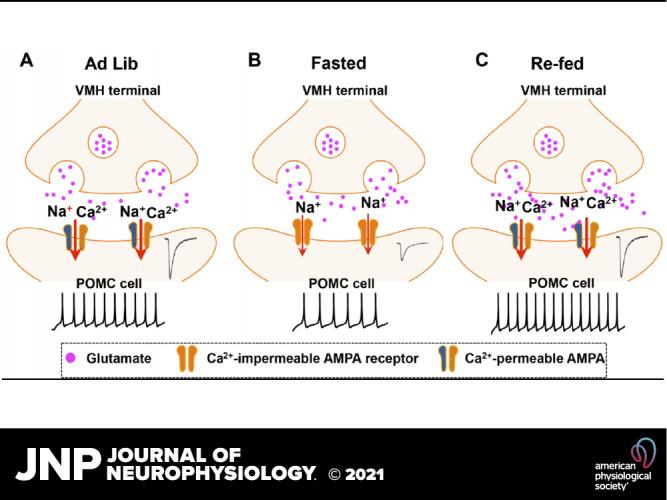
To maintain metabolic homeostasis, motivated behaviors are driven by neuronal circuits that process information encoding the animal's energy state. Such circuits likely include ventromedial hypothalamus (VMH) glutamatergic neurons that project throughout the brain to drive food intake and energy expenditure. Targets of VMH glutamatergic neurons include proopiomelanocortin (POMC) neurons in the arcuate nucleus that, when activated, inhibit food intake. Although an energy-state-sensitive, glutamate circuit between the VMH and POMC neurons has been previously indicated, the significance and details of this circuit have not been fully elucidated. Thus, the goal of the present work was to add to the understanding of this circuit. Using a knockout strategy, the data show that the VMH glutamate→POMC neuron circuit is important for the inhibition of food intake. Conditional deletion of the vesicular glutamate transporter (VGLUT2) in the VMH results in increased bodyweight and increased food intake following a fast in both male and female mice. Additionally, the targeted blunting of glutamate release from the VMH resulted in an ∼32% reduction in excitatory inputs to POMC cells, suggesting that this circuit may respond to changes in energy state to affect POMC activity. Indeed, we found that glutamate release is increased at VMH-to-POMC synapses during feeding and POMC AMPA receptors switch from a calcium-permeable state to a calcium-impermeable state during fasting. Collectively, these data indicate that there is an energy-balance-sensitive VMH-to-POMC circuit conveying excitatory neuromodulation onto POMC cells at both pre- and postsynaptic levels, which may contribute to maintaining appropriate food intake and body mass. Despite decades of research, the neurocircuitry underlying metabolic homeostasis remains incompletely understood. Specifically, the roles of amino acid transmitters, particularly glutamate, have received less attention than hormonal signals. Here, we characterize an energy-state-sensitive glutamate circuit from the ventromedial hypothalamus to anorexigenic proopiomelanocortin (POMC) neurons that responds to changes in energy state at both sides of the synapse, providing novel information about how variations in metabolic state affect excitatory drive onto POMC cells.
为了维持代谢平衡,受动机驱动的行为是由处理动物能量状态信息编码的神经元回路驱动的。这样的回路可能包括腹内侧下丘脑 (VMH) 谷氨酸能神经元,它们投射到整个大脑中以驱动食物摄入和能量消耗。VMH 谷氨酸能神经元的靶点包括弓状核中的促阿黑皮素原 (POMC) 神经元,当被激活时,它会抑制食物摄入。尽管以前已经表明 VMH 和 POMC 神经元之间存在能量状态敏感的谷氨酸能回路,但该回路的意义和细节尚未完全阐明。因此,本工作的目标是增加对该回路的理解。使用敲除策略,数据表明 VMH 谷氨酸→POMC 神经元回路对于抑制食物摄入很重要。VMH 中囊泡谷氨酸转运体 (VGLUT2) 的条件缺失会导致雄性和雌性小鼠在禁食后体重增加和食物摄入增加。此外,VMH 中谷氨酸释放的靶向钝化导致 POMC 细胞兴奋性输入减少约 32%,表明该回路可能会响应能量状态的变化来影响 POMC 活性。事实上,我们发现进食时 VMH 到 POMC 突触的谷氨酸释放增加,而 POMC AMPA 受体在禁食时从钙通透性状态转变为钙非通透性状态。总的来说,这些数据表明存在一个能量平衡敏感的 VMH 到 POMC 回路,在突触前和突触后水平上向 POMC 细胞传递兴奋性神经调制,这可能有助于维持适当的食物摄入和体重。尽管经过几十年的研究,代谢平衡的神经回路仍然不完全清楚。具体来说,氨基酸递质,特别是谷氨酸的作用,受到的关注比激素信号少。在这里,我们描述了一个从腹内侧下丘脑到厌食性促阿黑皮素原 (POMC) 神经元的能量状态敏感的谷氨酸能回路,该回路对突触两侧能量状态的变化做出反应,为代谢状态的变化如何影响 POMC 细胞的兴奋性驱动提供了新的信息。
 Zotero 插件