
体重指数和腰围与26种癌症风险的关系:西班牙350万成年人的前瞻性队列研究
Body mass index and waist circumference in relation to the risk of 26 types of cancer: a prospective cohort study of 3.5 million adults in Spain.
作者信息
Recalde Martina, Davila-Batista Veronica, Díaz Yesika, Leitzmann Michael, Romieu Isabelle, Freisling Heinz, Duarte-Salles Talita
机构信息
Fundació Institut Universitari per a la recerca a l'Atenció Primària de Salut Jordi Gol i Gurina (IDIAPJGol), Gran Via Corts Catalanes, 587 àtic, 08007, Barcelona, Spain.
Universitat Autònoma de Barcelona, Campus de Bellaterra, 08193, Bellaterra, Spain.
出版信息
BMC Med. 2021 Jan 14;19(1):10. doi: 10.1186/s12916-020-01877-3.
BACKGROUND
A high body mass index (BMI) has been associated with increased risk of several cancers; however, whether BMI is related to a larger number of cancers than currently recognized is unclear. Moreover, whether waist circumference (WC) is more strongly associated with specific cancers than BMI is not well established. We aimed to investigate the associations between BMI and 26 cancers accounting for non-linearity and residual confounding by smoking status as well as to compare cancer risk estimates between BMI and WC.
METHODS
Prospective cohort study with population-based electronic health records from Catalonia, Spain. We included 3,658,417 adults aged ≥ 18 years and free of cancer at baseline between 2006 and 2017. Our main outcome measures were cause-specific hazard ratios (HRs) with 99% confidence intervals (CIs) for incident cancer at 26 anatomical sites.
RESULTS
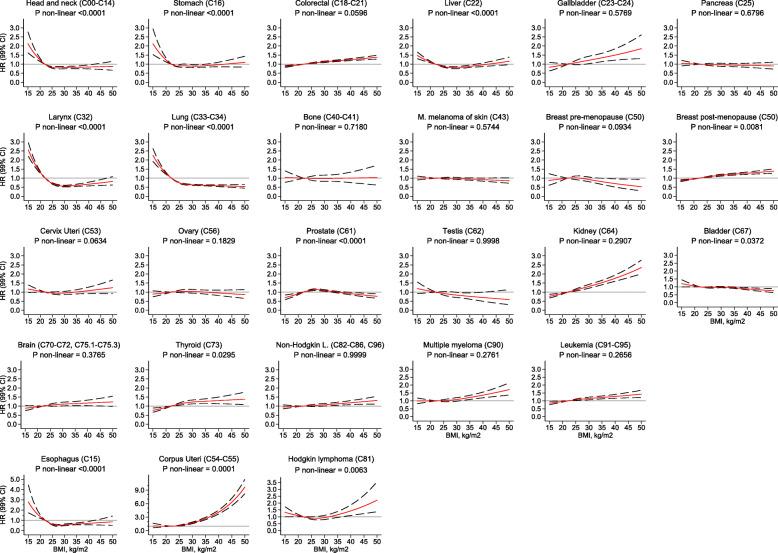
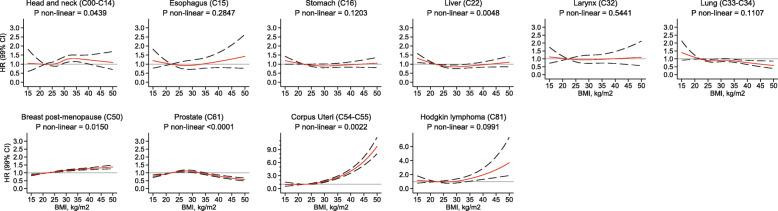
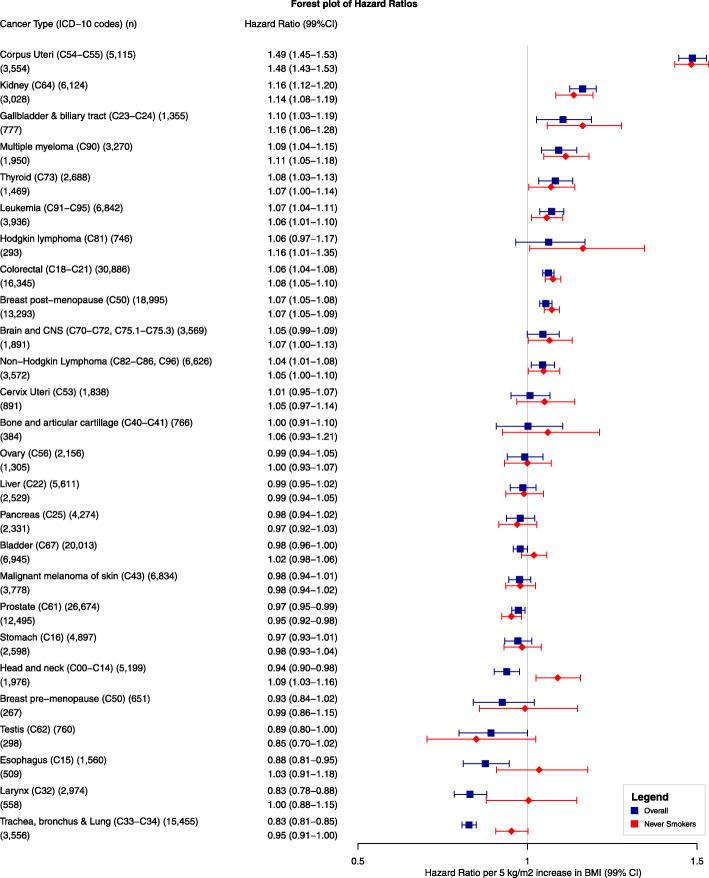
After a median follow-up time of 8.3 years, 202,837 participants were diagnosed with cancer. A higher BMI was positively associated with risk of nine cancers (corpus uteri, kidney, gallbladder, thyroid, colorectal, breast post-menopausal, multiple myeloma, leukemia, non-Hodgkin lymphoma) and was positively associated with three additional cancers among never smokers (head and neck, brain and central nervous system, Hodgkin lymphoma). The respective HRs (per 5 kg/m increment) ranged from 1.04 (99%CI 1.01 to 1.08) for non-Hodgkin lymphoma to 1.49 (1.45 to 1.53) for corpus uteri cancer. While BMI was negatively associated to five cancer types in the linear analyses of the overall population, accounting for non-linearity revealed that BMI was associated to prostate cancer in a U-shaped manner and to head and neck, esophagus, larynx, and trachea, bronchus and lung cancers in an L-shaped fashion, suggesting that low BMIs are an approximation of heavy smoking. Of the 291,305 participants with a WC measurement, 27,837 were diagnosed with cancer. The 99%CIs of the BMI and WC point estimates (per 1 standard deviation increment) overlapped for all cancers.
CONCLUSIONS
In this large Southern European study, a higher BMI was associated with increased risk of twelve cancers, including four hematological and head and neck (only among never smokers) cancers. Furthermore, BMI and WC showed comparable estimates of cancer risk associated with adiposity.
背景
高体重指数(BMI)与多种癌症风险增加相关;然而,BMI是否与比目前公认的更多种类的癌症有关尚不清楚。此外,腰围(WC)是否比BMI与特定癌症的关联更强也未得到充分证实。我们旨在研究BMI与26种癌症之间的关联,考虑吸烟状况导致的非线性和残余混杂因素,并比较BMI和WC对癌症风险的估计。
方法
基于西班牙加泰罗尼亚地区基于人群的电子健康记录进行前瞻性队列研究。我们纳入了2006年至2017年期间年龄≥18岁且基线时无癌症的3,658,417名成年人。我们的主要结局指标是26个解剖部位新发癌症的特定病因风险比(HRs)及99%置信区间(CIs)。
结果
中位随访时间8.3年后,202,837名参与者被诊断患有癌症。较高的BMI与9种癌症的风险呈正相关(子宫体癌、肾癌、胆囊癌、甲状腺癌、结直肠癌、绝经后乳腺癌、多发性骨髓瘤、白血病、非霍奇金淋巴瘤),并且在从不吸烟者中与另外3种癌症呈正相关(头颈癌、脑和中枢神经系统癌、霍奇金淋巴瘤)。各自的HRs(每增加5kg/m²)范围从不霍奇金淋巴瘤的1.04(99%CI 1.01至1.08)到子宫体癌的1.49(1.45至1.53)。在总体人群的线性分析中,BMI与5种癌症类型呈负相关,但考虑非线性因素后发现,BMI与前列腺癌呈U形关联,与头颈癌、食管癌、喉癌以及气管、支气管和肺癌呈L形关联,这表明低BMI近似于重度吸烟。在291,305名测量了WC的参与者中,27,837人被诊断患有癌症。BMI和WC点估计值(每增加1个标准差)的99%CI在所有癌症中均有重叠。
结论
在这项大型的南欧研究中,较高BMI与12种癌症的风险增加相关,包括4种血液系统癌症和头颈癌(仅在从不吸烟者中)。此外,BMI和WC显示出与肥胖相关的癌症风险估计相当。


 Zotero 插件