
猪骨髓间充质干细胞成脂分化过程中活性和抑制性组蛋白标记的改变。
Alteration of active and repressive histone marks during adipogenic differentiation of porcine mesenchymal stem cells.
机构信息
Department of Genetics and Animal Breeding, Poznan University of Life Sciences, Wolynska 33, 60-637, Poznan, Poland.
Department of Animal Physiology, Biochemistry and Biostructure, Poznan University of Life Sciences, Wolynska 35, 60-637, Poznan, Poland.
出版信息
Sci Rep. 2021 Jan 14;11(1):1325. doi: 10.1038/s41598-020-79384-x.
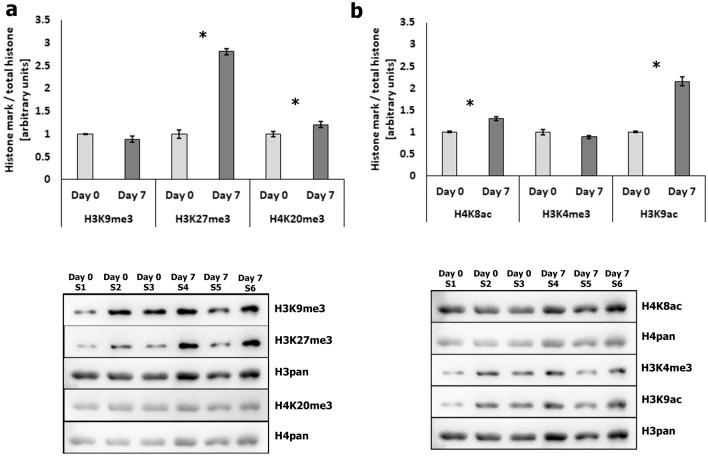
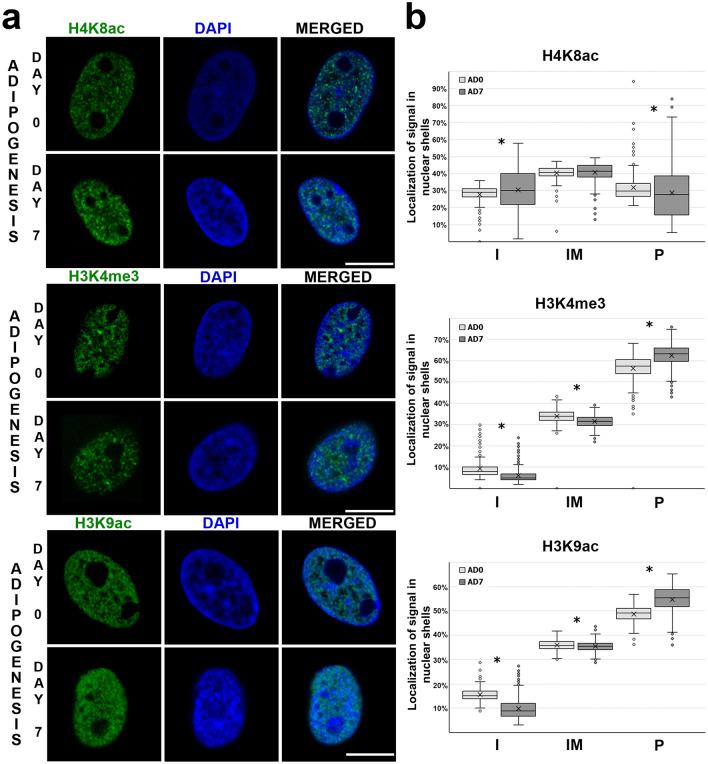
A characteristic spatial distribution of the main chromatin fractions is observed in most mammalian cell nuclei, with euchromatin localized in the interior and heterochromatin at the nuclear periphery. It has been shown that interactions of heterochromatin with the nuclear lamina are necessary to establish this conventional architecture. Adipocytes are specific cells in which a reduction in lamin A/C expression is observed. We hypothesize that the loss of lamin A/C during adipogenic differentiation of mesenchymal stem cells (MSCs) may be associated with the reorganization of the main classes of chromatin in the nucleus. Thus, in this study, we examine the abundance and nuclear distribution of selected heterochromatin (H3K9me3, H3K27me3 and H4K20me3) and euchromatin (H4K8ac, H3K4me3 and H3K9ac) histone marks during in vitro adipogenesis, using the pig as a model organism. We found that not only did the expression of lamin A/C decrease in our differentiation system, but so did the expression of lamin B receptor (LBR). The level of two heterochromatin marks, H3K27me3 and H4K20me3, increased during differentiation, while no changes were observed for H3K9me3. The levels of two euchromatin histone marks, H4K8ac and H3K9ac, were significantly higher in adipocytes than in undifferentiated cells, while the level of H3K4me3 did not change significantly. The spatial distribution of all the examined histone marks altered during in vitro adipogenesis. H3K27me3 and H4K20me3 moved towards the nuclear periphery and H3K9me3 localized preferentially in the intermediate part of adipocyte nuclei. The euchromatin marks H3K9ac and H3K4me3 preferentially occupied the peripheral part of the adipocyte nuclei, while H4K8ac was more evenly distributed in the nuclei of undifferentiated and differentiated cells. Analysis of the nuclear distribution of repetitive sequences has shown their clustering and relocalization toward nuclear periphery during differentiation. Our study shows that dynamic changes in the abundance and nuclear distribution of active and repressive histone marks take place during adipocyte differentiation. Nuclear reorganization of heterochromatin histone marks may allow the maintenance of the nuclear morphology of the adipocytes, in which reduced expression of lamin A/C and LBR is observed.
在大多数哺乳动物细胞核中观察到主要染色质成分的特征空间分布,常染色质定位于内部,异染色质位于核周。已经表明,异染色质与核纤层的相互作用对于建立这种传统结构是必要的。脂肪细胞是一种特殊的细胞,在其中观察到 lamin A/C 的表达减少。我们假设,在间充质干细胞 (MSC) 的脂肪生成分化过程中 lamin A/C 的丢失可能与核内主要染色质类别的重排有关。因此,在这项研究中,我们使用猪作为模型生物,检查了选定的异染色质 (H3K9me3、H3K27me3 和 H4K20me3) 和常染色质 (H4K8ac、H3K4me3 和 H3K9ac) 组蛋白标记在体外脂肪生成过程中的丰度和核分布。我们发现,不仅我们的分化系统中 lamin A/C 的表达减少,而且 lamin B 受体 (LBR) 的表达也减少。两种异染色质标记物 H3K27me3 和 H4K20me3 的水平在分化过程中增加,而 H3K9me3 没有变化。两种常染色质组蛋白标记物 H4K8ac 和 H3K9ac 的水平在脂肪细胞中明显高于未分化细胞,而 H3K4me3 的水平没有明显变化。所有检查的组蛋白标记的空间分布在体外脂肪生成过程中发生了改变。H3K27me3 和 H4K20me3 向核周移动,H3K9me3 优先定位于脂肪细胞核的中间部分。常染色质标记物 H3K9ac 和 H3K4me3 优先占据脂肪细胞核的外周部分,而 H4K8ac 在未分化和分化细胞的核中分布更为均匀。重复序列的核分布分析表明,在分化过程中它们发生了聚类和向核周的重新定位。我们的研究表明,在脂肪细胞分化过程中,活性和抑制性组蛋白标记的丰度和核分布发生了动态变化。异染色质组蛋白标记的核重排可能允许维持脂肪细胞的核形态,在脂肪细胞中观察到 lamin A/C 和 LBR 的表达减少。



 Zotero 插件