
2008 - 2017年美国商业保险人群中用于确诊或监测高血压及顽固性高血压的动态血压监测使用趋势
Trends in ambulatory blood pressure monitoring use for confirmation or monitoring of hypertension and resistant hypertension among the commercially insured in the U.S., 2008-2017.
作者信息
Desai Raj, Park Haesuk, Dietrich Eric A, Smith Steven M
机构信息
Department of Pharmaceutical Outcomes and Policy, College of Pharmacy, University of Florida, Gainesville, FL, USA.
Department of Pharmacotherapy and Translational Research, College of Pharmacy, University of Florida, Gainesville, FL, USA.
出版信息
Int J Cardiol Hypertens. 2020 Jun 1;6:100033. doi: 10.1016/j.ijchy.2020.100033. eCollection 2020 Sep.
BACKGROUND
Ambulatory blood pressure monitoring (ABPM) has been increasingly recommended for diagnosis confirmation and monitoring in patients with new-onset hypertension and apparent treatment-resistant hypertension (aTRH). We assessed insurance claims submitted for ABPM among a nationally representative sample of commercially insured U.S. patients.
METHODS
We conducted a retrospective cross-sectional analysis using the IBM MarketScan® commercial claims database from January 2008-December 2017, including 2 populations: those with incident treated hypertension (ITH; first antihypertensive filled) or aTRH (first overlapping use of 4 antihypertensive agents). We identified ABPM claims filed within 6 months before to 6 months after the qualifying antihypertensive fill and determined prevalence of ABPM use overall and by year in each population.
RESULTS
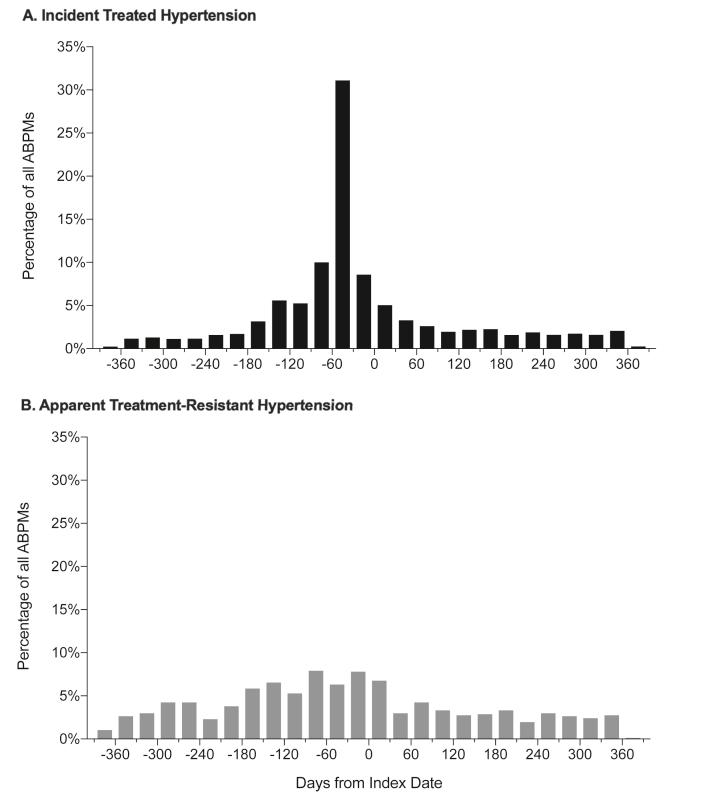
In total, 2,820,303 patients met ITH criteria and 298,049 met aTRH criteria. Of those with ITH, 7650 (2.7 per 1000 persons) had ≥1 ABPM claim submitted, and annual ABPM prevalence ranged from 2.0 to 3.7 per 1000 persons, increasing over time ( <0.0001). Among those with aTRH, 630 (2.1 per 1000 persons) had ≥1 ABPM claim submitted, and annual ABPM prevalence ranged from 1.6 to 2.7 per 1000 persons, decreasing over time ( = 0.054). Timing of ABPM claims suggested they were used primarily for diagnosis confirmation in ITH, and more evenly distributed between diagnosis confirmation and monitoring in aTRH.
CONCLUSIONS
Despite guideline recommendations for more widescale use, ABPM appears to be used rarely in the U.S., with fewer than 0.5% of commercially insured patients with newly treated hypertension or aTRH having ABPM claims submitted to their insurance.
背景
动态血压监测(ABPM)越来越多地被推荐用于确诊和监测新发高血压患者以及明显难治性高血压(aTRH)患者。我们评估了美国商业保险患者全国代表性样本中提交的ABPM保险理赔情况。
方法
我们使用IBM MarketScan®商业理赔数据库进行了一项回顾性横断面分析,时间跨度为2008年1月至2017年12月,包括2组人群:初治高血压患者(ITH;首次开具抗高血压药物)或aTRH患者(首次重叠使用4种抗高血压药物)。我们确定了在符合条件的抗高血压药物开具前6个月至开具后6个月内提交的ABPM理赔,并确定了每组人群中ABPM的总体使用患病率及逐年患病率。
结果
共有2,820,303例患者符合ITH标准,298,049例符合aTRH标准。在ITH患者中,7650例(每1000人中有2.7例)提交了≥1份ABPM理赔,年度ABPM患病率为每1000人2.0至3.7例,随时间增加(<0.0001)。在aTRH患者中,630例(每1000人中有2.1例)提交了≥1份ABPM理赔,年度ABPM患病率为每1000人从1.6至2.7例,随时间下降(=0.054)。ABPM理赔时间表明,它们主要用于ITH的诊断确认,而在aTRH中则更均匀地分布于诊断确认和监测之间。
结论
尽管指南建议更广泛地使用ABPM,但在美国,ABPM的使用似乎很少,在新治疗的高血压或aTRH的商业保险患者中,提交ABPM保险理赔的不到0.5%。

 Zotero 插件