
血清肌酐水平降低预示肌萎缩侧索硬化症患者的短期生存不良。
Decreased serum creatinine levels predict short survival in amyotrophic lateral sclerosis.
机构信息
Department of Neurology, Fujian Institute of Neurology, The First Affiliated Hospital, Fujian Medical University, Fuzhou, China.
Fujian Key Laboratory of Molecular Neurology, Fujian Medical University, Fuzhou, China.
出版信息
Ann Clin Transl Neurol. 2021 Feb;8(2):448-455. doi: 10.1002/acn3.51299. Epub 2021 Jan 15.
OBJECTIVE
To explore the associations between serum creatinine and creatine kinase (CK) levels with survival in male and female ALS patients.
METHODS
A prospective cohort study was carried out including 346 ALS patients with repeated serum creatinine and CK measurements. Kaplan Meier analysis and multivariable Cox regression were used to perform survival analysis.
RESULTS
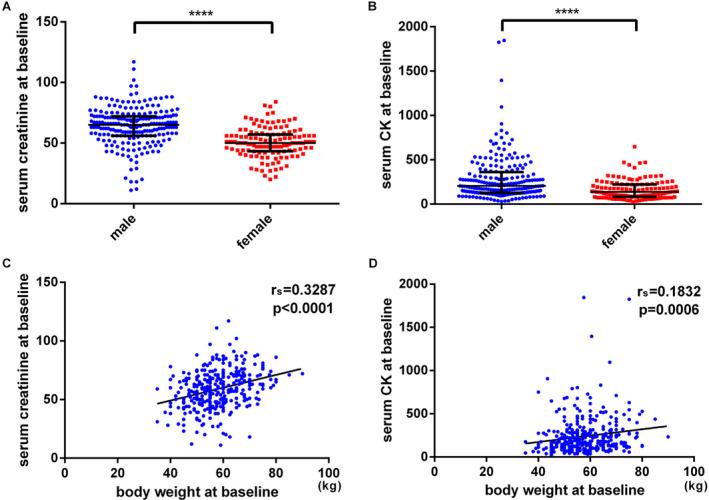
There were 218 male and 128 female patients, and the males had significantly higher baseline serum creatinine and CK levels than females. After multivariable Cox regression analysis, lower baseline serum creatinine levels were associated with a short survival in both male (≤61 μmol/L, HR: 1.629; 95%CI: 1.168-2.273) and female ALS patients (≤52 μmol/L, HR: 1.677; 95%CI: 1.042-2.699), whereas, the serum CK levels were not correlated with survival. Besides, creatinine levels were positively associated with ALSFRS-R scores, and inversely with the decline rate of ALSFRS-R per month. During follow-up, serum creatinine levels tended to be decreased along with the disease progression, and the higher decline rate of creatinine per month (>1.5) showed significantly shorter survival, compared to the lower group (≤1.5) (30.0 months vs. 65.0 months, Chi square = 28.25, P < 0.0001).
INTERPRETATION
Serum creatinine could be a reliable and easily accessible prognostic chemical marker for ALS, and decreased baseline creatinine levels could predict a poor prognosis and a short survival in both male and female ALS patients.
目的
探讨男性和女性肌萎缩侧索硬化症(ALS)患者血清肌酐和肌酸激酶(CK)水平与生存的关系。
方法
进行了一项前瞻性队列研究,纳入了 346 例反复检测血清肌酐和 CK 的 ALS 患者。采用 Kaplan-Meier 分析和多变量 Cox 回归进行生存分析。
结果
共有 218 名男性和 128 名女性患者,男性的基线血清肌酐和 CK 水平显著高于女性。多变量 Cox 回归分析后,男性(≤61μmol/L,HR:1.629;95%CI:1.168-2.273)和女性 ALS 患者(≤52μmol/L,HR:1.677;95%CI:1.042-2.699)中,较低的基线血清肌酐水平与较短的生存时间相关,而血清 CK 水平与生存时间无关。此外,肌酐水平与 ALSFRS-R 评分呈正相关,与 ALSFRS-R 每月下降率呈负相关。在随访期间,随着疾病的进展,血清肌酐水平趋于下降,与肌酐每月下降率较高(>1.5)的患者相比,下降率较低(≤1.5)的患者生存时间明显缩短(30.0 个月比 65.0 个月,卡方=28.25,P<0.0001)。
结论
血清肌酐可能是 ALS 可靠且易于获取的预后化学标志物,基线肌酐水平降低可预测男性和女性 ALS 患者预后不良和生存时间短。


 Zotero 插件