
对放疗中头颈部危及器官深度学习轮廓勾画后临床实践中进行的手动调整的评估。
Assessment of manual adjustment performed in clinical practice following deep learning contouring for head and neck organs at risk in radiotherapy.
作者信息
Brouwer Charlotte L, Boukerroui Djamal, Oliveira Jorge, Looney Padraig, Steenbakkers Roel J H M, Langendijk Johannes A, Both Stefan, Gooding Mark J
机构信息
University of Groningen, University Medical Center Groningen, Department of Radiation Oncology, Groningen, The Netherlands.
Mirada Medical Ltd., Oxford, United Kingdom.
出版信息
Phys Imaging Radiat Oncol. 2020 Oct 14;16:54-60. doi: 10.1016/j.phro.2020.10.001. eCollection 2020 Oct.
BACKGROUND AND PURPOSE
Auto-contouring performance has been widely studied in development and commissioning studies in radiotherapy, and its impact on clinical workflow assessed in that context. This study aimed to evaluate the manual adjustment of auto-contouring in routine clinical practice and to identify improvements regarding the auto-contouring model and clinical user interaction, to improve the efficiency of auto-contouring.
MATERIALS AND METHODS
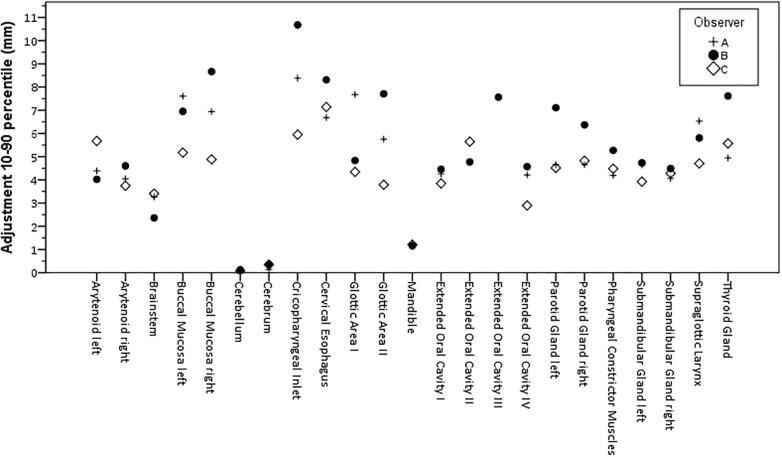
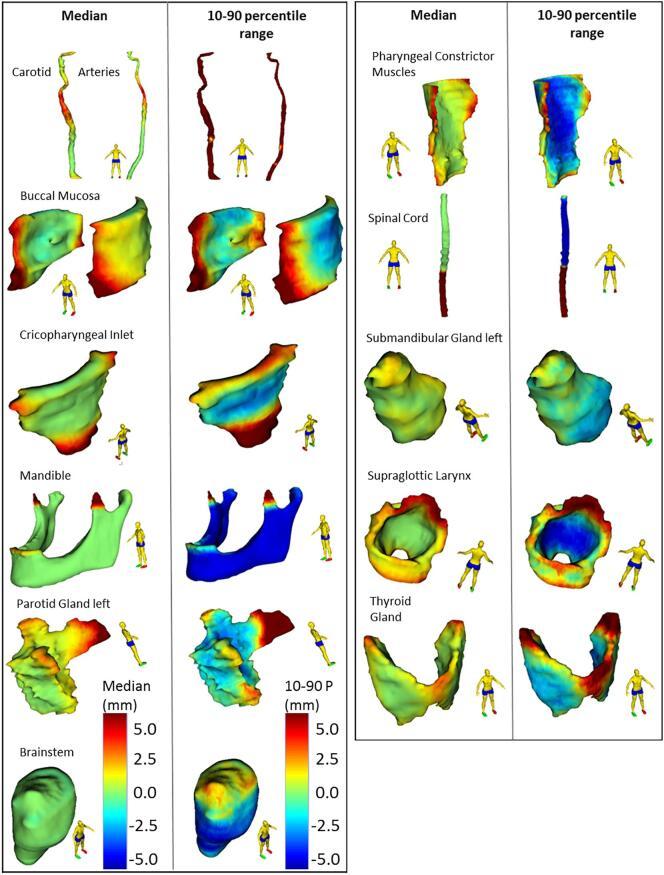
A total of 103 clinical head and neck cancer cases, contoured using a commercial deep-learning contouring system and subsequently checked and edited for clinical use were retrospectively taken from clinical data over a twelve-month period (April 2019-April 2020). The amount of adjustment performed was calculated, and all cases were registered to a common reference frame for assessment purposes. The median, 10th and 90th percentile of adjustment were calculated and displayed using 3D renderings of structures to visually assess systematic and random adjustment. Results were also compared to inter-observer variation reported previously. Assessment was performed for both the whole structures and for regional sub-structures, and according to the radiation therapy technologist (RTT) who edited the contour.
RESULTS
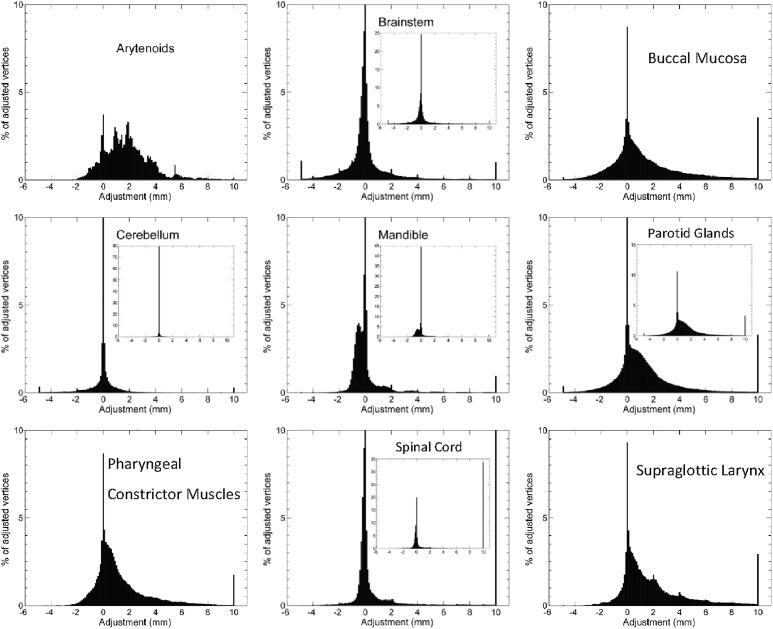
The median amount of adjustment was low for all structures (<2 mm), although large local adjustment was observed for some structures. The median was systematically greater or equal to zero, indicating that the auto-contouring tends to under-segment the desired contour.
CONCLUSION
Auto-contouring performance assessment in routine clinical practice has identified systematic improvements required technically, but also highlighted the need for continued RTT training to ensure adherence to guidelines.
背景与目的
自动轮廓勾画性能在放射治疗的开发和调试研究中已得到广泛研究,并在此背景下评估了其对临床工作流程的影响。本研究旨在评估常规临床实践中自动轮廓勾画的手动调整情况,并确定自动轮廓勾画模型和临床用户交互方面的改进措施,以提高自动轮廓勾画的效率。
材料与方法
回顾性收集了103例临床头颈部癌病例,这些病例使用商业深度学习轮廓勾画系统进行轮廓勾画,随后经过检查和编辑以供临床使用,数据来源于12个月期间(2019年4月至2020年4月)的临床资料。计算了进行调整的量,并将所有病例注册到一个公共参考框架中以进行评估。计算调整的中位数、第10百分位数和第90百分位数,并使用结构的三维渲染图进行展示,以直观评估系统和随机调整情况。还将结果与先前报道的观察者间差异进行了比较。对整个结构和区域子结构进行了评估,并根据编辑轮廓的放射治疗技师(RTT)进行评估。
结果
所有结构的调整中位数都较低(<2毫米),尽管某些结构观察到了较大的局部调整。中位数系统性地大于或等于零,表明自动轮廓勾画倾向于对所需轮廓进行欠分割。
结论
常规临床实践中的自动轮廓勾画性能评估不仅确定了技术上需要进行的系统性改进,还突出了持续进行RTT培训以确保遵循指南的必要性。

 Zotero 插件