
内酯中间体在连接特异性唾液酸衍生物反应中的结构和作用。
The structure and role of lactone intermediates in linkage-specific sialic acid derivatization reactions.
机构信息
Center for Proteomics and Metabolomics, Leiden University Medical Center, 2333ZA, Leiden, The Netherlands.
Copenhagen Center for Glycomics, University of Copenhagen, 2200, Copenhagen, Denmark.
出版信息
Glycoconj J. 2021 Apr;38(2):157-166. doi: 10.1007/s10719-020-09971-7. Epub 2021 Jan 18.
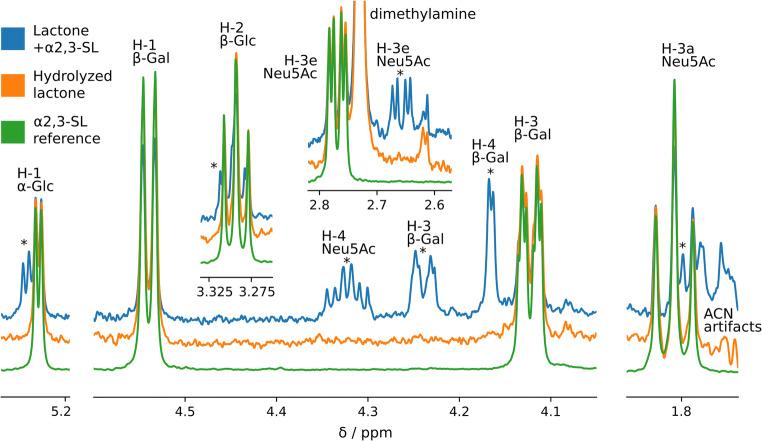
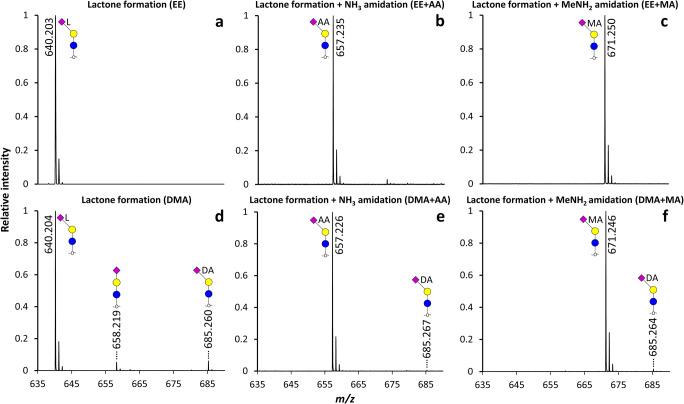
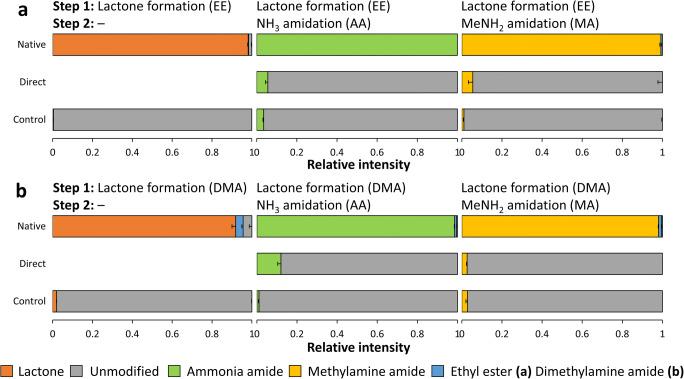
Sialic acids occur ubiquitously throughout vertebrate glycomes and often endcap glycans in either α2,3- or α2,6-linkage with diverse biological roles. Linkage-specific sialic acid characterization is increasingly performed by mass spectrometry, aided by differential sialic acid derivatization to discriminate between linkage isomers. Typically, during the first step of such derivatization reactions, in the presence of a carboxyl group activator and a catalyst, α2,3-linked sialic acids condense with the subterminal monosaccharides to form lactones, while α2,6-linked sialic acids form amide or ester derivatives. In a second step, the lactones are converted into amide derivatives. Notably, the structure and role of the lactone intermediates in the reported reactions remained ambiguous, leaving it unclear to which extent the amidation of α2,3-linked sialic acids depended on direct aminolysis of the lactone, rather than lactone hydrolysis and subsequent amidation. In this report, we used mass spectrometry to unravel the role of the lactone intermediate in the amidation of α2,3-linked sialic acids by applying controlled reaction conditions on simple and complex glycan standards. The results unambiguously show that in common sialic acid derivatization protocols prior lactone formation is a prerequisite for the efficient, linkage-specific amidation of α2,3-linked sialic acids, which proceeds predominantly via direct aminolysis. Furthermore, nuclear magnetic resonance spectroscopy confirmed that exclusively the C2 lactone intermediate is formed on a sialyllactose standard. These insights allow a more rationalized method development for linkage-specific sialic derivatization in the future.
唾液酸广泛存在于脊椎动物的聚糖中,通常以α2,3-或α2,6-键连接的方式终结聚糖,具有多种生物学功能。基于质谱的方法,通过对唾液酸进行差异衍生化来区分连接异构体,从而实现了对连接特异性唾液酸的特征分析。通常,在衍生化反应的第一步中,在羧基激活剂和催化剂的存在下,α2,3 连接的唾液酸与末端单糖缩合形成内酯,而α2,6 连接的唾液酸形成酰胺或酯衍生物。在第二步中,内酯转化为酰胺衍生物。值得注意的是,在报道的反应中,内酯中间体的结构和作用仍不明确,不清楚α2,3 连接的唾液酸的酰胺化在多大程度上取决于内酯的直接氨解,而不是内酯水解和随后的酰胺化。在本报告中,我们使用质谱法通过对简单和复杂糖标准品应用受控反应条件,揭示了内酯中间体在α2,3 连接的唾液酸酰胺化反应中的作用。结果明确表明,在常见的唾液酸衍生化方案中,内酯的形成是α2,3 连接的唾液酸高效、连接特异性酰胺化的前提条件,该反应主要通过直接氨解进行。此外,核磁共振波谱法证实仅在唾液乳糖标准品上形成 C2 内酯中间体。这些见解为未来的连接特异性唾液酸衍生化提供了更合理的方法开发。


 Zotero 插件