
韩国首尔松坡-姜洞地区基于人群队列的老年发病溃疡性结肠炎的临床特征和长期预后。
Clinical Characteristics and Long-term Prognosis of Elderly-Onset Ulcerative Colitis in a Population-Based Cohort in the Songpa-Kangdong District of Seoul, Korea.
机构信息
Department of Gastroenterology, Asan Medical Center, University of Ulsan College of Medicine, Seoul, Korea.
Department of Surgery, Yang Hospital, Seoul, Korea.
出版信息
Gut Liver. 2021 Sep 15;15(5):742-751. doi: 10.5009/gnl20289.
BACKGROUND/AIMS: We aimed to evaluate the clinical characteristics and long-term prognosis of elderly-onset ulcerative colitis (EOUC) in Korean patients over a 30-year period using a wellestablished population-based cohort in the Songpa-Kangdong district of Seoul, Korea.
METHODS
Clinical characteristics and prognosis were compared between two groups: EOUC, defined as UC diagnosed in individuals aged ≥60 years and non-EOUC (N-EOUC), defined as UC diagnosed in individuals aged 18 to 59 years.
RESULTS
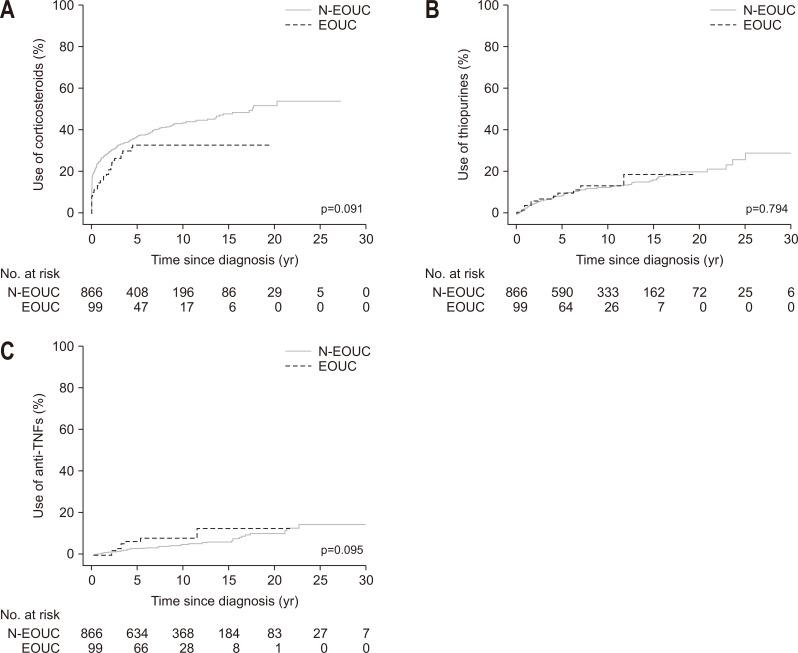
We identified 99 patients with EOUC (10.3%) and 866 patients with N-EOUC (89.7%) between 1986 and 2015. During the median follow-up of 104.5 months, the overall exposure to medications was comparable between patients with EOUC and N-EOUC (p=0.091 for corticosteroids, p=0.794 for thiopurines, and p=0.095 for anti-tumor necrosis factor agents). The cumulative risks of disease outcomes were also comparable between patients with EOUC and N-EOUC (22.4% vs 30.4% for proximal disease extension [p=0.351], 11.9% vs 18.1% for hospitalization [p=0.240], and 2.3% vs 1.8% for colectomy [p=0.977]) at 10 years after diagnosis. Multivariate Cox regression analysis revealed that corticosteroid use at diagnosis was an independent predictor of proximal disease extension (hazard ratio [HR], 6.216; 95% confidence interval [CI], 1.314 to 28.826) and hospitalization (HR, 11.241; 95% CI, 3.027 to 41.742) in patients with EOUC.
CONCLUSIONS
In this population-based study from Korea, the pattern of medication use seemed comparable between the EOUC and N-EOUC groups. Moreover, patients with EOUC and those with N-EOUC have a similar disease course in terms of proximal disease extension, hospitalization, and colectomy.
背景/目的:我们旨在通过韩国首尔松坡-姜东区一个经过良好建立的人群队列,评估 30 年来韩国老年发病溃疡性结肠炎(EOUC)的临床特征和长期预后。
方法
比较两组患者的临床特征和预后:EOUC 定义为年龄≥60 岁诊断的溃疡性结肠炎,非 EOUC(N-EOUC)定义为年龄 18 至 59 岁诊断的溃疡性结肠炎。
结果
我们在 1986 年至 2015 年期间发现 99 例 EOUC(10.3%)和 866 例 N-EOUC(89.7%)患者。在中位随访 104.5 个月期间,EOUC 患者和 N-EOUC 患者总体药物暴露情况相似(皮质类固醇 p=0.091,硫嘌呤 p=0.794,抗肿瘤坏死因子药物 p=0.095)。EOUC 患者和 N-EOUC 患者疾病结局的累积风险也相似(近端疾病扩展 22.4% vs 30.4% [p=0.351],住院 11.9% vs 18.1% [p=0.240],结肠切除术 2.3% vs 1.8% [p=0.977])诊断后 10 年。多变量 Cox 回归分析显示,诊断时使用皮质类固醇是 EOUC 患者近端疾病扩展(危险比 [HR],6.216;95%置信区间 [CI],1.314 至 28.826)和住院(HR,11.241;95% CI,3.027 至 41.742)的独立预测因素。
结论
在这项来自韩国的基于人群的研究中,EOUC 和 N-EOUC 两组患者的药物使用模式似乎相似。此外,EOUC 患者和 N-EOUC 患者在近端疾病扩展、住院和结肠切除术方面具有相似的疾病进程。

 Zotero 插件