
青少年特应性皮炎或哮喘患者接受度普利尤单抗临床试验中的结膜炎。
Conjunctivitis in Dupilumab Clinical Trials for Adolescents with Atopic Dermatitis or Asthma.
机构信息
Regeneron Pharmaceuticals, Inc., Tarrytown, NY, USA.
Oregon Health & Science University, Portland, OR, USA.
出版信息
Am J Clin Dermatol. 2021 Jan;22(1):101-115. doi: 10.1007/s40257-020-00577-1.
BACKGROUND
Conjunctivitis is a known comorbidity of atopic dermatitis. Dupilumab clinical trials for moderate-to-severe atopic dermatitis in adults showed a higher conjunctivitis incidence for dupilumab-treated patients than placebo-treated patients, whereas trials for uncontrolled asthma reported lower rates for both dupilumab and placebo.
OBJECTIVE
The objective of this study was to evaluate the incidence and severity of conjunctivitis in dupilumab clinical trials in adolescents with moderate-to-severe atopic dermatitis or uncontrolled asthma.
METHODS
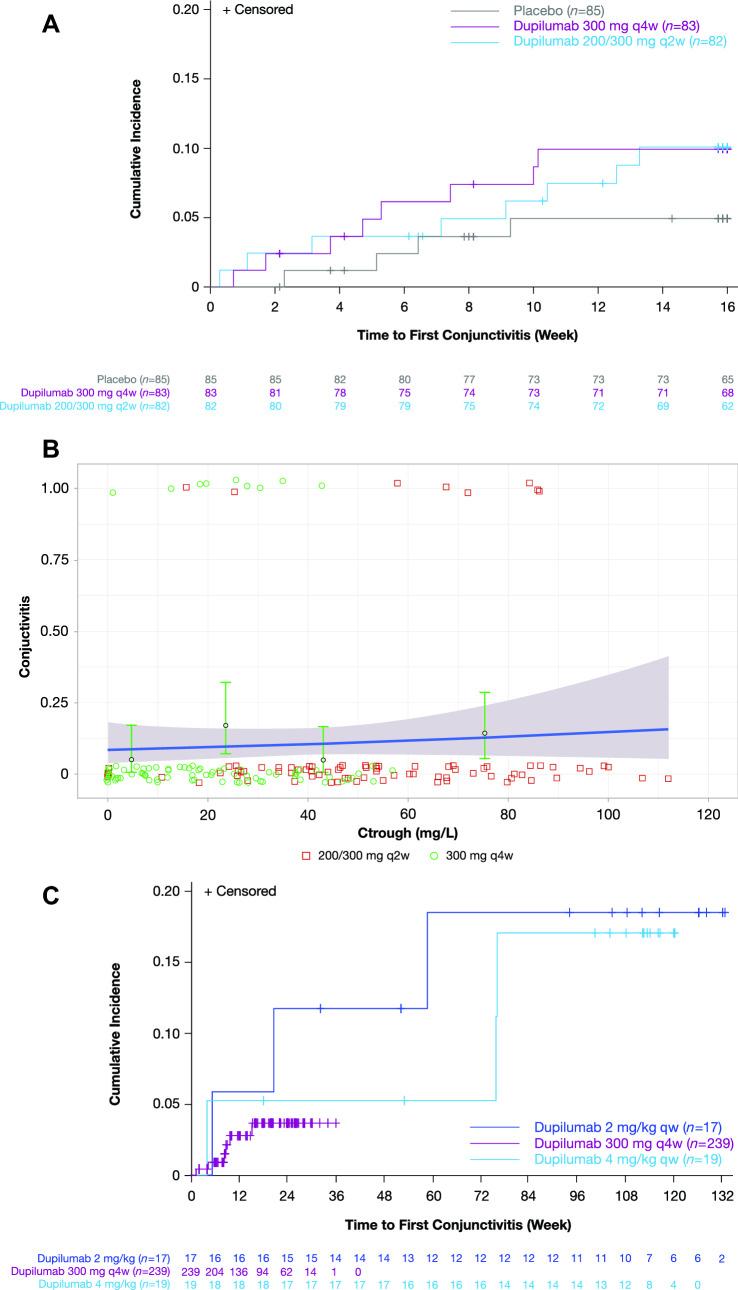
We evaluated the incidence of conjunctivitis in adolescents (aged 12 to < 18 years) in three phase III trials. Ocular events were diagnosed and treated based on patient-reported symptoms and an external eye examination by study investigators, in most cases without an ophthalmologic referral. In LIBERTY AD ADOL (16-week, randomized, placebo-controlled, double-blinded trial), adolescents with moderate-to-severe atopic dermatitis were randomized to subcutaneous placebo, dupilumab 300 mg every 4 weeks, or dupilumab every 2 weeks (200 mg, patients < 60 kg at baseline; 300 mg, ≥ 60 kg at baseline). In LIBERTY AD PED-OLE (open-label extension), pediatric patients from previous dupilumab atopic dermatitis trials received dupilumab 2 mg/kg or 4 mg/kg weekly (up to 300 mg) or 300 mg every 4 weeks. In LIBERTY ASTHMA QUEST (randomized, double-blinded, placebo-controlled trial), patients with uncontrolled moderate-to-severe asthma were randomized to 52 weeks of add-on therapy with dupilumab 200 or 300 mg every 2 weeks or matched-volume placebo.
RESULTS
In ADOL, more dupilumab-treated (17/165; 10.3%) than placebo-treated patients (4/85; 4.7%) reported one or more conjunctivitis event. All events were mild to moderate in severity; 12 (7.3%) dupilumab-treated and 4 (4.7%) placebo-treated patients received treatment. Most patients with conjunctivitis (dupilumab, 12/17; placebo, 4/4) recovered/resolved during the treatment period. The risk of conjunctivitis showed no relationship with dupilumab serum concentration. In PED-OLE, 12/275 adolescents (4.4%) reported one or more conjunctivitis event. Most conjunctivitis events were mild to moderate. Ten patients received treatment for conjunctivitis. Ten patients recovered/resolved during the study. In QUEST, similar low proportions of dupilumab-treated (2/68, 2.9%) and placebo-treated (1/39, 2.6%) adolescents reported one or more conjunctivitis event. All events were mild to moderate. One dupilumab-treated patient received treatment for conjunctivitis. All cases recovered/resolved during the study. No patients in these trials discontinued study treatment temporarily or permanently because of conjunctivitis. In ADOL, one case of unspecified viral keratitis (specific viral etiology not known) in the dupilumab 300-mg every 4 weeks group and one case of allergic blepharitis in the placebo group were reported; both events resolved during the treatment period, and neither led to treatment discontinuation.
CONCLUSIONS
Dupilumab-treated adolescents in atopic dermatitis trials had a higher incidence of conjunctivitis than placebo-treated patients, whereas overall rates of conjunctivitis among adolescents in the asthma trial were lower than in atopic dermatitis trials and were similar for dupilumab- and placebo-treated patients. Most events were mild to moderate, most recovered/resolved, and none prompted study withdrawal. These results are similar to those reported in adult trials and support a drug-disease interaction. CLINICALTRIALS.
GOV IDENTIFIERS
NCT03054428, NCT02612454, NCT02414854. Conjunctivitis in Dupilumab Clinical Trials for Adolescents with Atopic Dermatitis or Asthma (MP4 18453 kb).
背景
结膜炎是特应性皮炎的已知合并症。在成人中度至重度特应性皮炎的度普利尤单抗临床试验中,与安慰剂治疗组相比,度普利尤单抗治疗组的结膜炎发病率更高,而在未控制的哮喘试验中,度普利尤单抗和安慰剂治疗组的发病率均较低。
目的
本研究旨在评估中度至重度特应性皮炎或未控制的哮喘青少年的度普利尤单抗临床试验中结膜炎的发生率和严重程度。
方法
我们评估了三项三期临床试验中青少年(年龄 12 至<18 岁)结膜炎的发生率。眼部事件根据患者报告的症状和研究人员进行的外部眼部检查进行诊断和治疗,在大多数情况下无需眼科转诊。在 LIBERTY AD ADOL(16 周,随机,安慰剂对照,双盲试验)中,中度至重度特应性皮炎患者被随机分为皮下安慰剂、度普利尤单抗 300mg 每四周一次或每两周一次(200mg,基线时<60kg 的患者;300mg,基线时≥60kg 的患者)。在 LIBERTY AD PED-OLE(开放标签扩展)中,来自先前度普利尤单抗特应性皮炎试验的儿科患者接受度普利尤单抗 2mg/kg 或 4mg/kg 每周(最高 300mg)或每四周 300mg。在 LIBERTY ASTHMA QUEST(随机,双盲,安慰剂对照试验)中,未控制的中度至重度哮喘患者被随机分配接受 52 周的附加治疗,每日两次给予度普利尤单抗 200 或 300mg 或匹配体积的安慰剂。
结果
在 ADOL 中,与安慰剂治疗组(4/85;4.7%)相比,更多的度普利尤单抗治疗组(17/165;10.3%)患者报告了一个或多个结膜炎事件。所有事件均为轻度至中度严重程度;12(7.3%)例度普利尤单抗治疗组和 4(4.7%)例安慰剂治疗组患者接受了治疗。大多数结膜炎患者(度普利尤单抗,12/17;安慰剂,4/4)在治疗期间恢复/缓解。结膜炎的风险与度普利尤单抗的血清浓度没有关系。在 PED-OLE 中,12/275 名青少年(4.4%)报告了一个或多个结膜炎事件。大多数结膜炎事件为轻度至中度。10 名患者接受了结膜炎治疗。10 名患者在研究期间恢复/缓解。在 QUEST 中,接受度普利尤单抗治疗的青少年(2/68,2.9%)和安慰剂治疗的青少年(1/39,2.6%)报告了一个或多个结膜炎事件的比例相似。所有事件均为轻度至中度。一名度普利尤单抗治疗组患者接受了结膜炎治疗。所有病例在研究期间恢复/缓解。这些试验中没有患者因结膜炎而暂时或永久停止研究治疗。在 ADOL 中,报告了度普利尤单抗 300mg 每四周组一例未特指的病毒性角膜炎(具体病毒病因不明)和安慰剂组一例过敏性睑缘炎;所有事件均在治疗期间缓解,均未导致治疗中断。
结论
在特应性皮炎试验中,接受度普利尤单抗治疗的青少年结膜炎发病率高于安慰剂治疗组,而在哮喘试验中,青少年结膜炎的总体发生率低于特应性皮炎试验,且度普利尤单抗治疗组和安慰剂治疗组的发生率相似。大多数事件为轻度至中度,大多数患者恢复/缓解,无患者因结膜炎退出研究。这些结果与成人试验报告的结果相似,支持药物-疾病相互作用。临床试验。
政府标识符
NCT03054428、NCT02612454、NCT02414854。特应性皮炎或哮喘青少年度普利尤单抗临床试验中的结膜炎(MP4 18453 kb)。
 Zotero 插件