
利用紫外线辐射或硫酸肥料处理灌溉水以减少新鲜农产品中普通大肠杆菌的效果:一项对照干预试验。
The effectiveness of treating irrigation water using ultraviolet radiation or sulphuric acid fertilizer for reducing generic Escherichia coli on fresh produce-a controlled intervention trial.
机构信息
Department of Population Medicine and Diagnostic Sciences, College of Veterinary Medicine, Cornell University, Ithaca, NY, USA.
Comparative Pathobiology Department, College of Veterinary Medicine, Purdue University, West Lafayette, IN, USA.
出版信息
J Appl Microbiol. 2021 Sep;131(3):1360-1377. doi: 10.1111/jam.15011. Epub 2021 Feb 17.
AIMS
The aims of this study were to: (i) estimate the effectiveness of ultraviolet radiation (UV) and sulphuric acid-based fertilizer (SA), at reducing levels of generic Escherichia coli in surface irrigation water and on produce and surface soil in open produce fields; and (ii) describe the population dynamics of generic E. coli in produce fields.
METHODS AND RESULTS
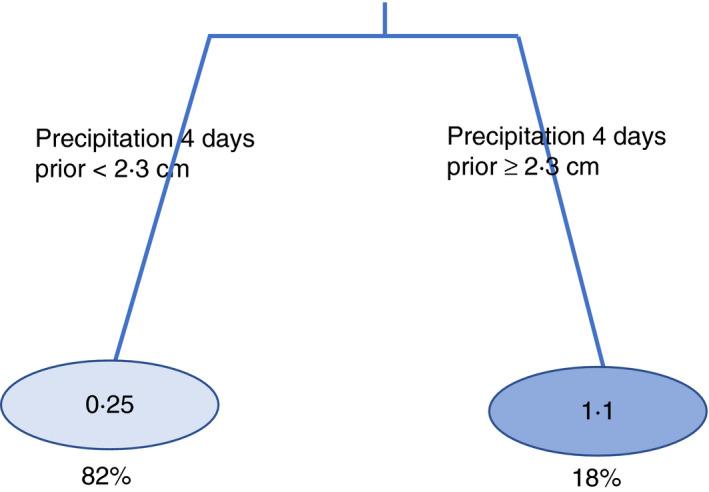
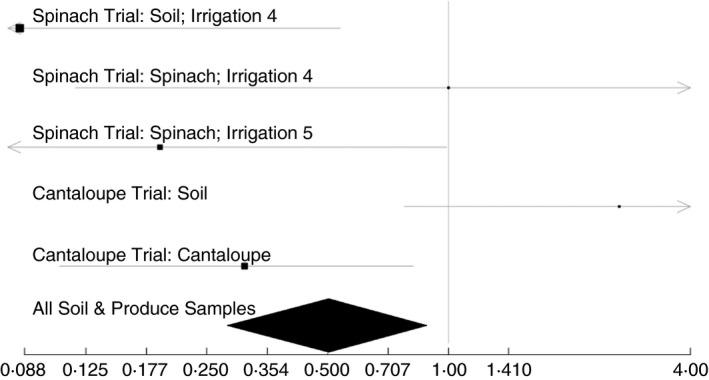
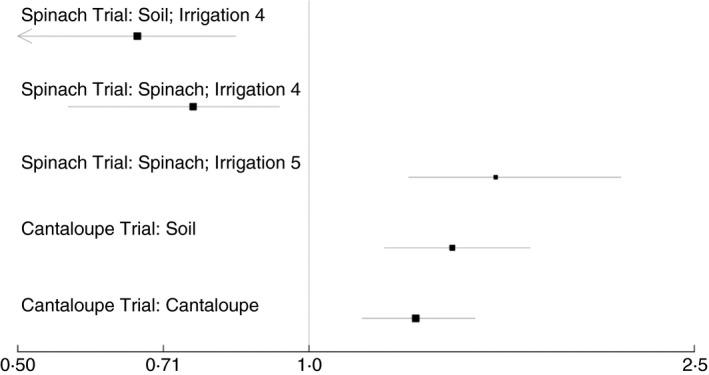
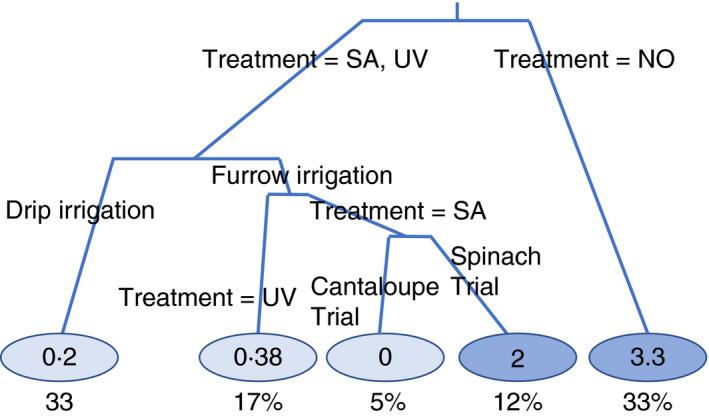
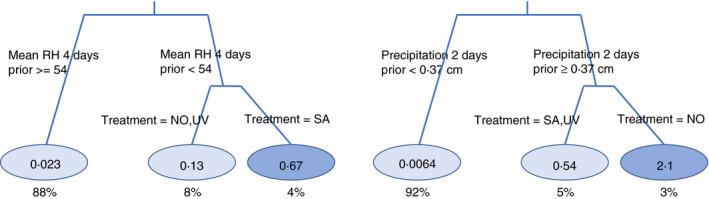
Spinach and cantaloupe plots were randomly assigned to control, UV or SA treatment groups. Irrigation water was inoculated with Rifampicin-resistant E. coli prior to treatment. More than 75% of UV- and SA-treated tank water samples had counts below the detection limit, compared to a mean count of 3·3 Log CFU per ml before treatment. Levels of Rifampicin-resistant E. coli in soil and produce both increased and decreased over 10-15 days after irrigation, depending on the plot and time-period.
CONCLUSIONS
UV and SA treatments effectively reduce the levels of E. coli in surface irrigation water. Their effectiveness at reducing contamination on produce was dependent on environmental conditions. Applying wait-times after irrigation and prior to harvest is not a reliable means of mitigating against contaminated produce.
SIGNIFICANCE AND IMPACT OF THE STUDY
The results are of timely importance for the agricultural industry as new FSMA guidelines require producers to demonstrate a low microbial load in irrigation water or allow producers to apply a wait-time to mitigate the risk of contaminated produce.
目的
本研究旨在:(i)评估紫外线(UV)和硫酸基肥料(SA)在降低表面灌溉水中以及开放种植地中作物和表面土壤中普通大肠杆菌水平的有效性;(ii)描述生产地中普通大肠杆菌的种群动态。
方法和结果
菠菜和哈密瓜田块被随机分配到对照组、UV 处理组或 SA 处理组。在处理前,用 Rifampicin 抗性大肠杆菌对灌溉水进行接种。与处理前每毫升 3.3 Log CFU 的平均计数相比,超过 75%的经 UV 和 SA 处理的水箱水样的计数低于检测限。土壤和作物中 Rifampicin 抗性大肠杆菌的水平在灌溉后 10-15 天内增加和减少,具体取决于田块和时间段。
结论
UV 和 SA 处理可有效降低表面灌溉水中大肠杆菌的水平。它们在降低作物污染方面的有效性取决于环境条件。在灌溉后和收获前等待一段时间并不是减轻污染作物风险的可靠方法。
研究的意义和影响
由于新的 FSMA 指南要求生产者证明灌溉水中的微生物负荷较低,或者允许生产者等待一段时间以减轻污染作物的风险,因此本研究结果具有及时性。



 Zotero 插件