
新冠疫情期间基于网络的团体正念训练对新加坡压力和睡眠质量的影响:回顾性等效性分析
Effects of Web-Based Group Mindfulness Training on Stress and Sleep Quality in Singapore During the COVID-19 Pandemic: Retrospective Equivalence Analysis.
作者信息
Lim Julian, Leow Zaven, Ong Jason, Pang Ly-Shan, Lim Eric
机构信息
Centre for Sleep and Cognition, Yong Loo Lin School of Medicine, National University of Singapore, Singapore, Singapore.
Department of Neurology, Center for Circadian and Sleep Medicine, Northwestern University Feinberg School of Medicine, Evanston, ID, United States.
出版信息
JMIR Ment Health. 2021 Mar 15;8(3):e21757. doi: 10.2196/21757.
BACKGROUND
The COVID-19 pandemic has negatively impacted psychological health. Mindfulness training, which helps individuals attend to the present moment with a nonjudgmental attitude, improves sleep and reduces stress during regular times. Mindfulness training may also be relevant to the mitigation of harmful health consequences during acute crises. However, certain restrictions may necessitate the web-based delivery of mindfulness training (ie, rather than in-person group training settings).
OBJECTIVE
The objective of our study was to examine the effects of mindfulness interventions during the COVID-19 pandemic and to evaluate the effectiveness of web-based interventions.
METHODS
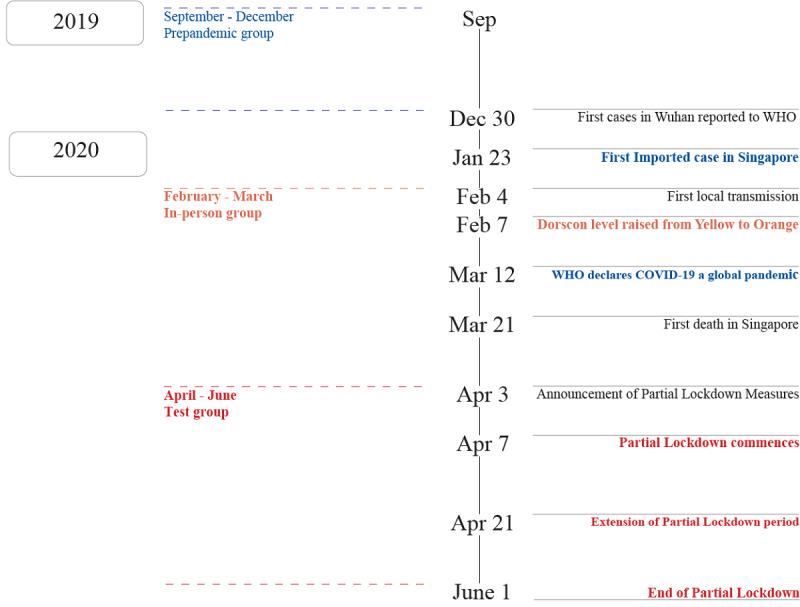
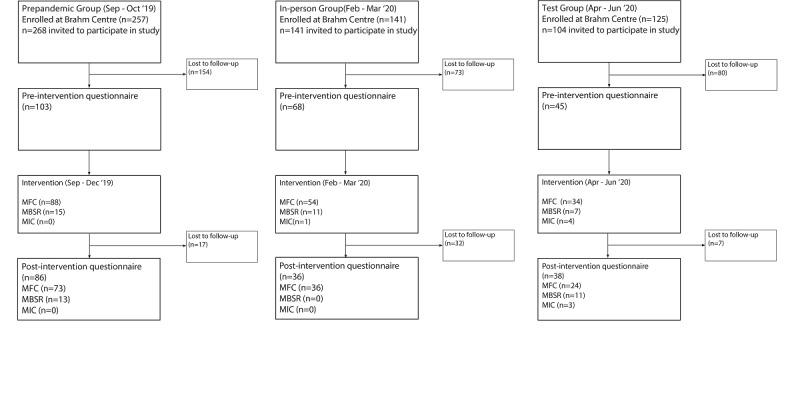
Data from an ongoing study were used for this retrospective equivalence analysis. Recruited participants were enrollees from mindfulness courses at a local charity organization that promoted mental wellness. This study had no exclusion criteria. We created three groups; two groups received their training during the COVID-19 pandemic (in-person training group: n=36; videoconferencing group: n=38), and a second control group included participants who were trained before the pandemic (n=86). Our primary outcomes were self-reported stress and sleep quality. Baseline levels and changes in these variables due to mindfulness training were compared among the groups via an analysis of covariance test and two one-tailed t tests.
RESULTS
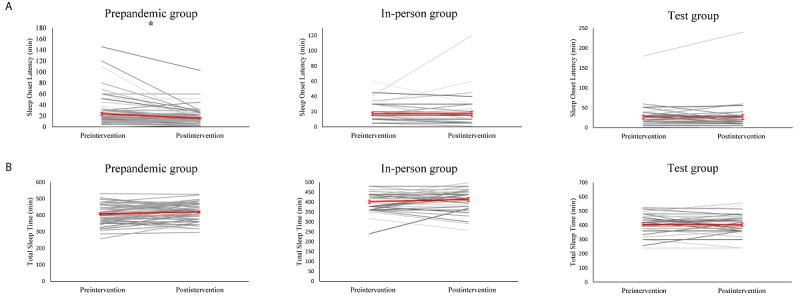
Baseline perceived stress (P=.50) and sleep quality (P=.22) did not differ significantly among the three groups. Mindfulness training significantly reduced stress in all three groups (P<.001), and this effect was statistically significant when comparing videoconferencing to in-person training (P=.002). Sleep quality improved significantly in the prepandemic training group (P<.001). However, sleep quality did not improve in the groups that received training during the pandemic. Participants reported that they required shorter times to initiate sleep following prepandemic mindfulness training (P<.001), but this was not true for those who received training during the pandemic. Course attendance was high and equivalent across the videoconferencing and comparison groups (P=.02), and participants in the videoconferencing group engaged in marginally more daily practice than the in-person training group.
CONCLUSIONS
Web-based mindfulness training via videoconferencing may be a useful intervention for reducing stress during times when traditional, in-person training is not feasible. However, it may not be useful for improving sleep quality.
背景
新型冠状病毒肺炎(COVID-19)大流行对心理健康产生了负面影响。正念训练可帮助个体以无评判的态度关注当下,在正常时期能改善睡眠并减轻压力。正念训练在缓解急性危机期间的有害健康后果方面可能也具有相关性。然而,某些限制可能使得有必要通过网络进行正念训练(即,而非面对面的团体训练形式)。
目的
我们研究的目的是检验COVID-19大流行期间正念干预的效果,并评估基于网络的干预措施的有效性。
方法
来自一项正在进行的研究的数据用于此次回顾性等效性分析。招募的参与者是当地一个促进心理健康的慈善组织的正念课程学员。本研究没有排除标准。我们创建了三组;两组在COVID-19大流行期间接受训练(面对面训练组:n = 36;视频会议组:n = 38),另一个对照组包括在大流行之前接受训练的参与者(n = 86)。我们的主要结局是自我报告的压力和睡眠质量。通过协方差分析检验和两个单尾t检验比较了各组之间这些变量的基线水平以及因正念训练导致的变化。
结果
三组之间的基线感知压力(P = 0.50)和睡眠质量(P = 0.22)无显著差异。正念训练在所有三组中均显著降低了压力(P < 0.001),并且在比较视频会议组和面对面训练组时,这种效果具有统计学意义(P = 0.002)。大流行前训练组的睡眠质量显著改善(P < 0.001)。然而,在大流行期间接受训练的组中睡眠质量并未改善。参与者报告称,在接受大流行前的正念训练后,他们开始入睡所需的时间缩短(P < 0.001),但对于在大流行期间接受训练的人来说并非如此。视频会议组和对照组的课程出勤率都很高且相当(P = 0.02),视频会议组的参与者每天的练习量略多于面对面训练组。
结论
在传统的面对面训练不可行时,通过视频会议进行基于网络的正念训练可能是一种减轻压力的有效干预措施。然而,它可能对改善睡眠质量没有帮助。


 Zotero 插件