
血管紧张素受体阻滞剂对癌症发展的影响:韩国全国队列研究。
Effect of angiotensin receptor blockers on the development of cancer: A nationwide cohort study in korea.
机构信息
Cardiovascular Center, Dongtan Sacred Heart Hospital, Hallym University College of Medicine, Hwaseong, Republic of Korea.
Division of Cardiology, Department of Internal Medicine, Chungbuk National University College of Medicine, Cheongju, Republic of Korea.
出版信息
J Clin Hypertens (Greenwich). 2021 Apr;23(4):879-887. doi: 10.1111/jch.14187. Epub 2021 Jan 25.
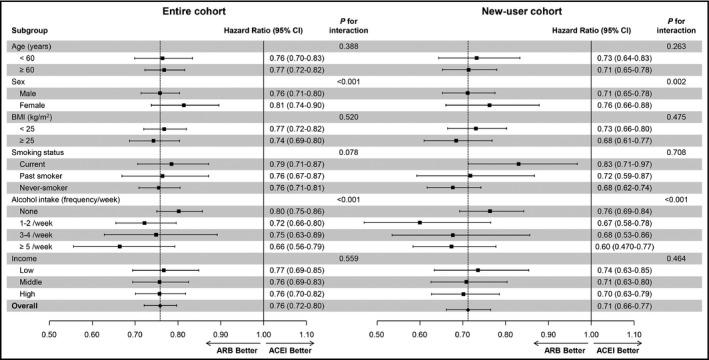
The potential cancer risk associated with long-term exposure to angiotensin receptor blockers (ARBs) is still unclear. We assessed the risk of incident cancer among hypertensive patients who were treated with ARBs compared with patients exposed to angiotensin-converting enzyme inhibitors (ACEIs), which are known to have a neutral effect on cancer development. Using the Korean National Health Insurance Service database, we analyzed the data of patients diagnosed with essential hypertension from January 2005 to December 2012 who were aged ≥40 years, initially free of cancer, and were prescribed either ACEI or ARB (n = 293,962). Cox proportional hazard model adjusted for covariates was used to evaluate the risk of incident cancer. During a mean follow-up of 10 years, 24,610 incident cancers were observed. ARB use was associated with a decreased risk of overall cancer compared with ACEI use (hazard ratio [HR] 0.76, 95% confidence interval [CI] 0.72-0.80). Similar results were obtained for lung (HR 0.73, 95% CI 0.64-0.82), hepatic (HR 0.56, 95% CI 0.48-0.65), and gastric cancers (HR 0.74, 95% CI 0.66-0.83). Regardless of the subgroup, greater reduction of cancer risk was seen among patients treated with ARB than that among patients treated with ACEIs. Particularly, the decreased risk of cancer among ARB users was more prominent among males and heavy drinkers (interaction P < .005). Dose-response analyses demonstrated a gradual decrease in risk with prolonged ARB therapy than that with ACEI use. In conclusion, ARB use was associated with a decreased risk of overall cancer and several site-specific cancers.
长期暴露于血管紧张素受体阻滞剂(ARBs)与癌症风险相关,但其具体风险尚不清楚。我们评估了高血压患者使用 ARB 与使用血管紧张素转换酶抑制剂(ACEI)治疗的癌症发病风险,ACEI 已知对癌症发展无影响。利用韩国国家健康保险服务数据库,我们分析了 2005 年 1 月至 2012 年 12 月期间年龄≥40 岁、初诊为原发性高血压、未患有癌症且接受 ACEI 或 ARB 治疗(n=293962)患者的数据。采用协变量调整的 Cox 比例风险模型评估癌症发病风险。平均随访 10 年后,共观察到 24610 例癌症发病。与 ACEI 相比,ARB 治疗与整体癌症风险降低相关(风险比 [HR] 0.76,95%置信区间 [CI] 0.72-0.80)。对于肺癌(HR 0.73,95% CI 0.64-0.82)、肝癌(HR 0.56,95% CI 0.48-0.65)和胃癌(HR 0.74,95% CI 0.66-0.83)也观察到了相似的结果。无论亚组如何,ARB 治疗患者的癌症风险降低程度均大于 ACEI 治疗患者。特别是,ARB 使用者的癌症风险降低在男性和重度饮酒者中更为明显(交互 P<.005)。剂量反应分析表明,ARB 治疗的风险降低程度随治疗时间的延长而逐渐增加,而 ACEI 治疗则无此趋势。总之,ARB 治疗与整体癌症及几种特定部位癌症风险降低相关。
 Zotero 插件