
严重急性呼吸综合征冠状病毒 2 抗体在孕妇及其新生儿中的水平。
Severe acute respiratory syndrome coronavirus 2 serology levels in pregnant women and their neonates.
机构信息
Department of Pathology and Laboratory Medicine, Weill Cornell Medicine, New York, NY; New York-Presbyterian Hospital, Weill Cornell Medicine, New York, NY.
Laboratory of Molecular Neuro-Oncology, The Rockefeller University, New York, NY.
出版信息
Am J Obstet Gynecol. 2021 Jul;225(1):73.e1-73.e7. doi: 10.1016/j.ajog.2021.01.016. Epub 2021 Jan 23.
BACKGROUND
Pregnant women and their neonates represent 2 vulnerable populations with an interdependent immune system that are highly susceptible to viral infections. The immune response of pregnant women to severe acute respiratory syndrome coronavirus 2 and the interplay of how the maternal immune response affects the neonatal passive immunity have not been studied systematically.
OBJECTIVE
We characterized the serologic response in pregnant women and studied how this serologic response correlates with the maternal clinical presentation and with the rate and level of passive immunity that the neonate received from the mother.
STUDY DESIGN
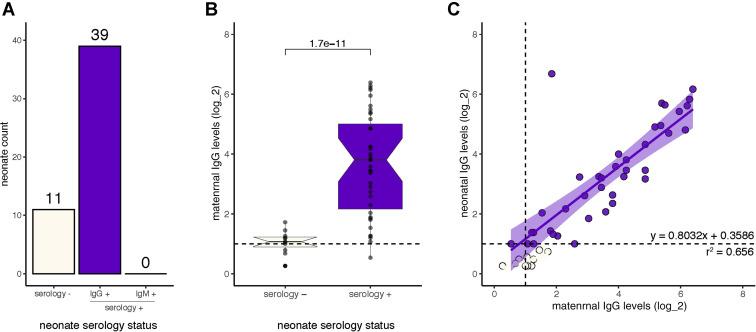
Women who gave birth and who tested positive for immunoglobulin M or immunoglobulin G against severe acute respiratory syndrome coronavirus 2 using semiquantitative detection in a New York City hospital between March 22, 2020, and May 31, 2020, were included in this study. A retrospective chart review of the cases that met the inclusion criteria was conducted to determine the presence of coronavirus disease 2019 symptoms and the use of oxygen support. Serology levels were compared between the symptomatic and asymptomatic patients using a Welch 2 sample t test. Further chart review of the same patient cohort was conducted to identify the dates of self-reported onset of coronavirus disease 2019 symptoms and the timing of the peak immunoglobulin M and immunoglobulin G antibody levels after symptom onset was visualized using local polynomial regression smoothing on log-scaled serologic values. To study the neonatal serology response, umbilical cord blood samples of the neonates born to the subset of serology positive pregnant women were tested for serologic antibody responses. The maternal antibody levels of serology positive vs the maternal antibody levels of serology negative neonates were compared using the Welch 2 sample t test. The relationship between the quantitative maternal and quantitative neonatal serologic data was studied using a Pearson correlation and linear regression. A multiple linear regression analysis was conducted using maternal symptoms, maternal serology levels, and maternal use of oxygen support to determine the predictors of neonatal immunoglobulin G levels.
RESULTS
A total of 88 serology positive pregnant women were included in this study. The antibody levels were higher in symptomatic pregnant women than in asymptomatic pregnant women. Serology studies in 34 women with symptom onset data revealed that the maternal immunoglobulin M and immunoglobulin G levels peak around 15 and 30 days after the onset of coronavirus disease 2019 symptoms, respectively. Furthermore, studies of 50 neonates born to this subset of serology positive women showed that passive immunity in the form of immunoglobulin G is conferred in 78% of all neonates. The presence of passive immunity is dependent on the maternal antibody levels, and the levels of neonatal immunoglobulin G correlate with maternal immunoglobulin G levels. The maternal immunoglobulin G levels and maternal use of oxygen support were predictive of the neonatal immunoglobulin G levels.
CONCLUSION
We demonstrated that maternal serologies correlate with symptomatic maternal infection, and higher levels of maternal antibodies are associated with passive neonatal immunity. The maternal immunoglobulin G levels and maternal use of oxygen support, a marker of disease severity, predicted the neonatal immunoglobulin G levels. These data will further guide the screening for this uniquely linked population of mothers and their neonates and can aid in developing maternal vaccination strategies.
背景
孕妇及其新生儿代表了两个易受病毒感染的脆弱群体,他们的免疫系统相互依存。孕妇对严重急性呼吸综合征冠状病毒 2 的免疫反应以及母体免疫反应如何影响新生儿被动免疫的相互作用尚未得到系统研究。
目的
我们描述了孕妇的血清学反应,并研究了这种血清学反应与母体临床表现以及新生儿从母体获得的被动免疫的速度和水平如何相关。
研究设计
本研究纳入了 2020 年 3 月 22 日至 2020 年 5 月 31 日期间在纽约市一家医院使用半定量检测方法检测到针对严重急性呼吸综合征冠状病毒 2 的免疫球蛋白 M 或免疫球蛋白 G 呈阳性的分娩妇女。通过回顾病历确定符合纳入标准的病例中是否存在 2019 年冠状病毒病的症状和使用氧气支持的情况。使用 Welch 2 样本 t 检验比较有症状和无症状患者的血清学水平。对同一患者队列进行进一步的病历回顾,以确定自我报告的 2019 年冠状病毒病症状出现日期以及症状出现后免疫球蛋白 M 和免疫球蛋白 G 抗体水平的峰值,通过对对数标度的血清学值进行局部多项式回归平滑来可视化。为了研究新生儿的血清学反应,对血清学阳性孕妇中部分新生儿的脐带血样本进行了血清学抗体反应检测。使用 Welch 2 样本 t 检验比较了血清学阳性母亲的抗体水平与血清学阴性母亲的抗体水平。使用 Pearson 相关和线性回归研究了定量母体和定量新生儿血清学数据之间的关系。使用多元线性回归分析,考虑了母体症状、母体血清学水平和母体使用氧气支持等因素,以确定新生儿免疫球蛋白 G 水平的预测因素。
结果
本研究共纳入 88 例血清学阳性孕妇。有症状孕妇的抗体水平高于无症状孕妇。对有症状出现数据的 34 名妇女进行的血清学研究表明,母体免疫球蛋白 M 和免疫球蛋白 G 水平分别在冠状病毒病 2019 症状出现后约 15 天和 30 天达到峰值。此外,对这部分血清学阳性妇女的 50 名新生儿进行的研究表明,以免疫球蛋白 G 形式存在的被动免疫在所有新生儿中占 78%。被动免疫的存在取决于母体抗体水平,新生儿免疫球蛋白 G 水平与母体免疫球蛋白 G 水平相关。母体免疫球蛋白 G 水平和母体使用氧气支持是新生儿免疫球蛋白 G 水平的预测因素。
结论
我们证明了母体血清学与有症状的母体感染相关,较高的母体抗体水平与新生儿被动免疫相关。母体免疫球蛋白 G 水平和母体使用氧气支持(疾病严重程度的标志物)可预测新生儿免疫球蛋白 G 水平。这些数据将进一步指导对这一独特的母婴群体的筛查,并有助于制定母体疫苗接种策略。


 Zotero 插件