
通过使用仿生机器人对地表和洞穴鱼类在光照和黑暗条件下社会行为的洞察
Insights into the Social Behavior of Surface and Cave-Dwelling Fish () in Light and Darkness through the Use of a Biomimetic Robot.
作者信息
Bierbach David, Lukas Juliane, Bergmann Anja, Elsner Kristiane, Höhne Leander, Weber Christiane, Weimar Nils, Arias-Rodriguez Lenin, Mönck Hauke J, Nguyen Hai, Romanczuk Pawel, Landgraf Tim, Krause Jens
机构信息
Humboldt-Universität zu Berlin, bologna.lab, Q-Team Programm, Berlin, Germany.
Department of Biology and Ecology of Fishes, Leibniz-Institute of Freshwater Ecology and Inland Fisheries, Berlin, Germany.
出版信息
Front Robot AI. 2018 Feb 5;5:3. doi: 10.3389/frobt.2018.00003. eCollection 2018.
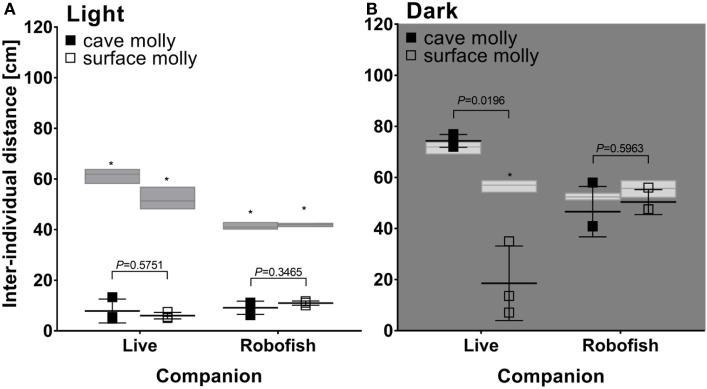
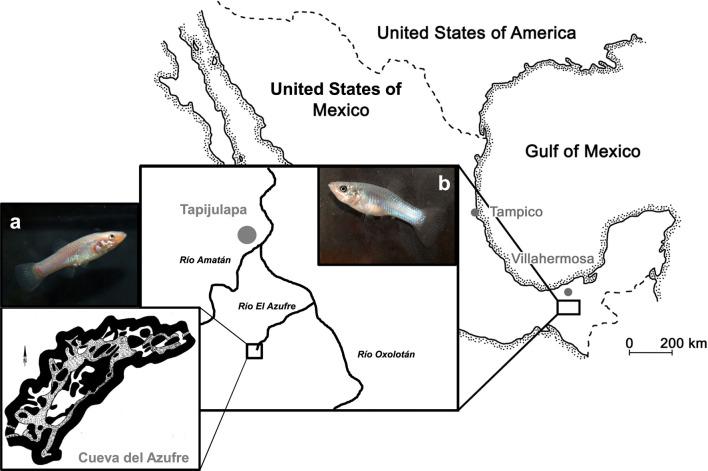
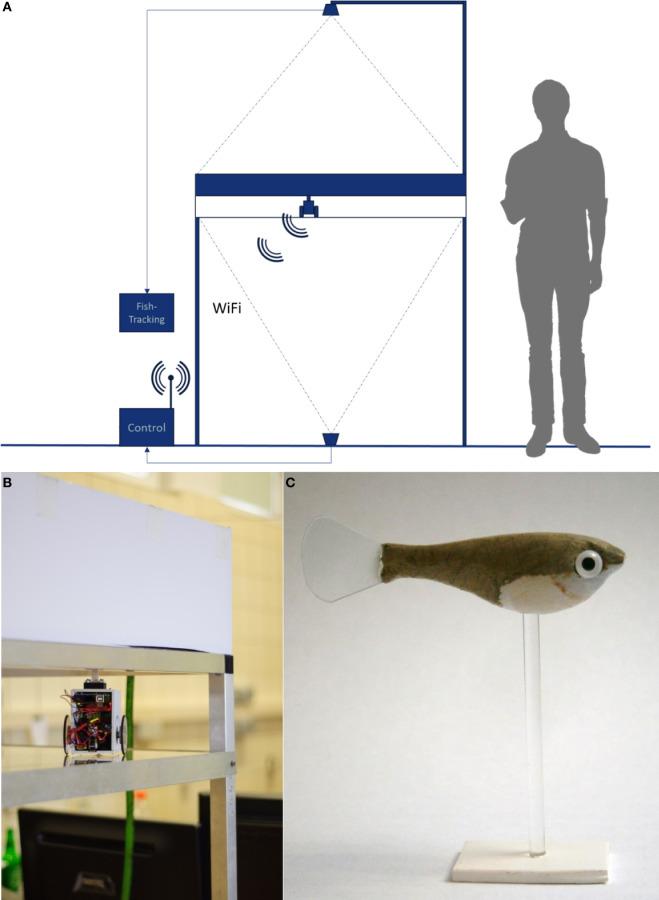
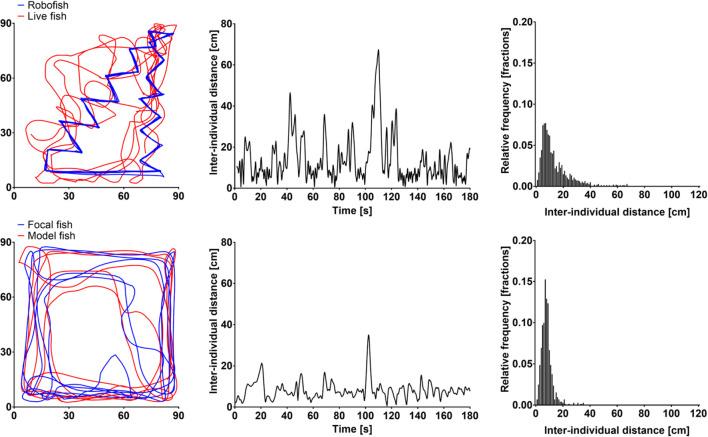
Biomimetic robots (BRs) are becoming more common in behavioral research and, if they are accepted as conspecifics, allow for new forms of experimental manipulations of social interactions. Nevertheless, it is often not clear which cues emanating from a BR are actually used as communicative signals and how species or populations with different sensory makeups react to specific types of BRs. We herein present results from experiments using two populations of livebearing fishes that differ in their sensory capabilities. In the South of Mexico, surface-dwelling mollies () successfully invaded caves and adapted to dark conditions. While almost without pigment, these cave mollies possess smaller but still functional eyes. Although previous studies found cave mollies to show reduced shoaling preferences with conspecifics in light compared to surface mollies, it is assumed that they possess specialized adaptations to maintain some kind of sociality also in their dark habitats. By testing surface- and cave-dwelling mollies with RoboFish, a BR made for use in laboratory experiments with guppies and sticklebacks, we asked to what extent visual and non-visual cues play a role in their social behavior. Both cave- and surface-dwelling mollies followed the BR as well as a live companion when tested in light. However, when tested in darkness, only surface-dwelling fish were attracted by a live conspecific, whereas cave-dwelling fish were not. Neither cave- nor surface-dwelling mollies were attracted to RoboFish in darkness. This is the first study to use BRs for the investigation of social behavior in mollies and to compare responses to BRs both in light and darkness. As our RoboFish is accepted as conspecific by both used populations of the Atlantic molly only under light conditions but not in darkness, we argue that our replica is providing mostly visual cues.
仿生机器人(BRs)在行为研究中越来越常见,如果它们被视为同种个体,就可以实现对社会互动的新型实验操纵。然而,通常并不清楚BR发出的哪些线索实际上被用作交流信号,以及具有不同感官构成的物种或种群如何对特定类型的BR做出反应。我们在此展示了使用两种感官能力不同的卵胎生鱼类种群进行实验的结果。在墨西哥南部,生活在水面的帆鳍玛丽鱼()成功入侵洞穴并适应了黑暗环境。这些洞穴帆鳍玛丽鱼几乎没有色素,眼睛较小但仍有功能。尽管先前的研究发现,与水面帆鳍玛丽鱼相比,洞穴帆鳍玛丽鱼在光照下与同种个体的聚群偏好降低,但据推测它们也具有专门的适应性,以便在黑暗栖息地中维持某种社会性。通过用RoboFish测试水面和洞穴中的帆鳍玛丽鱼,RoboFish是一种用于孔雀鱼和棘鱼实验室实验的BR,我们探究了视觉和非视觉线索在它们的社会行为中起到了多大作用。在光照下测试时,洞穴和水面的帆鳍玛丽鱼都跟随BR以及活体同伴。然而,在黑暗中测试时,只有水面的鱼被活体同种个体吸引,而洞穴的鱼则没有。洞穴和水面的帆鳍玛丽鱼在黑暗中都没有被RoboFish吸引。这是第一项使用BRs研究帆鳍玛丽鱼社会行为并比较在光照和黑暗中对BRs反应的研究。由于我们的RoboFish仅在光照条件下被两个使用的大西洋帆鳍玛丽鱼种群视为同种个体,而在黑暗中则不然,我们认为我们的复制品主要提供视觉线索。
 Zotero 插件