
哮喘诊断:进入第四维度。
Asthma diagnosis: into the fourth dimension.
机构信息
Division of Infection, Immunity and Respiratory Medicine, School of Biological Sciences, Faculty of Biology, Medicine and Health, The University of Manchester, Manchester, UK.
Manchester Academic Health Science Centre and NIHR Manchester Biomedical Research Centre, Manchester University NHS Foundation Trust, Manchester, UK.
出版信息
Thorax. 2021 Jun;76(6):624-631. doi: 10.1136/thoraxjnl-2020-216421. Epub 2021 Jan 27.
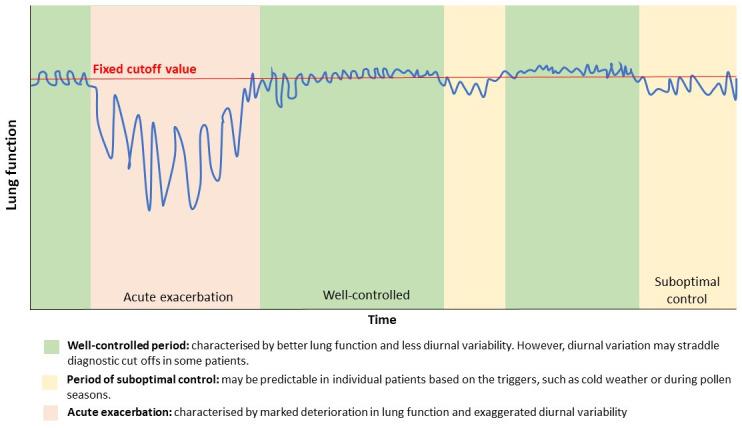
Asthma is the most common chronic respiratory disease in the UK; however, the misdiagnosis rate is substantial. The lack of consistency in national guidelines and the paucity of data on the performance of diagnostic algorithms compound the challenges in asthma diagnosis. Asthma is a highly rhythmic disease, characterised by diurnal variability in clinical symptoms and pathogenesis. Asthma also varies day to day, seasonally and from year to year. As much as it is a hallmark for asthma, this variability also poses significant challenges to asthma diagnosis. Almost all established asthma diagnostic tools demonstrate diurnal variation, yet few are performed with standardised timing of measurements. The dichotomous interpretation of diagnostic outcomes using fixed cut-off values may further limit the accuracy of the tests, particularly when diurnal variability straddles cut-off values within a day, and careful interpretation beyond the 'positive' and 'negative' outcome is needed. The day-to-day and more long-term variations are less predictable and it is unclear whether performing asthma diagnostic tests during asymptomatic periods may influence diagnostic sensitivities. With the evolution of asthma diagnostic tools, home monitoring and digital apps, novel strategies are needed to bridge these gaps in knowledge, and circadian variability should be considered during the standardisation process. This review summarises the biological mechanisms of circadian rhythms in asthma and highlights novel data on the significance of time (the fourth dimension) in asthma diagnosis.
哮喘是英国最常见的慢性呼吸道疾病,但误诊率相当高。国家指南缺乏一致性,以及诊断算法性能的数据不足,使哮喘诊断面临更大的挑战。哮喘是一种高度有节奏的疾病,其临床症状和发病机制具有昼夜变化。哮喘也会每天、季节性和逐年变化。尽管这种可变性是哮喘的一个显著特征,但它也给哮喘诊断带来了重大挑战。几乎所有已确立的哮喘诊断工具都显示出昼夜变化,但很少有工具按照标准化的测量时间进行操作。使用固定的截断值对诊断结果进行二分法解释可能进一步限制测试的准确性,特别是当昼夜变化跨越一天内的截断值时,需要对“阳性”和“阴性”结果进行仔细解释。日常和更长期的变化较难预测,并且尚不清楚在无症状期间进行哮喘诊断测试是否会影响诊断的敏感性。随着哮喘诊断工具的发展,家庭监测和数字应用,需要新的策略来弥补这些知识空白,并且应该在标准化过程中考虑昼夜节律变化。这篇综述总结了哮喘昼夜节律的生物学机制,并强调了时间(第四个维度)在哮喘诊断中的重要性的新数据。

 Zotero 插件