
GJA1 基因多态性的次要等位基因与心房颤动期间的心率升高有关。
Minor allele of GJA1 gene polymorphism is associated with higher heart rate during atrial fibrillation.
机构信息
Division of Frontier Medical Science, Department of Cardiovascular Medicine, Programs for Biomedical Research, Graduate School of Biomedical Science, Hiroshima University, 1-2-3 Kasumi, Minami-ku, Hiroshima, 734-8551, Japan.
Department of Health Management, Hiroshima Red Cross Hospital & Atomic-Bomb Survivors Hospital, Hiroshima, Japan.
出版信息
Sci Rep. 2021 Jan 28;11(1):2549. doi: 10.1038/s41598-021-82117-3.
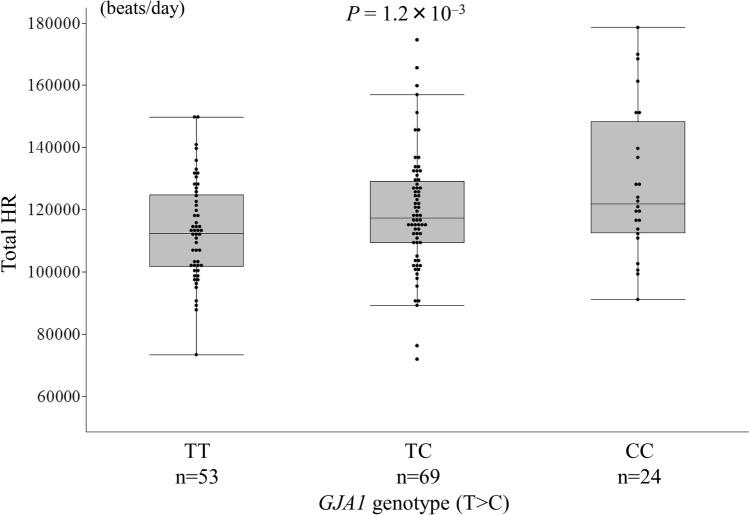
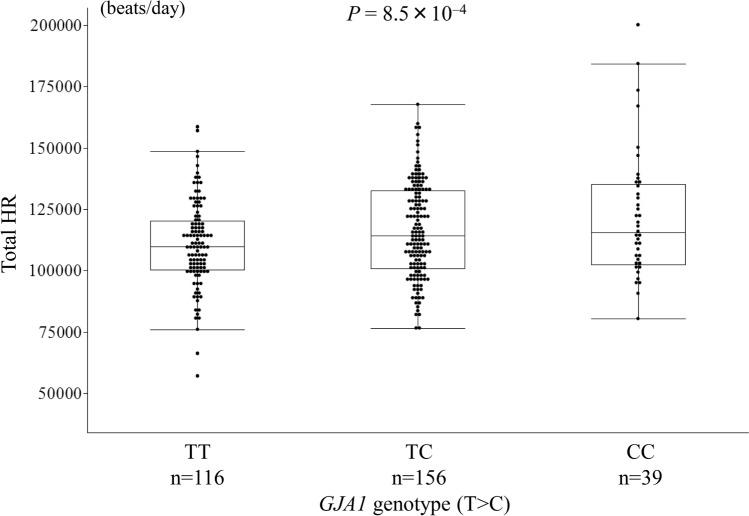
Atrial fibrillation (AF) tachycardia causes heart failure and requires more attention. The genetic background of individual heart rate (HR) variations during AF are unclear. We hypothesized that HR-associated single nucleotide polymorphisms (SNPs) reported in Genome-Wide Association Studies (GWAS) are also associated with HR during AF. We enrolled patients with persistent AF (311 for screening and 146 for replication) who underwent AF ablation and were genotyped for the 21 h-associated SNPs reported in GWAS. The patients underwent 24-h Holter monitoring before AF ablation and electrophysiological study after AF ablation during sinus rhythm. Only the GJA1 SNP rs1015451 (T>C) was significantly associated with total HR (TT 110,643 ± 17,542 beats/day, TC 116,350 ± 19,060 beats/day, CC 122,163 ± 25,684 beats/day, P = 8.5 × 10). We also confirmed this significant association in the replication set. The intra-atrial conduction was faster in AF patients with the GJA1 minor allele than in those without it. Multivariate analysis revealed the presence of a GJA1 SNP rs1015451 additive model, female gender, lower left ventricular ejection fraction, and higher 1:1 atrioventricular nodal conduction were independently associated with higher HR during AF. The GJA1 SNP might be a new genetic marker for AF tachycardia.
心房颤动(AF)性心动过速可导致心力衰竭,因此需要更加关注。目前尚不清楚 AF 期间个体心率(HR)变化的遗传背景。我们假设在全基因组关联研究(GWAS)中报道的与 HR 相关的单核苷酸多态性(SNP)也与 AF 期间的 HR 相关。我们招募了接受持续性 AF 消融的患者(用于筛查的 311 例和用于复制的 146 例),并对 GWAS 中报道的与 21h 相关的 SNP 进行了基因分型。患者在 AF 消融前进行 24 小时 Holter 监测,并在 AF 消融后窦性心律下进行电生理研究。只有 GJA1 SNP rs1015451(T>C)与总 HR(TT 110643±17542 次/天,TC 116350±19060 次/天,CC 122163±25684 次/天,P=8.5×10)显著相关。我们还在复制组中证实了这一显著相关性。与无 GJA1 次要等位基因的 AF 患者相比,GJA1 次要等位基因携带者的心房内传导更快。多变量分析显示,GJA1 SNP rs1015451 加性模型的存在、女性、较低的左心室射血分数以及较高的 1:1 房室结传导与 AF 期间较高的 HR 独立相关。GJA1 SNP 可能是 AF 心动过速的一个新的遗传标志物。
 Zotero 插件