
肿瘤干扰素信号和抑制性髓系细胞与大 B 细胞淋巴瘤中嵌合抗原受体 T 细胞治疗失败相关。
Tumor interferon signaling and suppressive myeloid cells are associated with CAR T-cell failure in large B-cell lymphoma.
机构信息
Department of Blood and Marrow Transplant and Cellular Immunotherapy.
Department of Clinical Science.
出版信息
Blood. 2021 May 13;137(19):2621-2633. doi: 10.1182/blood.2020007445.
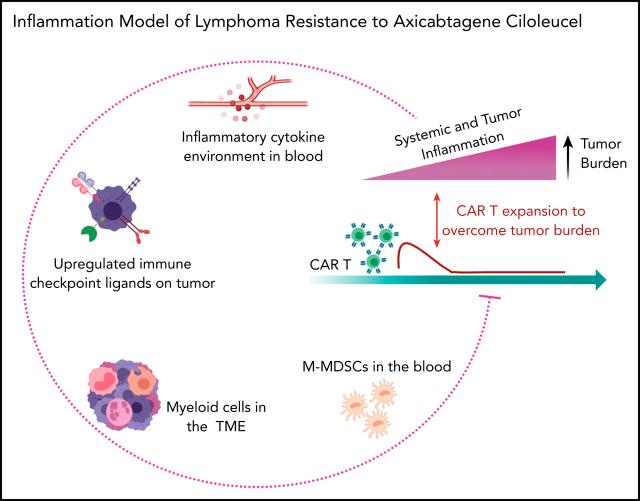
Axicabtagene ciloleucel (axi-cel) is a chimeric antigen receptor (CAR) T-cell therapy for relapsed or refractory large B-cell lymphoma (LBCL). This study evaluated whether immune dysregulation, present before CAR T-cell therapy, was associated with treatment failure. Tumor expression of interferon (IFN) signaling, high blood levels of monocytic myeloid-derived suppressor cells (M-MDSCs), and high blood interleukin-6 and ferritin levels were each associated with a lack of durable response. Similar to other cancers, we found that in LBCL tumors, IFN signaling is associated with the expression of multiple checkpoint ligands, including programmed cell death-ligand 1, and these were higher in patients who lacked durable responses to CAR-T therapy. Moreover, tumor IFN signaling and blood M-MDSCs associated with decreased axi-cel expansion. Finally, patients with high tumor burden had higher immune dysregulation with increased serum inflammatory markers and tumor IFN signaling. These data support that immune dysregulation in LBCL promotes axi-cel resistance via multiple mechanistic programs: insufficient axi-cel expansion associated with both circulating M-MDSC and tumor IFN signaling, which also gives rise to expression of immune checkpoint ligands.
阿基仑赛(axi-cel)是一种嵌合抗原受体(CAR)T 细胞疗法,用于治疗复发或难治性大 B 细胞淋巴瘤(LBCL)。本研究评估了 CAR T 细胞治疗前存在的免疫失调是否与治疗失败相关。肿瘤中干扰素(IFN)信号的表达、血液中单核细胞来源的髓系抑制细胞(M-MDSCs)水平升高、血液中白细胞介素 6 和铁蛋白水平升高,均与缺乏持久反应相关。与其他癌症类似,我们发现 LBCL 肿瘤中的 IFN 信号与多种检查点配体的表达相关,包括程序性细胞死亡配体 1,而这些在对 CAR-T 治疗缺乏持久反应的患者中更高。此外,肿瘤 IFN 信号和血液中的 M-MDSC 与 axi-cel 的扩增减少相关。最后,肿瘤负担较高的患者存在更高的免疫失调,伴有血清炎症标志物和肿瘤 IFN 信号的增加。这些数据支持 LBCL 中的免疫失调通过多种机制促进 axi-cel 耐药:与循环 M-MDSC 和肿瘤 IFN 信号相关的 axi-cel 扩增不足,这也导致免疫检查点配体的表达。
 Zotero 插件