
CLL 家族中亲属的单克隆 B 细胞淋巴细胞增多症的自然史。
Natural history of monoclonal B-cell lymphocytosis among relatives in CLL families.
机构信息
Department of Health Sciences Research, Mayo Clinic, Rochester, MN.
Department of Medicine, Duke University, Duke Cancer Institute, Durham, NC.
出版信息
Blood. 2021 Apr 15;137(15):2046-2056. doi: 10.1182/blood.2020006322.
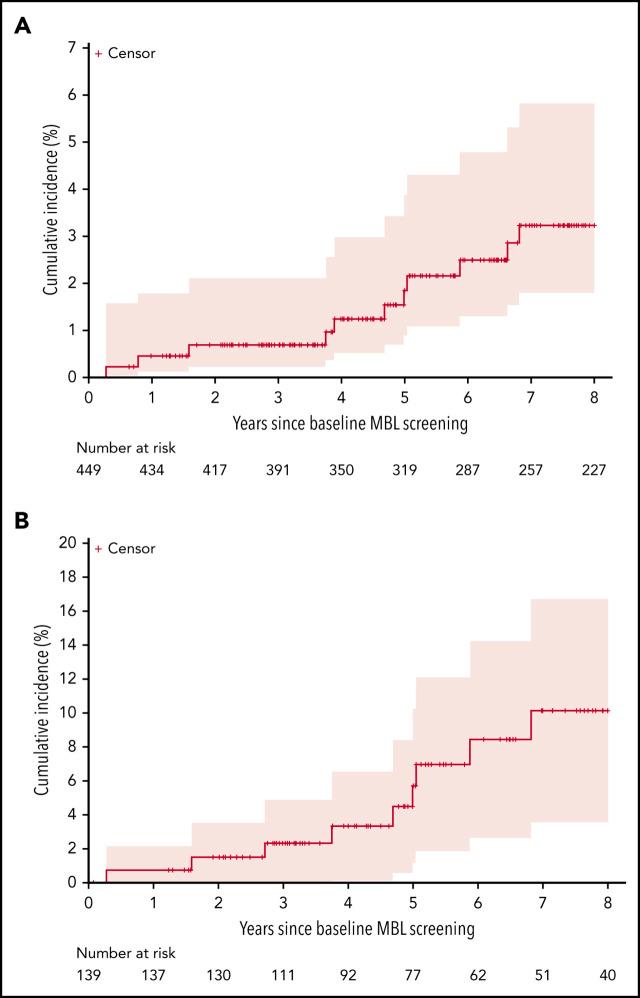
Chronic lymphocytic lymphoma (CLL) has one of the highest familial risks among cancers. Monoclonal B-cell lymphocytosis (MBL), the precursor to CLL, has a higher prevalence (13%-18%) in families with 2 or more members with CLL compared with the general population (5%-12%). Although, the rate of progression to CLL for high-count MBLs (clonal B-cell count ≥500/µL) is ∼1% to 5%/y, no low-count MBLs have been reported to progress to date. We report the incidence and natural history of MBL in relatives from CLL families. In 310 CLL families, we screened 1045 relatives for MBL using highly sensitive flow cytometry and prospectively followed 449 of them. MBL incidence was directly age- and sex-adjusted to the 2010 US population. CLL cumulative incidence was estimated using Kaplan-Meier survival curves. At baseline, the prevalence of MBL was 22% (235/1045 relatives). After a median follow-up of 8.1 years among 449 relatives, 12 individuals progressed to CLL with a 5-year cumulative incidence of 1.8%. When considering just the 139 relatives with low-count MBL, the 5-year cumulative incidence increased to 5.7%. Finally, 264 had no MBL at baseline, of whom 60 individuals subsequently developed MBL (2 high-count and 58 low-count MBLs) with an age- and sex-adjusted incidence of 3.5% after a median of 6 years of follow-up. In a screening cohort of relatives from CLL families, we reported progression from normal-count to low-count MBL to high-count MBL to CLL, demonstrating that low-count MBL precedes progression to CLL. We estimated a 1.1% annual rate of progression from low-count MBL, which is in excess of that in the general population.
慢性淋巴细胞白血病 (CLL) 是癌症中家族遗传风险最高的疾病之一。CLL 的前体——单克隆 B 细胞淋巴增生症 (MBL),在有 2 个或更多 CLL 患者的家族中,其发病率(13%-18%)高于普通人群(5%-12%)。尽管高计数 MBL(克隆性 B 细胞计数≥500/µL)进展为 CLL 的速度约为 1%至 5%/年,但迄今为止尚无低计数 MBL 进展为 CLL 的报道。我们报告了来自 CLL 家族的亲属中 MBL 的发生率和自然史。在 310 个 CLL 家族中,我们使用高度敏感的流式细胞术对 1045 名亲属进行了 MBL 筛查,并前瞻性随访了其中 449 名。MBL 发病率直接根据 2010 年美国人口进行年龄和性别调整。使用 Kaplan-Meier 生存曲线估计 CLL 的累积发病率。在基线时,MBL 的患病率为 22%(1045 名亲属中的 235 名)。在 449 名亲属中,中位随访 8.1 年后,有 12 人进展为 CLL,5 年累积发病率为 1.8%。当仅考虑低计数 MBL 的 139 名亲属时,5 年累积发病率增加到 5.7%。最后,基线时无 MBL 的 264 名亲属中,有 60 名随后发展为 MBL(2 例高计数和 58 例低计数 MBL),在中位随访 6 年后,年龄和性别调整后的发病率为 3.5%。在来自 CLL 家族的亲属筛查队列中,我们报告了从正常计数 MBL 到低计数 MBL 到高计数 MBL 再到 CLL 的进展,表明低计数 MBL 是进展为 CLL 的前兆。我们估计从低计数 MBL 进展的年发生率为 1.1%,高于普通人群。
 Zotero 插件