
地塞米松与脊髓麻醉下剖宫产术后女性的硬膜外穿刺后头痛:一项随机对照试验的系统评价和荟萃分析
Dexamethasone and post-dural puncture headache in women who underwent cesarean delivery under spinal anesthesia: A systemic review and meta-analysis of randomized controlled trials.
作者信息
Fenta Efrem, Kibret Simegnew, Hunie Metages, Teshome Diriba
机构信息
Department of Anesthesia, College of Health Sciences, Debre Tabor University, Debre Tabor, Ethiopia.
出版信息
Ann Med Surg (Lond). 2021 Jan 18;62:104-113. doi: 10.1016/j.amsu.2021.01.024. eCollection 2021 Feb.
BACKGROUND
Post-dural puncture headache is a common complication after spinal anesthesia for women who undergo cesarean delivery. Intravenous (IV) dexamethasone has been used to reduce the incidence and severity of PDPH with controversial results. This Systemic review and meta-analysis aimed to assess the effects of IV dexamethasone on PDPH.
METHODS
This study is reported as per Preferred Reporting Items for Systematic and Meta-analysis. The primary outcome was the incidence and severity of PDPH. The secondary outcome variables were the postoperative total analgesic requirement and incidence of nausea and/or vomiting. Twelve randomized controlled trials with a total of 1548 women were included.
RESULTS
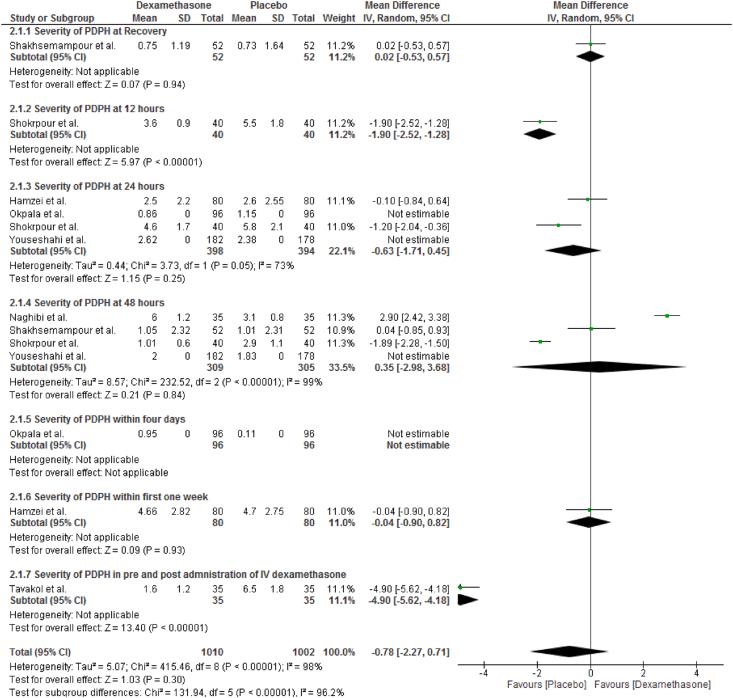
Intravenous (IV) dexamethasone had no effect on the incidence of PDPH (OR = 0.64; CI, 0.39 to 1.05; I = 71%, P = 0.08). Intravenous dexamethasone did not show a significant difference in the incidence of PDPH at 24 h at 48 h, and within one week postoperatively with p-values of less than 0.05. In a random-effect model, a pooled analysis showed that IV dexamethasone had no effect on the severity of PDPH in VAS (MD = 0.78; CI, -2.27 to 0.71; I = 98%, P = 0.30).
CONCLUSION
Intravenous dexamethasone failed to decrease the incidence and severity of PDPH in women who underwent cesarean delivery under spinal anesthesia.
背景
硬膜穿刺后头痛是剖宫产女性脊髓麻醉后常见的并发症。静脉注射地塞米松已被用于降低硬膜穿刺后头痛的发生率和严重程度,但其结果存在争议。本系统评价和荟萃分析旨在评估静脉注射地塞米松对硬膜穿刺后头痛的影响。
方法
本研究按照系统评价和荟萃分析的首选报告项目进行报告。主要结局是硬膜穿刺后头痛的发生率和严重程度。次要结局变量是术后总镇痛需求以及恶心和/或呕吐的发生率。纳入了12项随机对照试验,共1548名女性。
结果
静脉注射地塞米松对硬膜穿刺后头痛的发生率无影响(OR = 0.64;CI,0.39至1.05;I² = 71%,P = 0.08)。静脉注射地塞米松在术后24小时、48小时以及术后一周内硬膜穿刺后头痛的发生率方面未显示出显著差异,P值均小于0.05。在随机效应模型中,汇总分析表明静脉注射地塞米松对视觉模拟量表(VAS)中硬膜穿刺后头痛的严重程度无影响(MD = 0.78;CI,-2.27至0.71;I² = 98%,P = 0.30)。
结论
静脉注射地塞米松未能降低脊髓麻醉下剖宫产女性硬膜穿刺后头痛的发生率和严重程度。


 Zotero 插件