
细胞周期惯性是DNA损伤后细胞命运发生分歧的基础。
Cell cycle inertia underlies a bifurcation in cell fates after DNA damage.
作者信息
Nathans Jenny F, Cornwell James A, Afifi Marwa M, Paul Debasish, Cappell Steven D
机构信息
Laboratory of Cancer Biology and Genetics, Center for Cancer Research, National Cancer Institute, Bethesda, MD, USA.
出版信息
Sci Adv. 2021 Jan 13;7(3). doi: 10.1126/sciadv.abe3882. Print 2021 Jan.
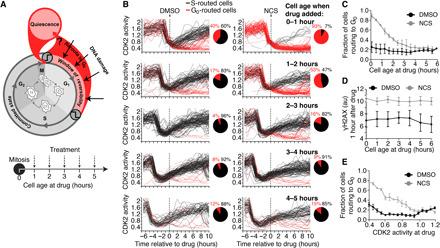
The G-S checkpoint is thought to prevent cells with damaged DNA from entering S phase and replicating their DNA and efficiently arrests cells at the G-S transition. Here, using time-lapse imaging and single-cell tracking, we instead find that DNA damage leads to highly variable and divergent fate outcomes. Contrary to the textbook model that cells arrest at the G-S transition, cells triggering the DNA damage checkpoint in G phase route back to quiescence, and this cellular rerouting can be initiated at any point in G phase. Furthermore, we find that most of the cells receiving damage in G phase actually fail to arrest and proceed through the G-S transition due to persistent cyclin-dependent kinase (CDK) activity in the interval between DNA damage and induction of the CDK inhibitor p21. These observations necessitate a revised model of DNA damage response in G phase and indicate that cells have a G checkpoint.
G-S 检验点被认为可防止 DNA 受损的细胞进入 S 期并复制其 DNA,从而有效地将细胞阻滞在 G-S 转换期。然而,在这里,通过延时成像和单细胞追踪,我们发现 DNA 损伤会导致高度可变且不同的命运结果。与教科书模型中细胞在 G-S 转换期停滞不同,在 G 期触发 DNA 损伤检验点的细胞会回到静止状态,并且这种细胞重定向可以在 G 期的任何时间点启动。此外,我们发现大多数在 G 期受到损伤的细胞实际上并未停滞,而是由于在 DNA 损伤与细胞周期蛋白依赖性激酶 (CDK) 抑制剂 p21 诱导之间的间隔期内 CDK 活性持续存在,从而继续通过 G-S 转换期。这些观察结果需要对 G 期 DNA 损伤反应模型进行修订,并表明细胞存在一个 G 检验点。




 Zotero 插件