
加拿大因纽特人社区结核病预防的社会和行为风险降低策略:成本效益分析
Social and behavioral risk reduction strategies for tuberculosis prevention in Canadian Inuit communities: a cost-effectiveness analysis.
作者信息
Uppal Aashna, Oxlade Olivia, Nsengiyumva Ntwali Placide, N'Diaye Dieynaba S, Alvarez Gonzalo G, Schwartzman Kevin
机构信息
Montreal Chest Institute, Montreal, Quebec, Canada.
Respiratory Epidemiology and Clinical Research Unit, Centre for Outcomes Research and Evaluation, Research Institute of McGill University Health Centre, Montreal, Quebec, Canada.
出版信息
BMC Public Health. 2021 Feb 3;21(1):280. doi: 10.1186/s12889-021-10187-z.
BACKGROUND
Tuberculosis (TB) is an important public health problem in Inuit communities across Canada, with an annual incidence rate in 2017 that was nearly 300 times higher than in Canadian-born non-Indigenous individuals. Social and behavioral factors that are prevalent in the North, such as commercial tobacco use, excessive alcohol use, food insecurity and overcrowded housing put individuals at higher risk for TB morbidity and mortality. We examined the potential impact of mitigation strategies for these risk factors, in reducing TB burden in this setting.
METHODS
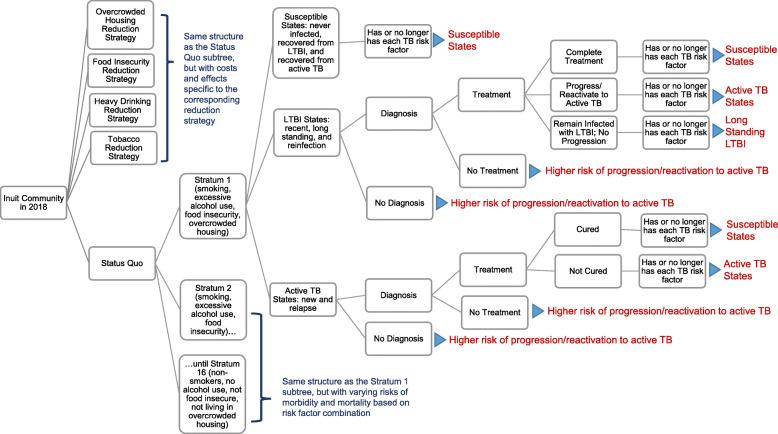
We created a transmission model to simulate the epidemiology of TB in Nunavut, Canada. We then used a decision analysis model to assess the potential impact of several evidence-based strategies targeting tobacco use, excessive alcohol use, food insecurity and overcrowded housing. We predicted TB incidence, TB-related deaths, quality adjusted life years (QALYs), and associated costs and cost-effectiveness over 20 years. All costs were expressed in 2018 Canadian dollars.
RESULTS
Compared to a status quo scenario with no new interventions for these risk factors, the reduction strategy for tobacco use was most effective and cost-effective, reducing TB incidence by 5.5% (95% uncertainty range: 2.7-11%) over 20 years, with an estimated cost of $95,835 per TB case prevented and $49,671 per QALY gained. The addition of the food insecurity reduction strategy reduced incidence by a further 2% (0.5-3%) compared to the tobacco cessation strategy alone, but at significant cost.
CONCLUSIONS
Strategies that aim to reduce commercial tobacco use and improve food security will likely lead to modest reductions in TB morbidity and mortality. Although important for the communities, strategies that address excess alcohol use and overcrowding will likely have a more limited impact on TB-related outcomes at current scale, and are associated with much higher cost. Their benefits will be more substantial with scale up, which will also likely have important downstream impacts such as improved mental health, educational attainment and food security.
背景
结核病是加拿大各地因纽特社区的一个重要公共卫生问题,2017年的年发病率比在加拿大出生的非原住民个体高出近300倍。北方普遍存在的社会和行为因素,如商业烟草使用、过度饮酒、粮食不安全和住房拥挤,使个人患结核病发病和死亡的风险更高。我们研究了针对这些风险因素的缓解策略在减轻该地区结核病负担方面的潜在影响。
方法
我们创建了一个传播模型来模拟加拿大努纳武特地区结核病的流行病学情况。然后,我们使用决策分析模型来评估针对烟草使用、过度饮酒、粮食不安全和住房拥挤的几种循证策略的潜在影响。我们预测了20年内的结核病发病率、与结核病相关的死亡、质量调整生命年(QALYs)以及相关成本和成本效益。所有成本均以2018年加拿大元表示。
结果
与对这些风险因素不采取新干预措施的现状情景相比,烟草使用减少策略最为有效且具有成本效益,在20年内结核病发病率降低了5.5%(95%不确定性范围:2.7-11%),估计每预防一例结核病病例的成本为95,835加元,每获得一个质量调整生命年的成本为49,671加元。与仅采用戒烟策略相比,增加粮食不安全减少策略可使发病率进一步降低2%(0.5-3%),但成本高昂。
结论
旨在减少商业烟草使用和改善粮食安全的策略可能会使结核病发病率和死亡率略有降低。虽然对社区很重要,但在当前规模下,解决过度饮酒和住房拥挤问题的策略对结核病相关结果的影响可能更为有限,且成本更高。随着规模扩大,其益处将更加显著,这也可能会产生重要的下游影响,如改善心理健康、教育程度和粮食安全。
 Zotero 插件