
从零售禽肉中分离出的-1阳性菌株的毒力特性
Virulence Properties of -1-Positive Isolated from Retail Poultry Meat.
作者信息
Kubelová Michaela, Koláčková Ivana, Gelbíčová Tereza, Florianová Martina, Kalová Alžběta, Karpíšková Renáta
机构信息
Department of Microbiology and Antimicrobial Resistance, Veterinary Research Institute, Hudcova 70, 621 00 Brno, Czech Republic.
出版信息
Microorganisms. 2021 Feb 2;9(2):308. doi: 10.3390/microorganisms9020308.
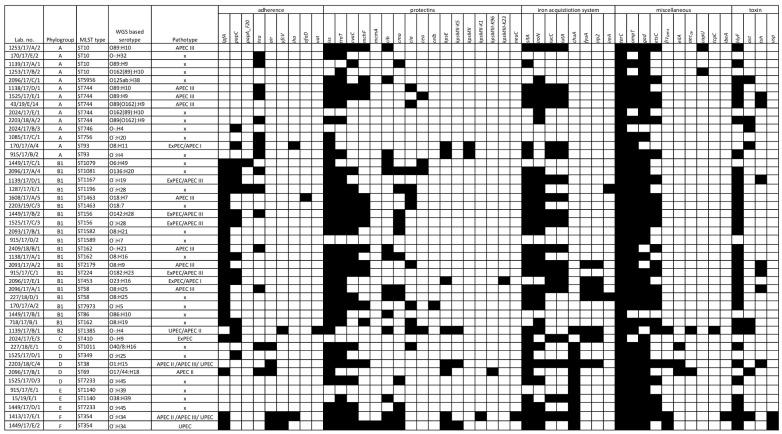
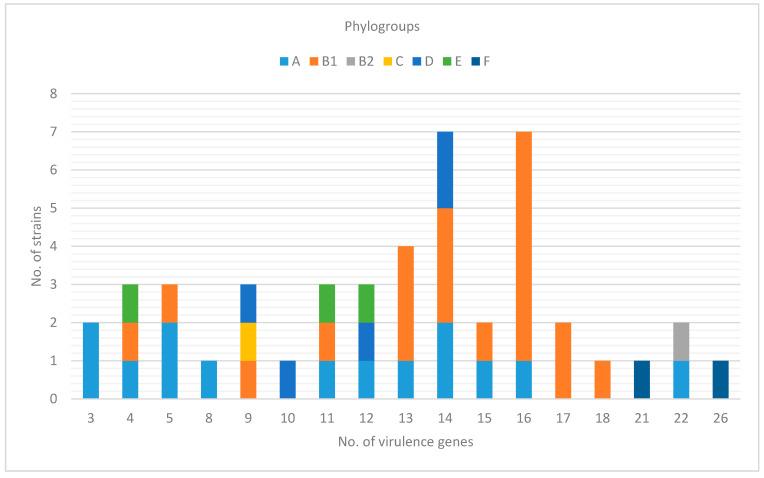
The great plasticity and diversity of the genome, together with the ubiquitous occurrence, make a bacterium of world-wide concern. Of particular interest are pathogenic strains and strains harboring antimicrobial resistance genes. Overlapping virulence-associated traits between avian-source and human extraintestinal pathogenic (ExPEC) suggest zoonotic potential and safety threat of poultry food products. We analyzed whole-genome sequencing (WGS) data of 46 -1-positive strains isolated from retail raw meat purchased in the Czech Republic. The investigated strains were characterized by their phylogroup-B1 (43%), A (30%), D (11%), E (7%), F (4%), B2 (2%), C (2%), MLST type, and serotype. A total of 30 multilocus sequence types (STs), of which ST744 was the most common (11%), were identified, with O8 and O89 as the most prevalent serogroups. Using the VirulenceFinder tool, 3 to 26 virulence genes were detected in the examined strains and a total of 7 (15%) strains met the pathogenic criteria for ExPEC. Four strains were defined as UPEC (9%) and 18 (39%) strains could be classified as APEC. The WGS methods and available on-line tools for their evaluation enable a comprehensive approach to the diagnosis of virulent properties of strains and represent a suitable and comfortable platform for their detection. Our results show that poultry meat may serve as an important reservoir of strains carrying both virulence and antibiotic resistance genes for animal and human populations.
基因组具有高度可塑性和多样性,且广泛存在,这使得细菌成为全球关注的对象。特别值得关注的是致病菌株和携带抗菌抗性基因的菌株。禽源和人肠道外致病性(ExPEC)菌株之间存在重叠的毒力相关特征,这表明禽肉食品存在人畜共患病潜力和安全威胁。我们分析了从捷克共和国购买的零售生肉中分离出的46株1型阳性菌株的全基因组测序(WGS)数据。所研究的菌株通过其B1型菌系(43%)、A型(30%)、D型(11%)、E型(7%)、F型(4%)、B2型(2%)、C型(2%)、多位点序列分型(MLST)类型和血清型进行表征。共鉴定出30种多位点序列类型(STs),其中ST744最为常见(11%),O8和O89是最常见的血清群。使用VirulenceFinder工具,在所检测的菌株中检测到3至26个毒力基因,共有7株(15%)菌株符合ExPEC的致病标准。4株被定义为尿道致病性大肠杆菌(UPEC,9%),18株(39%)可归类为禽致病性大肠杆菌(APEC)。WGS方法及其可用的在线评估工具能够全面诊断菌株的毒力特性,是检测菌株的合适且便捷的平台。我们的结果表明,禽肉可能是动物和人类群体中携带毒力和抗生素抗性基因菌株的重要储存库。
 Zotero 插件