
绵羊的蜱传血液寄生虫:土耳其的一项分子研究。
Tick-Borne Hemoparasites of Sheep: A Molecular Research in Turkey.
作者信息
Ceylan Onur, Byamukama Benedicto, Ceylan Ceylan, Galon Eloiza May, Liu Mingming, Masatani Tatsunori, Xuan Xuenan, Sevinc Ferda
机构信息
Department of Parasiyology, Faculty of Veterinary Medicine, Selcuk University, 42250 Konya, Turkey.
National Research Center for Protozoan Diseases, Obihiro University of Agriculture and Veterinary Medicine, Obihiro, Hokkaido 080-8555, Japan.
出版信息
Pathogens. 2021 Feb 3;10(2):162. doi: 10.3390/pathogens10020162.
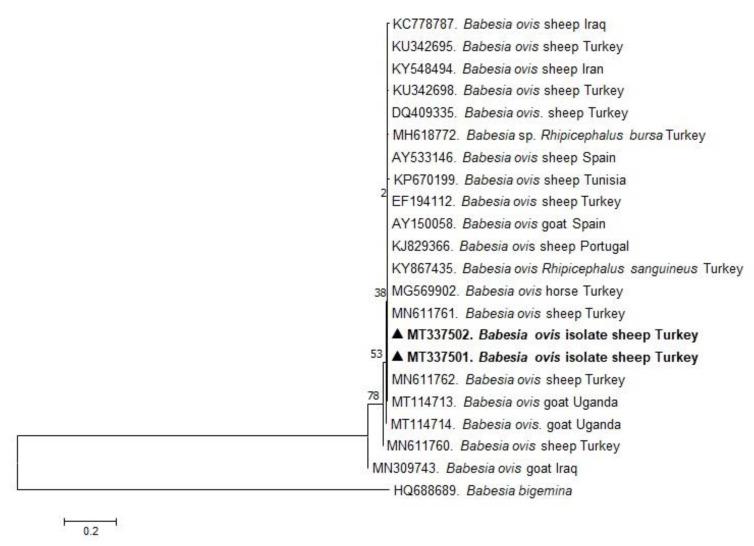
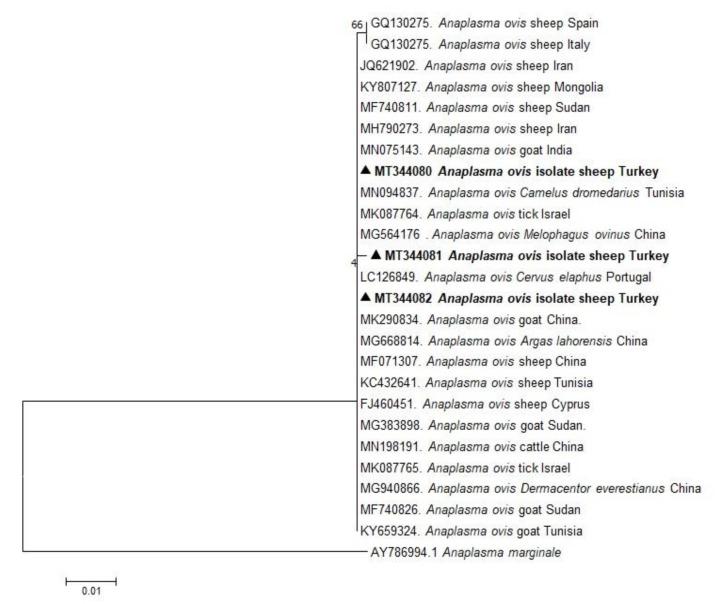
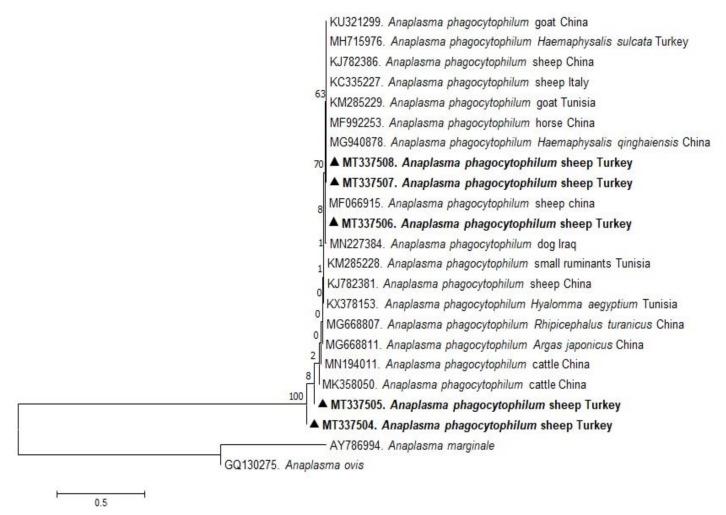
Tick-borne diseases (TBDs) indulge in severe economic losses in the livestock industry by adversely affecting the small ruminant breeding in tropical and subtropical zone countries, including Turkey. Turkey encompasses a wide land area representing diverse climatic conditions. The present study explored the presence and distribution of , , , , and the co-occurrence status of these pathogens. A total of 299 sheep blood samples were collected from fifteen provinces located in six different geographical regions in Turkey. PCR analyses were executed using species-specific primers based on BoSSU rRNA, ToSSU rRNA, 18S rRNA, Major Surface Protein , and 16S rRNA genes. Overall, 219 (73.24%) sheep were found to be infected with at least one of the following protozoan and rickettsial pathogens; , , and . was not detected in any blood sample. The global prevalence of , , and was estimated to be 2.68%, 16.05%, 41.47%, and 57.19%, respectively. Besides this, dual (24.41%), triple (9.03%), and quadruple (0.67%) co-infections were detected in the study. Phylogenetic analysis revealed significant nucleotide sequence identities between the sequences obtained in this study and the sequences registered in the GenBank. This study provides relevant data regarding the predominance of ovine tick-borne protozoan and rickettsial agents in Turkey. A high molecular prevalence of tick-borne pathogens (TBPs) was identified in the study. This situation indicates that TBPs should be screened continuously, and necessary control measures should be taken to prevent diseases caused by tick-borne protozoan and rickettsial agents.
蜱传疾病(TBDs)通过对包括土耳其在内的热带和亚热带地区国家的小反刍动物养殖产生不利影响,给畜牧业造成严重经济损失。土耳其地域广阔,气候条件多样。本研究探讨了[具体病原体名称1]、[具体病原体名称2]、[具体病原体名称3]、[具体病原体名称4]、[具体病原体名称5]的存在与分布以及这些病原体的共现情况。从土耳其六个不同地理区域的十五个省份共采集了299份绵羊血样。基于[病原体1的基因名称]BoSSU rRNA、[病原体2的基因名称]ToSSU rRNA、[病原体3的基因名称]18S rRNA、[病原体4的基因名称]主要表面蛋白[具体名称]和[病原体5的基因名称]16S rRNA基因,使用物种特异性引物进行PCR分析。总体而言,发现219只(73.24%)绵羊感染了以下至少一种原生动物和立克次氏体病原体:[具体病原体名称1]、[具体病原体名称2]和[具体病原体名称3]。在任何血样中均未检测到[具体病原体名称4]。[具体病原体名称1]、[具体病原体名称2]、[具体病原体名称3]和[具体病原体名称5]的总体患病率估计分别为2.68%、16.05%、41.47%和57.19%。此外,本研究还检测到双重感染(24.41%)、三重感染(9.03%)和四重感染(0.67%)。系统发育分析显示,本研究获得的序列与GenBank中登记的序列之间存在显著的核苷酸序列同一性。本研究提供了有关土耳其绵羊蜱传原生动物和立克次氏体病原体优势情况的相关数据。研究中发现蜱传病原体(TBPs)的分子患病率较高。这种情况表明应持续筛查TBPs,并采取必要的控制措施以预防蜱传原生动物和立克次氏体病原体引起的疾病。


 Zotero 插件