
开发和验证一种用于三级医院患者分诊的 COVID-19 严重程度预后评估 (COSA) 评分和机器学习模型。
Development and validation of a prognostic COVID-19 severity assessment (COSA) score and machine learning models for patient triage at a tertiary hospital.
机构信息
Clinical Pharmacology and Toxicology, Department of General Internal Medicine, Inselspital, Bern University Hospital, University of Bern, Bern, Switzerland.
Department of General Internal Medicine, Inselspital, Bern University Hospital, University of Bern, Bern, Switzerland.
出版信息
J Transl Med. 2021 Feb 5;19(1):56. doi: 10.1186/s12967-021-02720-w.
BACKGROUND
Clinical risk scores and machine learning models based on routine laboratory values could assist in automated early identification of severe acute respiratory syndrome coronavirus 2 (SARS-CoV-2) patients at risk for severe clinical outcomes. They can guide patient triage, inform allocation of health care resources, and contribute to the improvement of clinical outcomes.
METHODS
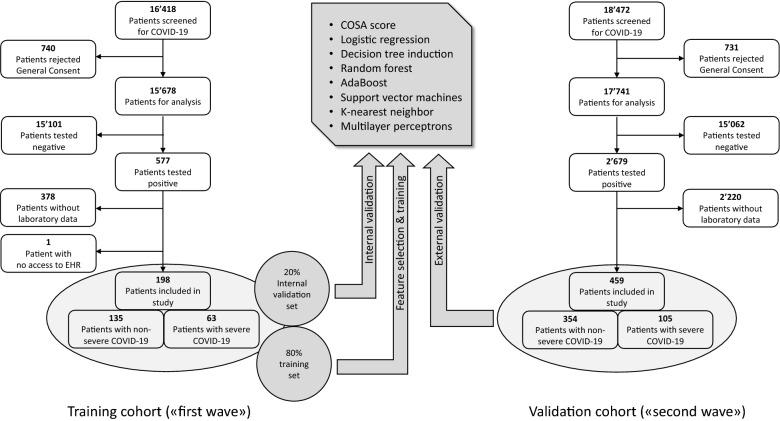
In- and out-patients tested positive for SARS-CoV-2 at the Insel Hospital Group Bern, Switzerland, between February 1st and August 31st ('first wave', n = 198) and September 1st through November 16th 2020 ('second wave', n = 459) were used as training and prospective validation cohort, respectively. A clinical risk stratification score and machine learning (ML) models were developed using demographic data, medical history, and laboratory values taken up to 3 days before, or 1 day after, positive testing to predict severe outcomes of hospitalization (a composite endpoint of admission to intensive care, or death from any cause). Test accuracy was assessed using the area under the receiver operating characteristic curve (AUROC).
RESULTS
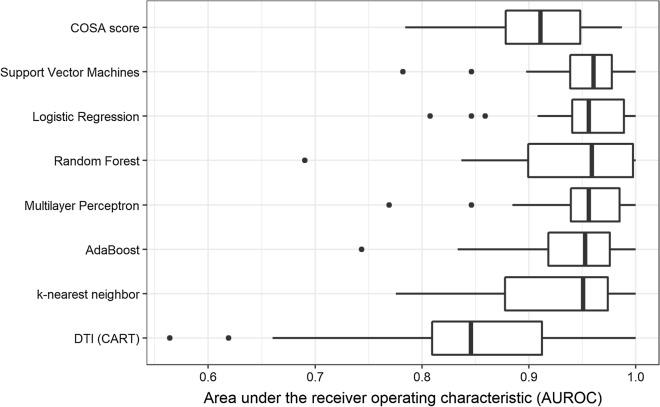
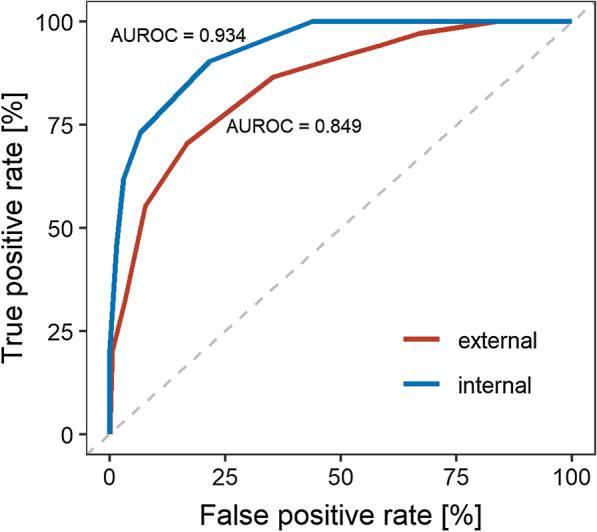
Sex, C-reactive protein, sodium, hemoglobin, glomerular filtration rate, glucose, and leucocytes around the time of first positive testing (- 3 to + 1 days) were the most predictive parameters. AUROC of the risk stratification score on training data (AUROC = 0.94, positive predictive value (PPV) = 0.97, negative predictive value (NPV) = 0.80) were comparable to the prospective validation cohort (AUROC = 0.85, PPV = 0.91, NPV = 0.81). The most successful ML algorithm with respect to AUROC was support vector machines (median = 0.96, interquartile range = 0.85-0.99, PPV = 0.90, NPV = 0.58).
CONCLUSION
With a small set of easily obtainable parameters, both the clinical risk stratification score and the ML models were predictive for severe outcomes at our tertiary hospital center, and performed well in prospective validation.
背景
基于常规实验室值的临床风险评分和机器学习模型可以帮助自动识别有发生严重急性呼吸综合征冠状病毒 2(SARS-CoV-2)不良临床结局风险的 SARS-CoV-2 患者。这些模型可以指导患者分诊,为医疗资源配置提供信息,并有助于改善临床结局。
方法
瑞士伯尔尼岛医院集团的门诊和住院患者在 2020 年 2 月 1 日至 8 月 31 日(“第一波”,n=198)和 9 月 1 日至 11 月 16 日(“第二波”,n=459)期间经检测对 SARS-CoV-2 呈阳性,分别作为训练和前瞻性验证队列。使用从第一次阳性检测前 3 天或后 1 天的人口统计学数据、病史和实验室值来开发临床风险分层评分和机器学习(ML)模型,以预测住院的严重结局(重症监护入院或任何原因导致的死亡的复合终点)。使用接受者操作特征曲线下的面积(AUROC)评估测试准确性。
结果
第一次阳性检测时的性别、C 反应蛋白、钠、血红蛋白、肾小球滤过率、葡萄糖和白细胞是最具预测性的参数。风险分层评分在训练数据上的 AUROC(AUROC=0.94,阳性预测值(PPV)=0.97,阴性预测值(NPV)=0.80)与前瞻性验证队列相似(AUROC=0.85,PPV=0.91,NPV=0.81)。在 AUROC 方面,最成功的 ML 算法是支持向量机(中位数=0.96,四分位距=0.85-0.99,PPV=0.90,NPV=0.58)。
结论
使用一组容易获得的参数,临床风险分层评分和 ML 模型均可以预测我们的三级医院中心的严重结局,并且在前瞻性验证中表现良好。
 Zotero 插件