
基于系统生物学方法假设遗传变异对阿尔茨海默病神经影像学特征的影响
A Systems Biology Approach for Hypothesizing the Effect of Genetic Variants on Neuroimaging Features in Alzheimer's Disease.
机构信息
Department of Bioinformatics, Fraunhofer Institute for Algorithms and Scientific Computing (Fraunhofer SCAI), Sankt Augustin, Germany.
Bonn-Aachen International Center for IT, Rheinische Friedrich-Wilhelms-Universität Bonn, Bonn, Germany.
出版信息
J Alzheimers Dis. 2021;80(2):831-840. doi: 10.3233/JAD-201397.
BACKGROUND
Neuroimaging markers provide quantitative insight into brain structure and function in neurodegenerative diseases, such as Alzheimer's disease, where we lack mechanistic insights to explain pathophysiology. These mechanisms are often mediated by genes and genetic variations and are often studied through the lens of genome-wide association studies. Linking these two disparate layers (i.e., imaging and genetic variation) through causal relationships between biological entities involved in the disease's etiology would pave the way to large-scale mechanistic reasoning and interpretation.
OBJECTIVE
We explore how genetic variants may lead to functional alterations of intermediate molecular traits, which can further impact neuroimaging hallmarks over a series of biological processes across multiple scales.
METHODS
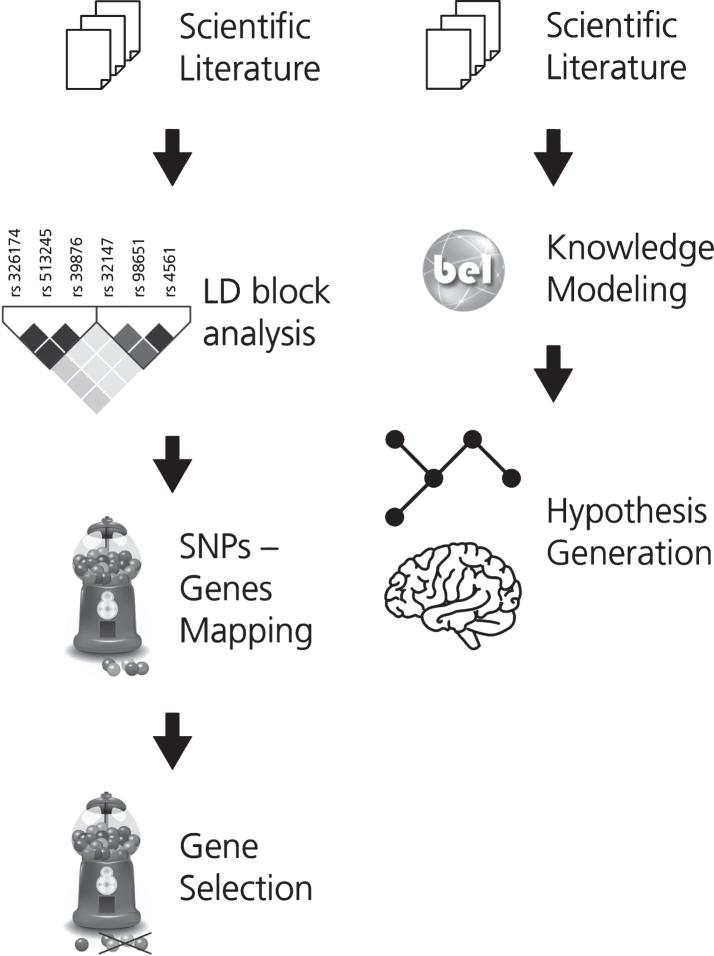
We present an approach in which knowledge pertaining to single nucleotide polymorphisms and imaging readouts is extracted from the literature, encoded in Biological Expression Language, and used in a novel workflow to assist in the functional interpretation of SNPs in a clinical context.
RESULTS
We demonstrate our approach in a case scenario which proposes KANSL1 as a candidate gene that accounts for the clinically reported correlation between the incidence of the genetic variants and hippocampal atrophy. We find that the workflow prioritizes multiple mechanisms reported in the literature through which KANSL1 may have an impact on hippocampal atrophy such as through the dysregulation of cell proliferation, synaptic plasticity, and metabolic processes.
CONCLUSION
We have presented an approach that enables pinpointing relevant genetic variants as well as investigating their functional role in biological processes spanning across several, diverse biological scales.
背景
神经影像学标志物为神经退行性疾病(如阿尔茨海默病)的大脑结构和功能提供了定量的见解,而我们缺乏解释其病理生理学的机制见解。这些机制通常由基因和遗传变异介导,并且通常通过全基因组关联研究来研究。通过将涉及疾病病因的生物实体之间的因果关系联系起来,将这两个截然不同的层面(即影像和遗传变异)联系起来,将为大规模的机制推理和解释铺平道路。
目的
我们探讨遗传变异如何导致中间分子特征的功能改变,这些改变又如何进一步影响神经影像学特征,跨越多个尺度的一系列生物学过程。
方法
我们提出了一种方法,从文献中提取单核苷酸多态性和影像读数相关的知识,并用生物表达语言进行编码,并在新的工作流程中使用,以协助在临床环境中对 SNP 进行功能解释。
结果
我们在一个案例场景中展示了我们的方法,该方法提出 KANSL1 是一个候选基因,它解释了遗传变异与海马体萎缩之间的临床报告相关性。我们发现,该工作流程通过多种机制优先考虑了文献中报道的 KANSL1 可能对海马体萎缩产生影响的机制,例如通过细胞增殖、突触可塑性和代谢过程的失调。
结论
我们提出了一种方法,可以精确定位相关的遗传变异,并研究它们在跨越多个不同生物学尺度的生物学过程中的功能作用。


 Zotero 插件