
照顾 COVID-19 逝者的挑战:一项多国观察性研究(CovPall)。
The Challenges of Caring for People Dying From COVID-19: A Multinational, Observational Study (CovPall).
机构信息
Cicely Saunders Institute of Palliative Care, Policy and Rehabilitation, King's College London, London, UK.
International Observatory on End of Life Care, Division of Health Research, Lancaster University, Lancaster, UK.
出版信息
J Pain Symptom Manage. 2021 Sep;62(3):460-470. doi: 10.1016/j.jpainsymman.2021.01.138. Epub 2021 Feb 5.
CONTEXT
Systematic data on the care of people dying with COVID-19 are scarce.
OBJECTIVES
To understand the response of and challenges faced by palliative care services during the COVID-19 pandemic, and identify associated factors.
METHODS
We surveyed palliative care and hospice services, contacted via relevant organizations. Multivariable logistic regression identified associations with challenges. Content analysis explored free text responses.
RESULTS
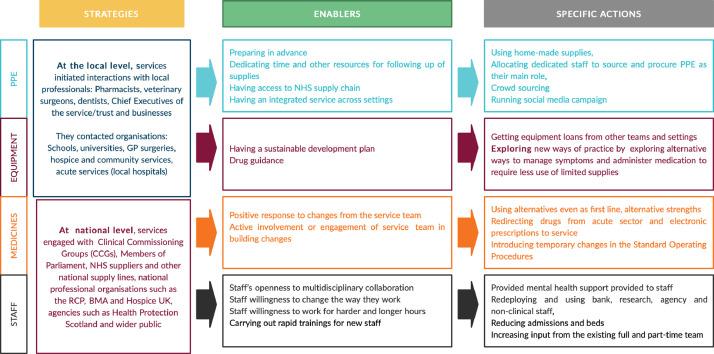
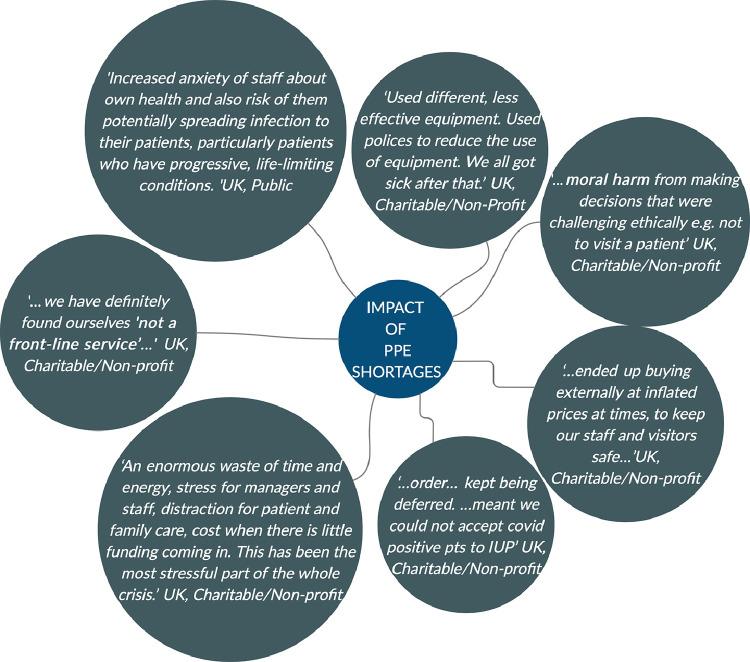
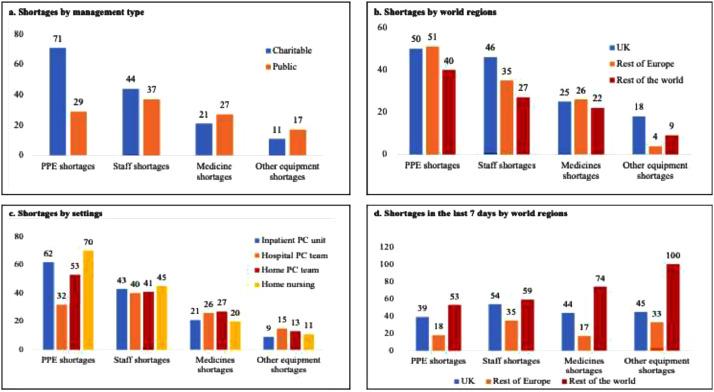
A total of 458 services responded; 277 UK, 85 rest of Europe, 95 rest of the world; 81% cared for patients with suspected or confirmed COVID-19, 77% had staff with suspected or confirmed COVID-19; 48% reported shortages of Personal Protective Equipment (PPE), 40% staff shortages, 24% medicines shortages, 14% shortages of other equipment. Services provided direct care and education in symptom management and communication; 91% changed how they worked. Care often shifted to increased community and hospital care, with fewer admissions to inpatient palliative care units. Factors associated with increased odds of PPE shortages were: charity rather than public management (OR 3.07, 95% CI 1.81-5.20), inpatient palliative care unit rather than other settings (OR 2.34, 95% CI 1.46-3.75). Being outside the UK was associated with lower odds of staff shortages (OR 0.44, 95% CI 0.26-0.76). Staff described increased workload, concerns for their colleagues who were ill, whilst expending time struggling to get essential equipment and medicines, perceiving they were not a front-line service.
CONCLUSION
Palliative care services were often overwhelmed, yet felt ignored in the COVID-19 response. Palliative care needs better integration with health care systems when planning and responding to future epidemics/pandemics.
背景
关于 COVID-19 患者护理的系统数据很少。
目的
了解大流行期间姑息治疗服务的应对情况和面临的挑战,并确定相关因素。
方法
我们通过相关组织联系了姑息治疗和临终关怀服务机构,并对其进行了调查。多变量逻辑回归确定了与挑战相关的因素。内容分析探讨了自由文本的回复。
结果
共有 458 家服务机构做出回应;277 家来自英国,85 家来自欧洲其他地区,95 家来自世界其他地区;81%的机构照顾了疑似或确诊 COVID-19 的患者,77%的机构有疑似或确诊 COVID-19 的员工;48%的机构报告个人防护设备短缺,40%的机构员工短缺,24%的机构药品短缺,14%的机构其他设备短缺。服务机构提供了症状管理和沟通方面的直接护理和教育;91%的机构改变了工作方式。护理工作重心通常转移到增加社区和医院护理,减少了住院姑息治疗病房的收治。与个人防护设备短缺相关的因素是:慈善机构而非公共管理(比值比 3.07,95%置信区间 1.81-5.20),住院姑息治疗病房而非其他环境(比值比 2.34,95%置信区间 1.46-3.75)。不在英国的机构与员工短缺的可能性较低相关(比值比 0.44,95%置信区间 0.26-0.76)。员工描述了工作量增加,对生病同事的担忧,同时还要努力获得必要的设备和药品,他们认为自己不是一线服务机构。
结论
姑息治疗服务机构经常不堪重负,但在 COVID-19 应对中却被忽视。在规划和应对未来的疫情/大流行时,姑息治疗需要更好地与医疗保健系统相结合。
 Zotero 插件