
1033 例患者 1308 份鼻咽拭子的前瞻性研究:LUMIPULSE SARS-CoV-2 抗原检测与 RT-qPCR 的比较。
Prospective study of 1308 nasopharyngeal swabs from 1033 patients using the LUMIPULSE SARS-CoV-2 antigen test: Comparison with RT-qPCR.
机构信息
Genome Analysis Centre, Yamanashi Central Hospital, Kofu, Yamanashi, Japan.
Division of Microbiology in Clinical Laboratory, Yamanashi Central Hospital, Kofu, Yamanashi, Japan.
出版信息
Int J Infect Dis. 2021 Apr;105:7-14. doi: 10.1016/j.ijid.2021.02.005. Epub 2021 Feb 5.
BACKGROUND
Reverse transcription polymerase chain reaction (RT-PCR) is the gold standard for detection of severe acute respiratory syndrome coronavirus-2 (SARS-CoV-2). Previously, the accuracy of the quantitative LUMIPULSE SARS-CoV-2 antigen test was demonstrated using samples collected retrospectively. In this study, the LUMIPULSE antigen test was clinically validated using prospective samples.
METHODS
In total, 1033 nasopharyngeal swab samples were collected from 1033 individuals, and an additional 275 follow-up samples were collected from 43 patients who subsequently tested positive for coronavirus disease 2019 (COVID-19). All 1308 samples were subjected to quantitative RT-PCR (RT-qPCR) and the antigen test. The antibody response was investigated for patients with discordant results to clarify if seroconversion had occurred.
RESULTS
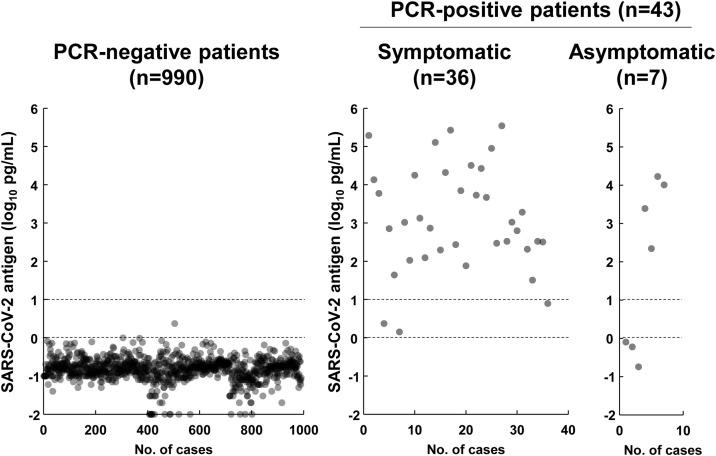
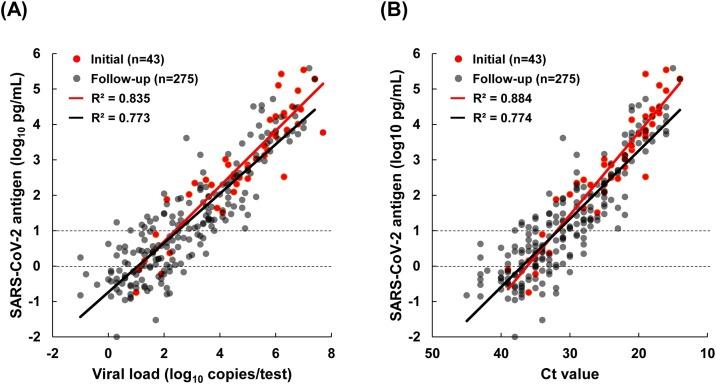
RT-qPCR identified 990 samples as negative and 43 as positive, while the antigen test identified 992 samples as negative, 37 as positive and four as inconclusive. The overall concordance rate was 99.7% (1026/1029). Sensitivity, specificity, positive predictive value and negative predictive value of the antigen test were 92.5% (37/40), 100% (989/989), 100% (37/37) and 99.7% (989/992), respectively, after exclusion of the four inconclusive results. The kappa coefficient was 0.960 (95% confidence interval 0.892-0.960), suggesting excellent agreement between the two tests. Seropositivity in five of seven patients with discordant results suggested that the discrepancy was caused by samples collected during the late phase of infection. Using follow-up samples, correlation was observed between the antigen level and the viral load or cycle threshold value. The concordance rate between these test results tended to be high among samples collected 0-9 days after symptom onset, but this decreased gradually in samples collected thereafter.
CONCLUSIONS
This prospective study demonstrated that the LUMIPULSE antigen test is a highly accurate diagnostic test for SARS-CoV-2.
背景
逆转录聚合酶链反应(RT-PCR)是检测严重急性呼吸综合征冠状病毒 2 型(SARS-CoV-2)的金标准。此前,已通过回顾性采集的样本证明了定量 LUMIPULSE SARS-CoV-2 抗原检测的准确性。在这项研究中,使用前瞻性样本对 LUMIPULSE 抗原检测进行了临床验证。
方法
共采集了 1033 名个体的 1033 份鼻咽拭子样本,对随后确诊为 2019 年冠状病毒病(COVID-19)的 43 名患者采集了另外 275 份随访样本。所有 1308 份样本均进行了定量 RT-PCR(RT-qPCR)和抗原检测。对于检测结果不一致的患者,检测其抗体反应以明确是否发生血清转换。
结果
RT-qPCR 检测到 990 份样本为阴性,43 份样本为阳性,而抗原检测检测到 992 份样本为阴性,37 份样本为阳性,4 份样本为不确定。总符合率为 99.7%(1026/1029)。排除 4 份不确定结果后,抗原检测的灵敏度、特异性、阳性预测值和阴性预测值分别为 92.5%(37/40)、100%(989/989)、100%(37/37)和 99.7%(989/992)。两种检测方法的kappa 系数为 0.960(95%置信区间 0.892-0.960),表明两种检测方法具有极好的一致性。在 7 例检测结果不一致的患者中,5 例的血清阳性表明差异是由感染后期采集的样本引起的。使用随访样本,观察到抗原水平与病毒载量或循环阈值之间存在相关性。在症状出现后 0-9 天采集的样本中,这些检测结果的一致性率较高,但此后逐渐降低。
结论
这项前瞻性研究表明,LUMIPULSE 抗原检测是一种高度准确的 SARS-CoV-2 诊断检测方法。

 Zotero 插件