
土耳其 COVID-19 大流行期间儿童多系统炎症综合征:来自东地中海地区的首次报告。
Multisystem inflammatory syndrome in children during the COVID-19 pandemic in Turkey: first report from the Eastern Mediterranean.
机构信息
Faculty of Medicine, Department of Pediatric Infectious Diseases, Hacettepe University, Ankara, Turkey.
Faculty of Medicine, Department of Pediatrics, Division of Pediatric Intensive Care Unit, Hacettepe University, Ankara, Turkey.
出版信息
Clin Rheumatol. 2021 Aug;40(8):3227-3237. doi: 10.1007/s10067-021-05631-9. Epub 2021 Feb 12.
OBJECTIVE
We aimed to describe the typical clinical and laboratory features and treatment of children diagnosed with multisystem inflammatory syndrome in children (MIS-C) and to understand the differences as compared to severe/critical pediatric cases with COVID-19 in an eastern Mediterranean country.
METHODS
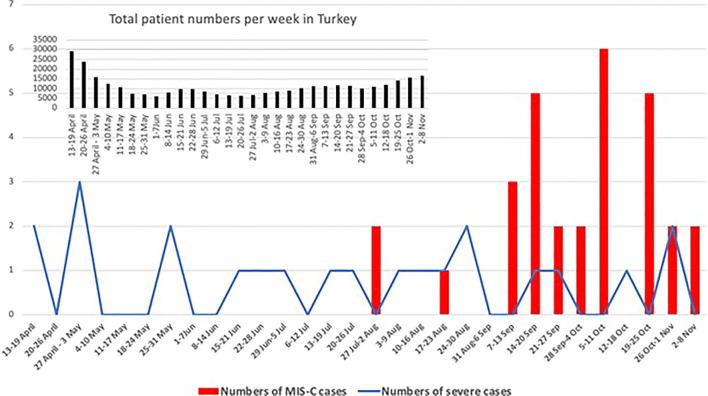
Children (aged <18 years) who diagnosed with MIS-C and severe/critical pediatric cases with COVID-19 and were admitted to hospital between March 26 and November 3, 2020 were enrolled in the study.
RESULTS
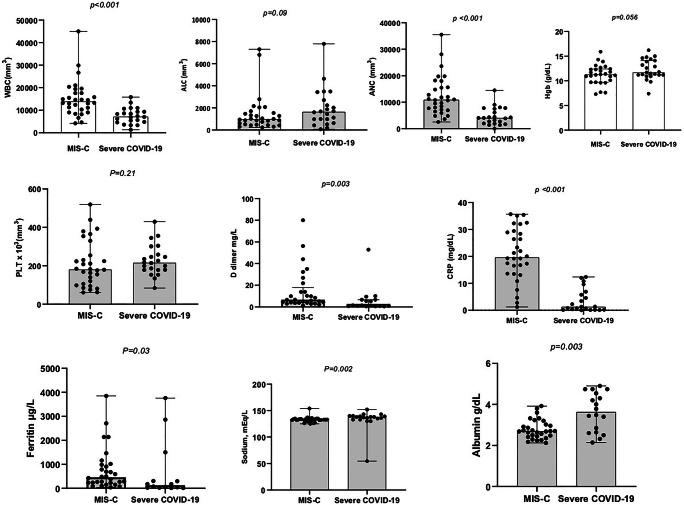
A total of 52 patients, 22 patients diagnosed with COVID-19 with severe/critical disease course and 30 patients diagnosed with MIS-C, were included in the study. Although severe COVID-19 cases and cases with MIS-C share many clinical and laboratory features, MIS-C cases had longer fever duration and higher rate of the existence of rash, conjunctival injection, peripheral edema, abdominal pain, altered mental status, and myalgia than in severe cases (p<0.001 for each). Of all, 53.3% of MIS-C cases had the evidence of myocardial involvement as compared to severe cases (27.2%). Additionally, C-reactive protein (CRP) and white blood cell (WBC) are the independent predictors for the diagnosis of MIS-C, particularly in the existence of conjunctival injection and rash. Corticosteroids, intravenous immunoglobulin (IVIG), and biologic immunomodulatory treatments were mainly used in MIS-C cases rather than cases with severe disease course. There were only three deaths among 52 patients, one of whom had Burkitt lymphoma and the two cases with severe COVID-19 of late referral.
CONCLUSION
Differences between clinical presentations, acute phase responses, organ involvements, and management strategies indicate that MIS-C might be a distinct immunopathogenic disease as compared to pediatric COVID-19. Conjunctival injection and higher CRP and low WBC count are reliable diagnostic parameters for MIS-C cases. Key Points • MIS-C cases had longer fever duration and higher rate of the existence of rash, conjunctival injection, peripheral edema, abdominal pain, altered mental status, and myalgia than in severe/critical pediatric cases with COVID-19. • Higher CRP and low total WBC count are the independent predictors for the diagnosis of MIS-C. • MIS-C might be a distinct immunopathogenic disease as compared to pediatric COVID-19.
目的
描述儿童多系统炎症综合征(MIS-C)的典型临床和实验室特征及治疗方法,并了解与在东地中海国家住院的 COVID-19 重症/危重症患儿相比的差异。
方法
研究纳入 2020 年 3 月 26 日至 11 月 3 日期间被诊断为 MIS-C 和 COVID-19 重症/危重症并住院的<18 岁儿童。
结果
共纳入 52 例患儿,其中 22 例 COVID-19 重症/危重症患儿和 30 例 MIS-C 患儿。虽然 COVID-19 重症患儿和 MIS-C 患儿有许多相似的临床和实验室特征,但 MIS-C 患儿的发热时间更长,皮疹、结膜充血、外周水肿、腹痛、精神状态改变和肌痛的发生率更高(p<0.001)。MIS-C 患儿中 53.3%有心肌受累证据,而 COVID-19 重症患儿中为 27.2%(p<0.001)。此外,C 反应蛋白(CRP)和白细胞(WBC)是 MIS-C 诊断的独立预测指标,尤其是在存在结膜充血和皮疹时。MIS-C 患儿主要使用皮质类固醇、静脉注射免疫球蛋白(IVIG)和生物免疫调节治疗,而 COVID-19 重症患儿则较少使用这些治疗方法。52 例患儿中仅 3 例死亡,其中 1 例为 Burkitt 淋巴瘤患儿,2 例为 COVID-19 重症患儿,且转诊较晚。
结论
临床表现、急性期反应、器官受累和治疗策略的差异表明,MIS-C 可能是一种与儿科 COVID-19 不同的免疫发病疾病。结膜充血和较高的 CRP 及较低的 WBC 计数是 MIS-C 患儿的可靠诊断参数。关键点:
MIS-C 患儿的发热时间更长,皮疹、结膜充血、外周水肿、腹痛、精神状态改变和肌痛的发生率更高。
较高的 CRP 和较低的总 WBC 计数是 MIS-C 诊断的独立预测指标。
MIS-C 可能是一种与儿科 COVID-19 不同的免疫发病疾病。

 Zotero 插件