
撒哈拉以南非洲地区 COVID-19 期间的避孕动态:来自布基纳法索和肯尼亚的纵向证据。
Contraceptive dynamics during COVID-19 in sub-Saharan Africa: longitudinal evidence from Burkina Faso and Kenya.
机构信息
Department of Population, Family and Reproductive Health, Johns Hopkins University Bloomberg School of Public Health, Baltimore, Maryland, USA
Department of Population, Family and Reproductive Health, Johns Hopkins University Bloomberg School of Public Health, Baltimore, Maryland, USA.
出版信息
BMJ Sex Reprod Health. 2021 Oct;47(4):252-260. doi: 10.1136/bmjsrh-2020-200944. Epub 2021 Feb 12.
INTRODUCTION
Evidence from health emergencies suggests COVID-19 will disrupt women's sexual and reproductive health (SRH). In sub-Saharan Africa, which experiences the highest rates of unintended pregnancy and unsafe abortion globally, COVID-19 is projected to slow recent progress toward universal access to contraceptive services.
METHODS
We used longitudinal data collected from women at risk of unintended pregnancy in Burkina Faso (n=1186) and Kenya (n=2784) before (November 2019-February 2020) and during (May-July 2020) COVID-19 to quantify contraceptive dynamics during COVID-19; examine sociodemographic factors and COVID-19 experiences related to contraceptive dynamics; and assess COVID-19-related reasons for contraceptive non-use. Bivariate and multivariate logistic regressions were used to examine correlates of contraceptive dynamics amid COVID-19.
RESULTS
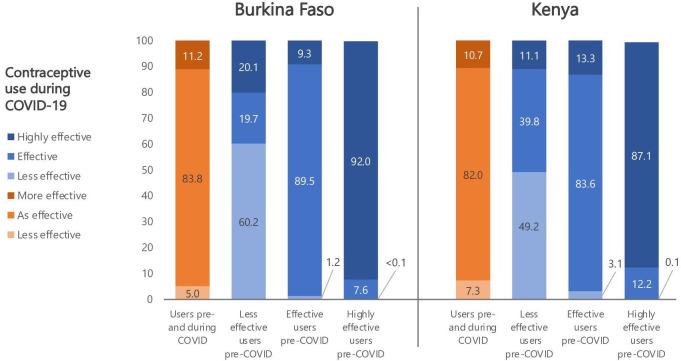
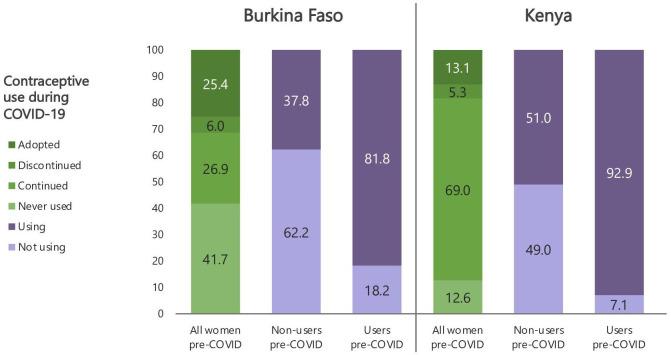
Most women did not change their contraceptive status during COVID-19 (68.6% in Burkina Faso and 81.6% in Kenya) and those who did were more likely to adopt a method (25.4% and 13.1%, respectively) than to discontinue (6.0% and 5.3%, respectively). Most women who switched contraceptives were using methods as or more effective than their pre-pandemic contraception. Economic instability related to COVID-19 was associated with increased contraceptive protection in Burkina Faso but not in Kenya. Altogether, 14.4% of non-contraceptive users in Kenya and 3.8% in Burkina Faso identified COVID-19-related reasons for non-use.
CONCLUSIONS
The vast majority of women at risk of unintended pregnancy did not change their contraceptive status during COVID-19, and more women adopted than discontinued methods. A minority of women reported COVID-19-related reasons for non-use, underscoring the importance of expanding safe modes of service delivery during health crises.
简介
来自卫生应急事件的证据表明,COVID-19 将扰乱妇女的性健康和生殖健康(SRH)。在全球范围内经历最高意外怀孕和不安全堕胎率的撒哈拉以南非洲,COVID-19 预计将减缓近期普及避孕服务的进展。
方法
我们使用在 COVID-19 之前(2019 年 11 月至 2020 年 2 月)和期间(2020 年 5 月至 7 月)从布基纳法索(n=1186)和肯尼亚(n=2784)有意外怀孕风险的妇女那里收集的纵向数据来量化 COVID-19 期间的避孕动态;检查与避孕动态相关的社会人口因素和 COVID-19 经历;并评估 COVID-19 相关的避孕原因。使用二变量和多变量逻辑回归来检查 COVID-19 期间避孕动态的相关因素。
结果
大多数妇女在 COVID-19 期间没有改变其避孕状况(布基纳法索为 68.6%,肯尼亚为 81.6%),而那些改变避孕状况的妇女更有可能采用一种方法(分别为 25.4%和 13.1%),而不是停止使用(分别为 6.0%和 5.3%)。大多数更换避孕方法的妇女使用的方法与疫情前的避孕方法一样有效或更有效。与 COVID-19 相关的经济不稳定与布基纳法索避孕保护的增加有关,但在肯尼亚则没有。肯尼亚共有 14.4%的非避孕使用者和布基纳法索的 3.8%认为 COVID-19 是导致非使用的原因。
结论
绝大多数有意外怀孕风险的妇女在 COVID-19 期间没有改变其避孕状况,而且更多的妇女采用了方法,而不是停止使用。少数妇女报告了 COVID-19 相关的非使用原因,这强调了在卫生危机期间扩大安全服务提供模式的重要性。
 Zotero 插件