
闲暇时体力活动与血管弹性指数的纵向关联。
Longitudinal association between leisure-time physical activity and vascular elasticity indices.
机构信息
The Skaraborg Institute, Skövde, Sweden.
Primary Health Care, School of Public Health and Community Medicine, Institute of Medicine, Sahlgrenska Academy, University of Gothenburg, Gothenburg, Sweden.
出版信息
BMC Cardiovasc Disord. 2021 Feb 16;21(1):99. doi: 10.1186/s12872-021-01911-z.
AIM
We investigated the association between levels of leisure-time physical activity and vascular stiffness in a longitudinal observational study from a representative Swedish population.
METHOD
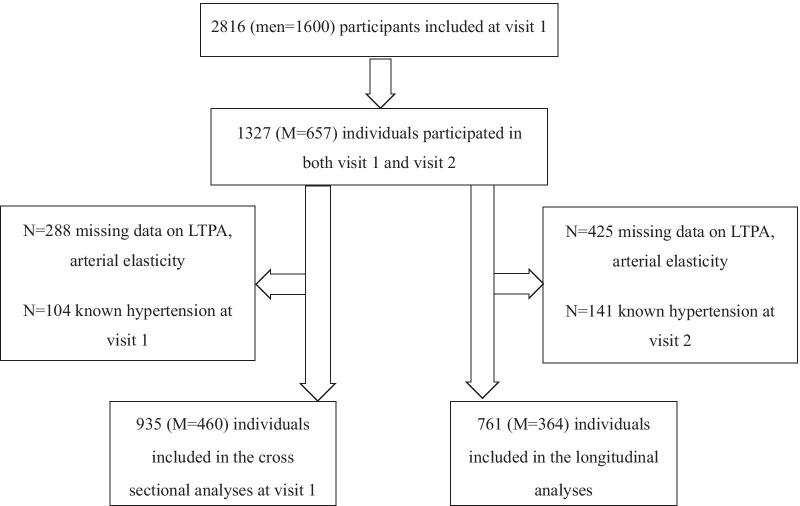
A total of 2816 randomly selected individuals were examined at visit 1 (2002-2005, Men = 1400). After a mean follow-up of 9.7 ± 1.4 years, a representative sample of 1327 of the original participants were re-examined at visit 2. After excluding subjects with hypertension at baseline, 761 participants were included in the longitudinal analyses. Leisure-time physical (LTPA) activity was self-reported and dichotomized as high or low (level 3, 4 and level 1, 2, respectively). Large Arterial Elasticity Index (LAEI) and Small Arterial Elasticity Index (SAEI) were measured using the HDI/Pulse Wave™ CR2000. Multivariable general linear models were used to investigate the differences in changes SAEI and LAEI based on LTPA levels.
RESULTS
At visit 1, and after adjustment for possible confounders, participants in the high LTPA group had better small artery elasticity (SAEI) (SAEI in low-level LTPA: 7.89 ± 0.11, SAEI in high-level LTPA: 8.32 ± 0.15, ΔSAEI: 0.42, CI: 0.07-0.78; p = 0.020). SAEI decreased between the two assessments (Visit 1: SAEI 8.01 ± 3.37 ml/mmHg; Δ SAEI: 1.4, CI 1.2-1.6, p < 0.001). Participants with a higher LTPA at visit 1 had significantly better SAEI at visit 2 (ΔSAEI: 0.44, CI 0.03-0.85, p = 0.037). No significant associations were observed between LAEI and LTPA after adjustments.
CONCLUSIONS
High LTPA predicted higher small arterial compliance at visit 2 suggesting that positive effects of LTPA on arterial elasticity persists over time.
目的
我们通过一项来自代表性瑞典人群的纵向观察性研究,调查了休闲时间体力活动水平与血管僵硬之间的关联。
方法
在第 1 次就诊时(2002-2005 年,男性=1400)共检查了 2816 名随机选择的个体。平均随访 9.7±1.4 年后,对最初参与者中的代表性样本 1327 名进行了第 2 次就诊。排除基线时患有高血压的受试者后,共有 761 名受试者纳入纵向分析。休闲时间体力活动(LTPA)由自我报告,并分为高或低水平(第 3、4 级和第 1、2 级)。使用 HDI/Pulse Wave™ CR2000 测量大动脉弹性指数(LAEI)和小动脉弹性指数(SAEI)。多变量一般线性模型用于研究 LTPA 水平差异对 SAEI 和 LAEI 变化的影响。
结果
在第 1 次就诊时,在校正可能的混杂因素后,高水平 LTPA 组的小动脉弹性(SAEI)更好(低水平 LTPA 的 SAEI:7.89±0.11,高水平 LTPA 的 SAEI:8.32±0.15,ΔSAEI:0.42,CI:0.07-0.78;p=0.020)。两次评估之间 SAEI 下降(第 1 次就诊:SAEI 8.01±3.37 ml/mmHg;ΔSAEI:1.4,CI 1.2-1.6,p<0.001)。第 1 次就诊时 LTPA 水平较高的患者在第 2 次就诊时 SAEI 显著改善(ΔSAEI:0.44,CI 0.03-0.85,p=0.037)。调整后,LAEI 与 LTPA 之间无显著相关性。
结论
高水平 LTPA 预测第 2 次就诊时较小的动脉顺应性更高,提示 LTPA 对动脉弹性的积极影响持续存在。

 Zotero 插件