
癌症化疗患者的体力活动、重返工作岗位自我效能感和工作状况 - 一项为期 12 个月随访的前瞻性研究。
Physical activity, return to work self-efficacy, and work status among employees undergoing chemotherapy for cancer - a prospective study with 12 months follow-up.
机构信息
Department of Public Health, Aarhus University, Aarhus, Denmark.
DEFACTUM, Central Denmark Region, Denmark, P.P. Ørums Gade 11, 1.B, 8000, Aarhus, Denmark.
出版信息
BMC Cancer. 2021 Feb 17;21(1):169. doi: 10.1186/s12885-021-07824-6.
BACKGROUND
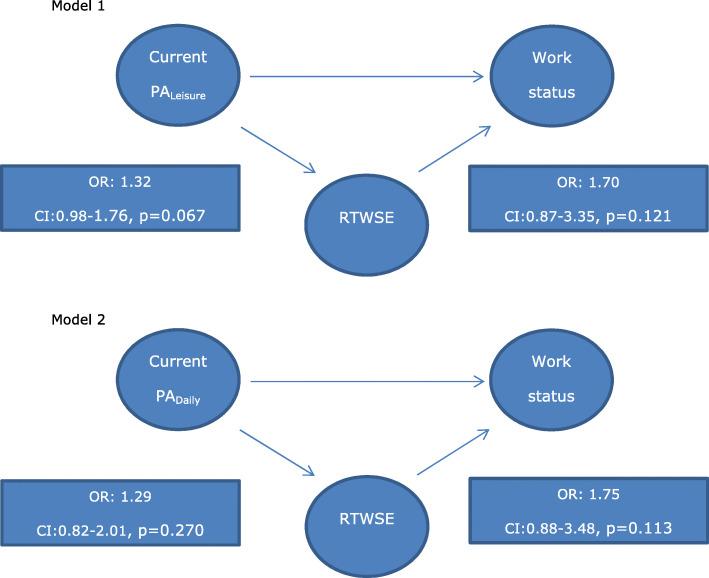
Numerous studies emphasize the positive effects of physical activity on health and well-being in cancer patients. The effects of physical activity on the working lives of cancer patients have received less attention. The aim of the present study was to examine the association between physical activity and work status in employees with cancer, and the mediating role of return to work self-efficacy (RTWSE) in this association.
METHODS
Data from questionnaires (physical activity, RTWSE, performance status, sociodemographic), patient records, and Danish national registries (work status, education) were collected for 217 employees initiating chemotherapy for cancer. The associations of physical activity at baseline with work status at baseline and at twelve months follow-up, respectively, were estimated with logistic regression. The mediating role of RTWSE was investigated using the Sobel Goodmann test.
RESULTS
Employees with moderate (> 30 min/day) or high (> 150 min/day) levels of current daily activity at baseline had significantly increased odds for working at baseline (OR = 2.83, 95%CI = 0.73-10.96 and OR = 6.13, 95%CI = 1.68-22.40, respectively) and at twelve months (OR = 3.90, 95%CI = 1.19-12.77 and OR = 3.43, 95%CI = 1.12-10.51, respectively), compared to sedentary employees. Likewise, employees, physically active in their leisure time (light or vigorous psychical activity) for 2-4 h/week or > 4 h/week of light activity at baseline, had increased odds for working at twelve months (OR range = 1.20 (95%CI = 0.40-3.61)-5.39(95%CI = 0.78-37.32)), compared to sedentary employees. RTWSE was not found to mediate the observed associations.
CONCLUSIONS
Physical activity appears positively associated with work status in employees undergoing treatment for cancer in the twelve months period after initiating chemotherapy.
背景
许多研究强调了身体活动对癌症患者健康和幸福感的积极影响。身体活动对癌症患者工作生活的影响受到的关注较少。本研究的目的是探讨身体活动与癌症患者工作状态之间的关系,以及在这种关系中重返工作岗位自我效能感(RTWSE)的中介作用。
方法
对 217 名接受癌症化疗的员工进行问卷调查(身体活动、RTWSE、身体状况、社会人口统计学)、病历和丹麦国家登记处(工作状态、教育)收集数据。使用逻辑回归估计基线时身体活动与基线和 12 个月随访时工作状态的关联。使用 Sobel-Goodman 检验探讨 RTWSE 的中介作用。
结果
基线时进行中高强度(>30 分钟/天或>150 分钟/天)日常活动的员工,与基线时(OR=2.83,95%CI=0.73-10.96 和 OR=6.13,95%CI=1.68-22.40)和 12 个月时(OR=3.90,95%CI=1.19-12.77 和 OR=3.43,95%CI=1.12-10.51)工作的几率更高。相比之下,久坐不动的员工在 12 个月时工作的几率较低。同样,基线时每周进行 2-4 小时或>4 小时轻度体育活动的员工,12 个月时工作的几率也更高(OR 范围=1.20(95%CI=0.40-3.61)-5.39(95%CI=0.78-37.32))。RTWSE 未被发现介导观察到的关联。
结论
在开始化疗后的 12 个月内,身体活动与癌症患者的工作状态呈正相关。

 Zotero 插件